

Prometheus (moon)
Images
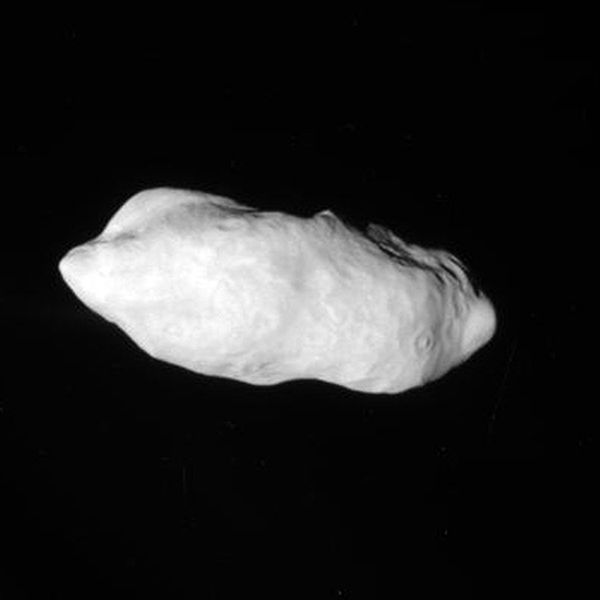
Prometheus (moon)
Morphology and Surface Characteristics of an Irregular Satellite
Prometheus is a prime example of an irregularly shaped moon, a common morphology for smaller celestial bodies in the solar system. Its dimensions, approximately 168 x 90 x 55 miles (270 x 144 x 88 kilometers), reveal a highly elongated form, indicative of its formation history and subsequent tidal forces exerted by Saturn. The surface is heavily cratered, suggesting a long history of impacts, and is covered in a regolith of dust and ice particles.
Unlike larger, spherical moons, Prometheus lacks sufficient mass to achieve hydrostatic equilibrium, resulting in its distinctive, non-spherical shape. Its low density further suggests a composition rich in ice and possibly porous rock. Understanding its surface features provides insights into the bombardment history of the inner Saturnian system and the processes that shape small moons.
The Gravitational Ballet
Prometheus's most significant scientific interest lies in its profound gravitational interaction with Saturn's F ring. Orbiting just inside the F ring, Prometheus acts as a 'shepherd moon.' Its gravitational pull creates distinct waves, streamers, and knots within the ring material. The moon's proximity and orbital period, approximately 0.61 Earth days (14.7 hours), allow for continuous gravitational tugging.
This interaction is not static; Prometheus periodically collides with or passes very close to the ring, leading to the ejection of ring particles and the formation of bright clumps. This dynamic process is crucial for the F ring's stability and complexity, preventing it from dispersing and contributing to its unique, braided appearance. Studying these interactions offers a window into the delicate balance of forces that govern planetary ring systems.
An Extreme Environment
Prometheus exists in an extreme environment characterized by near-absolute zero temperatures and a complete vacuum. The absence of a substantial atmosphere means there is no atmospheric pressure, no weather, and no protection from solar and cosmic radiation. Surface temperatures likely hover around -200 degrees Celsius (-328 degrees Fahrenheit).
The moon is bathed in the faint light of the distant Sun, casting long shadows across its rugged terrain. The lack of geological activity, such as volcanism or plate tectonics, means its surface is largely a record of past impacts and the ongoing processes of space weathering. For any potential future exploration, these conditions present significant engineering challenges, requiring robust spacecraft and specialized equipment.
Prometheus as a Case Study in Planetary Dynamics
Prometheus serves as a vital case study for understanding the broader principles of planetary dynamics and satellite-planet interactions. Its role as a shepherd moon is not unique; similar phenomena are observed in other ring systems, such as those around Uranus. By analyzing the intricate gravitational dance between Prometheus and the F ring, scientists can refine models of ring formation, evolution, and stability. Data from missions like Voyager and Cassini have been instrumental in revealing these complex interactions, providing high-resolution imagery and orbital data.
The study of Prometheus contributes to our understanding of how small moons can exert significant influence over vast planetary structures, offering clues about the processes that shaped the early solar system and the ongoing evolution of planetary systems throughout the cosmos.
Scientific Investigations and Future Prospects
The scientific investigation of Prometheus has primarily been conducted through remote sensing by spacecraft. The Voyager 1 and 2 missions provided the first close-up views, followed by more detailed observations from the Cassini-Huygens mission. Cassini's prolonged presence in the Saturnian system allowed for unprecedented study of Prometheus's orbit, its surface features, and its continuous interaction with the F ring.
Future research may involve advanced telescopic observations or potentially dedicated missions to further explore its composition and the precise mechanisms of its ring-shepherding capabilities. Understanding Prometheus is key to a comprehensive picture of Saturn's complex and beautiful ring system, and by extension, the diverse ways moons and rings interact across the universe.
See also
Frequently Asked Questions
What is Prometheus and why is it special?+
How does Prometheus affect Saturn's rings?+
How big is Prometheus compared to other moons?+
What is the surface of Prometheus like?+
Why do scientists study Prometheus?+
Based on content from Wikipedia · Licensed under CC BY-SA 4.0