

Primordial Black Holes: Tiny Cosmic Mysteries!
Images

Primordial black hole
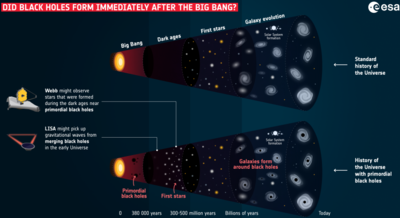


Cosmological Genesis
Primordial black holes (PBHs) represent a fascinating class of compact objects hypothesized to have formed not from stellar collapse, but from the extreme density fluctuations present in the very early universe, potentially within the first second after the Big Bang. During this epoch, the universe was a rapidly expanding, incredibly dense plasma. Quantum fluctuations, amplified by cosmic inflation, could have created regions of overdensity so significant that they collapsed gravitationally to form black holes.
The mass spectrum of these PBHs is theoretically vast, ranging from Planck-mass objects (around 10^-8 kg) to objects far exceeding stellar masses. Unlike astrophysical black holes, their formation is tied directly to the physics of the early universe, offering a unique probe into conditions far beyond what we can replicate in terrestrial experiments. Their existence is contingent on the amplitude and scale of these primordial density fluctuations.
The Dark Matter Connection
One of the most compelling aspects of PBHs is their potential role as a component, or even the entirety, of dark matter. The standard cosmological model requires a significant amount of non-baryonic dark matter to explain galactic rotation curves, gravitational lensing, and the large-scale structure of the universe. PBHs, being non-luminous and interacting primarily through gravity, fit this description.
Depending on their mass range, they could account for all or part of the observed dark matter density. For instance, PBHs with masses around 10^17 to 10^23 grams are particularly interesting candidates, as they would not have evaporated via Hawking radiation by the present day and are not constrained by nucleosynthesis or cosmic microwave background observations. Their abundance and mass distribution are crucial parameters in determining their viability as dark matter.
Observational Signatures
The search for PBHs is multifaceted, employing a variety of observational techniques that probe different mass ranges. Gravitational microlensing surveys are sensitive to PBHs in the mass range from approximately that of the Moon to tens of solar masses, looking for transient amplifications of background stellar light. The evaporation of very small PBHs (masses less than 10^15 grams) via Hawking radiation could produce a detectable flux of gamma rays or other particles, though this is highly constrained.
For more massive PBHs, their accretion of surrounding matter could lead to observable signatures, or their mergers could be detected as gravitational waves by instruments like LIGO and Virgo. Furthermore, PBHs could influence the formation of the first stars and galaxies, or leave imprints on the cosmic microwave background, providing further avenues for detection and constraint.
Cosmological Implications and Future Prospects
The existence and properties of PBHs have profound implications for cosmology and fundamental physics. If detected, they would provide direct evidence for physics beyond the Standard Model and the inflationary epoch. Their abundance could constrain inflationary models and the nature of quantum fluctuations in the early universe.
Conversely, stringent observational limits on PBH abundance across various mass windows place significant constraints on theoretical models of their formation and evolution. Future gravitational wave observatories and advanced microlensing surveys hold promise for either discovering these elusive objects or further refining the limits on their existence, potentially settling the question of whether these ancient cosmic relics play a significant role in the universe we observe today.
See also
Frequently Asked Questions
What are primordial black holes?+
How could primordial black holes help explain dark matter?+
Why do scientists look for primordial black holes with different methods?+
Can primordial black holes evaporate?+
What would it mean if we found a primordial black hole?+
Based on content from Wikipedia · Licensed under CC BY-SA 4.0