

Presidential Dollar Coins
Images

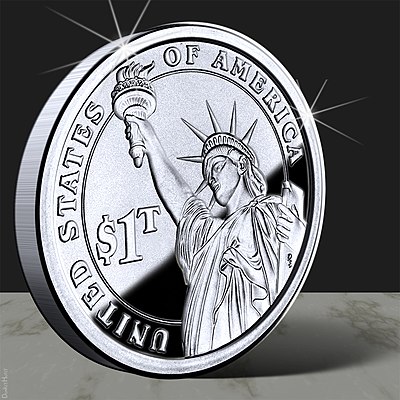
US Dollar Coin - Illustration



Genesis and Design Philosophy of the Presidential Series
The Presidential dollar coin program, authorized by Public Law 109-145 in December 2005, represented a deliberate effort by the United States Mint to revive interest in dollar coinage and simultaneously serve an educational purpose. The core concept was to honor each U.S. president in the order they served, releasing four new designs annually. This sequential approach provided a structured narrative of American leadership.
The obverse features a sculpted portrait of the president, accompanied by their name and the years of their presidential term. The reverse consistently displays the Statue of Liberty, a powerful symbol of American ideals, reinforcing the national identity. This dual design strategy aimed to create both a personal connection to the leaders and a broader sense of national pride.
The coins themselves are composed of a clad structure: a pure copper core sandwiched between outer layers of a manganese brass alloy, resulting in their distinctive golden hue and durability, a departure from the silver composition of earlier dollar coins.
Circulation Challenges and the Shift to Collector Markets
The initial phase of the Presidential dollar coin program (2007-2011) was characterized by exceptionally high mintages intended for widespread circulation. The Mint produced hundreds of millions of coins annually, anticipating a greater uptake of dollar coins in commerce. However, this projection proved overly optimistic.
The American public's preference for paper currency over dollar coins, coupled with the Federal Reserve's distribution policies, resulted in a massive surplus of these coins accumulating in bank reserves and the Mint's own inventory. This oversupply rendered further large-scale production for circulation economically unviable. Consequently, the program underwent a significant pivot.
Beginning in 2012, the Mint ceased producing Presidential dollars for general circulation, opting instead to mint them exclusively for collectors. This shift allowed the program to continue honoring presidents while catering to a dedicated numismatic audience, often through special finishes like uncirculated or proof strikes, and in collector-focused packaging. A notable exception was the release of a George H.
W. Bush dollar coin in 2020, posthumously honoring him after the original program's conclusion.
Cultural Significance and Educational Imperative
The Presidential dollar coin series transcends mere currency; it functions as a dynamic educational tool and a reflection of American cultural values. By featuring presidents, the series democratizes history, making figures of national importance accessible to the general populace through an everyday object. This initiative sought to foster civic engagement and historical literacy, encouraging individuals to learn about the presidencies, the challenges they faced, and their impact on the nation's trajectory.
The program implicitly highlights the evolution of the United States, showcasing the diverse leadership styles and historical contexts across different eras. Furthermore, the series has contributed to the growth of numismatics, attracting new collectors and reinforcing the hobby's role in preserving and celebrating history. The coins serve as tangible reminders of the nation's past, prompting reflection on the continuity and change in American governance and society.
Minting Processes and Numismatic Variations
The production of Presidential dollar coins involves sophisticated minting techniques. The designs are initially created by medallic artists and then translated into working hubs and dies. For circulation strikes, planchets are fed into high-speed coining presses, where immense pressure strikes the design onto both sides.
A distinctive feature of these coins is the placement of inscriptions like the mint date and 'E Pluribus Unum' on the edge, a departure from the traditional incused or raised lettering on the obverse or reverse. This edge-incused design required specialized minting equipment. Beyond standard circulation strikes, the U.S.
Mint also produces special collector versions. These include 'uncirculated' coins, which are struck using special dies and are handled carefully to maintain their finish, and 'proof' coins, which undergo a more rigorous process involving multiple strikes with specially polished dies and planchets, resulting in a mirror-like field and frosted design elements. These variations cater to different collector preferences and highlight the Mint's capabilities in producing high-quality numismatic items.
Legacy and Future Implications
The Presidential dollar coin program, despite its shift away from mass circulation, has left a lasting mark on American numismatics and public consciousness. It successfully raised awareness about dollar coins and provided a unique platform for historical commemoration. The program demonstrated the potential for coinage to serve as a powerful medium for storytelling and education, influencing subsequent U.S.
Mint initiatives like the America the Beautiful Quarters program. While the direct circulation impact was limited by public preference, the series ensured that the legacies of numerous presidents were preserved in a tangible, accessible format. The surplus of coins from the circulation era continues to be managed by the Mint, and the collector market remains active.
The program's legacy lies in its innovative approach to engaging the public with history and coinage, setting a precedent for future commemorative programs that blend artistic merit with educational objectives.
See also
Frequently Asked Questions
What are Presidential Dollar Coins?+
Why did the U.S. Mint make these coins?+
How many new presidents are added each year?+
Why did the coins stop being made for everyday use?+
Who was honored after the program ended?+
Based on content from Wikipedia · Licensed under CC BY-SA 4.0