

Liberty: What's That Big Idea?
Images
Liberty
Conception and Franco-American Alliance
The Statue of Liberty, officially 'Liberty Enlightening the World,' was conceived by Édouard René de Laboulaye, a French jurist and abolitionist, in the mid-1860s. He envisioned a monumental gift from France to the United States that would celebrate the centennial of American independence and, importantly, highlight the shared republican ideals and the abolition of slavery in both nations. This was a deliberate political statement, particularly resonant in France following the turmoil of the Franco-Prussian War and the establishment of the Third Republic.
The statue's design by Frédéric Auguste Bartholdi was intended to be a powerful allegorical figure, embodying Libertas, the Roman goddess of freedom. The collaboration between French and American engineers and artisans was crucial, with Gustave Eiffel's innovative internal framework allowing for the statue's immense scale and resilience against environmental factors, a testament to advanced engineering for its time. The project was a significant undertaking, requiring substantial fundraising on both sides of the Atlantic to cover the costs of design, construction, and the monumental pedestal.
Engineering Marvel
The construction of the Statue of Liberty was an engineering feat that pushed the boundaries of 19th-century technology. Bartholdi's vision of a colossal copper statue required a robust internal support system. Gustave Eiffel's ingenious design featured a central iron pylon that supported a secondary framework of lighter iron beams.
This secondary framework, in turn, held the thin copper skin in place. The copper, hammered into shape over wooden molds, was only about 3/32 of an inch thick – roughly the thickness of two pennies. This allowed the statue to be relatively lightweight for its size and enabled the copper to expand and contract with temperature changes without cracking.
The statue was assembled in Paris, standing tall enough to be seen from the city, before being disassembled into 350 pieces and shipped across the Atlantic in 214 crates. The pedestal, designed by American architect Richard Morris Hunt, was a massive granite structure that provided a stable base and elevated the statue to its commanding height of over 305 feet from the ground to the torch tip.
Evolving Symbolism
Initially conceived as a symbol of Franco-American friendship and republican ideals, the Statue of Liberty's meaning has evolved significantly over time. Its location at the gateway to New York Harbor made it the first glimpse of America for millions of immigrants arriving by sea, particularly after the nearby Ellis Island immigration station opened in 1892. Emma Lazarus's sonnet, 'The New Colossus,' written in 1883 and later inscribed on a plaque inside the pedestal, transformed the statue into a powerful emblem of welcome and refuge: 'Give me your tired, your poor, Your huddled masses yearning to breathe free.' This interpretation has made Liberty a global icon, representing not just American ideals but the universal aspiration for freedom, opportunity, and a sanctuary from oppression.
While its original political context was specific, its message has broadened to encompass humanitarian values, making it a potent symbol in international discourse.
The Torch and Tablet
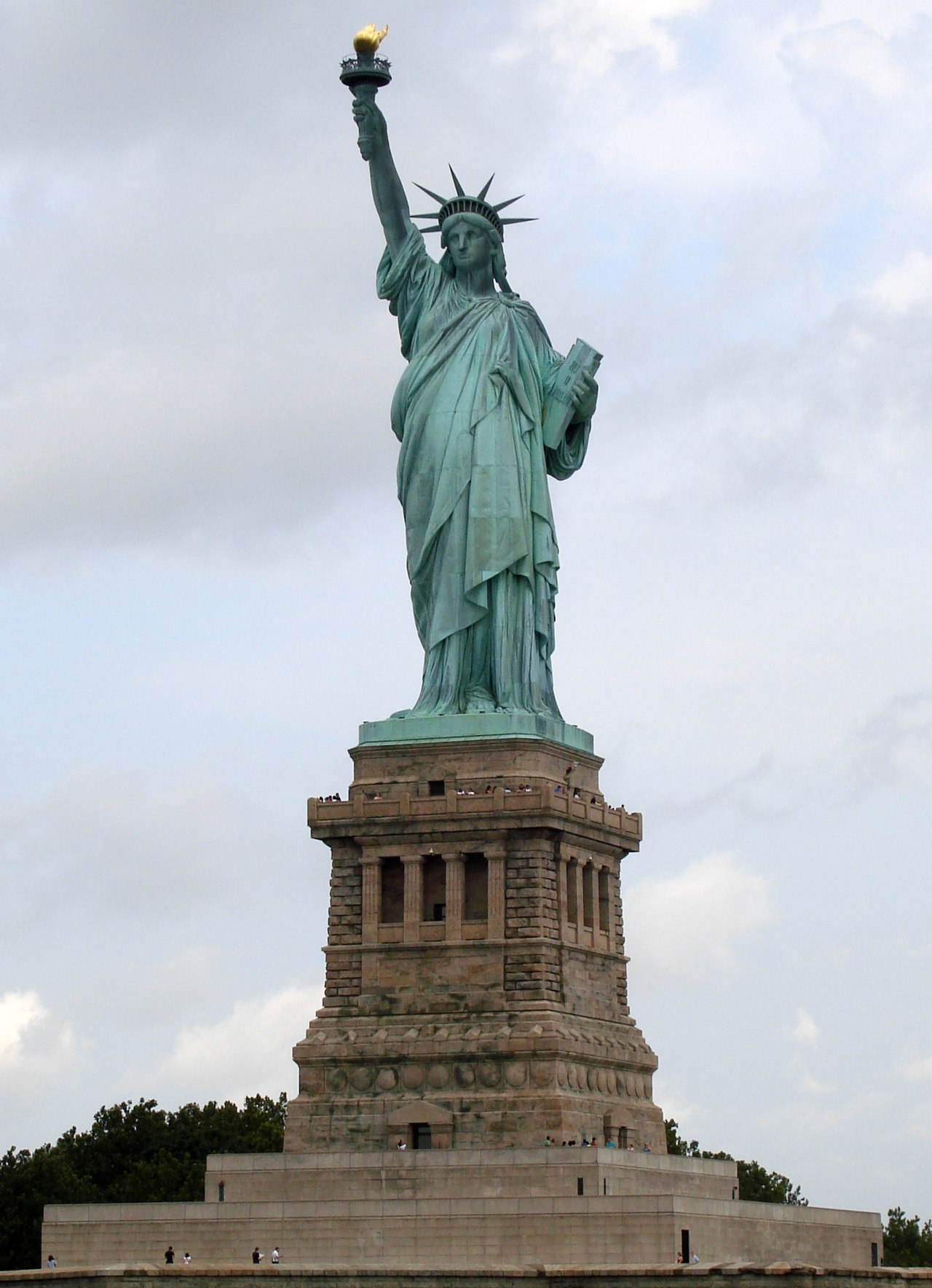
The elements Lady Liberty holds are deeply symbolic. Her torch, originally a copper structure with glass panes, was intended to represent enlightenment, guiding the way towards liberty. It has undergone several modifications, with the current torch, installed in the 1980s, being gilded with 24-karat gold leaf to enhance its visibility and brilliance.
The tablet in her left arm is inscribed with the date 'JULY IV MDCCLXXVI' (July 4, 1776), the date of the U.S. Declaration of Independence. This inscription anchors the statue's meaning to the foundational principles of American democracy and self-governance.
The seven spikes of her crown represent the seven continents and the seven seas, suggesting the universality of liberty. The broken chains at her feet, often overlooked, are a direct reference to the abolition of slavery, a critical aspect of the statue's original intent and a powerful symbol of liberation from bondage.
Liberty's Legacy and Modern Relevance
The Statue of Liberty continues to be a potent symbol in contemporary society. It serves as a reminder of the historical significance of immigration to the United States and the ongoing debates surrounding immigration policies. Its image is frequently invoked in discussions about freedom of speech, human rights, and democratic values worldwide.
The statue's enduring appeal lies in its ability to represent abstract ideals in a tangible, awe-inspiring form. It stands as a testament to international cooperation, artistic vision, and engineering prowess. Its preservation and ongoing maintenance are crucial to ensuring that its message of liberty and hope continues to inspire future generations, both within the United States and across the globe.
The statue remains a powerful focal point for national identity and a global beacon for those seeking a better life.
Go deeper
Frequently Asked Questions
What is the Statue of Liberty?+
Why was the Statue of Liberty built?+
How was the Statue of Liberty made?+
Where does the Statue of Liberty stand?+
When did people first see the Statue of Liberty?+
Based on content from Wikipedia · Licensed under CC BY-SA 4.0