

Poulnabrone dolmen
Images

Poulnabrone Dolmen in Burren National Park 06


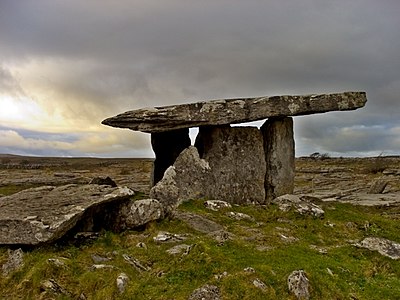


An Iconic Neolithic Portal Tomb
Poulnabrone dolmen, translating to 'Hole of the Quernstone,' stands as one of Ireland's most recognizable prehistoric monuments. Situated atop a limestone plateau in the starkly beautiful Burren region of County Clare, this early Neolithic portal tomb is a masterpiece of megalithic construction. Its defining feature is the arrangement of three large, upright portal stones supporting a massive, roughly hewn capstone, creating a distinct chamber.
While not the largest dolmen in Ireland, its accessible location and striking visual presence have cemented its status as the most famous. The monument's construction dates to the early Neolithic period, with archaeological evidence suggesting its use between 3800 and 3200 BC, placing it among the earliest megalithic structures in Western Europe. The surrounding landscape itself, a unique karst formation sculpted from limestone laid down approximately 350 million years ago, adds to the site's profound sense of ancient history and geological time.
The Builders and Their Purpose
The construction of Poulnabrone dolmen was undertaken by Neolithic farmers, a society transitioning towards settled agricultural lifestyles. The choice of such a prominent, elevated location within the desolate Burren suggests deliberate intent. Archaeologists theorize several potential purposes for its erection.
It may have served as a focal point for ritualistic activities, a sacred space where ceremonies were performed. Alternatively, it could have functioned as a territorial marker, a visible signpost to delineate the boundaries of a community's land or influence. Most significantly, the evidence points towards its use as a collective burial site.
Originally, the stone structure would have been concealed beneath a mound of earth and stone, known as a cairn, a common practice for Neolithic tombs, emphasizing its role in funerary rites and ancestor veneration.
Excavations and the Unveiling of Human Remains
The archaeological investigations at Poulnabrone dolmen, notably in 1986 and 1988, yielded remarkable insights into its function and the people who used it. Excavations beneath the capstone and within the chamber revealed the skeletal remains of approximately 33 individuals. This assemblage included adults and children, indicating that the dolmen served as a communal burial ground over an extended period.
The presence of a later Bronze Age infant's remains suggests a continuity of use or re-use of the site. Accompanying these human remains were various artifacts crafted from stone and bone, such as tools and personal adornments. These grave goods were likely deposited intentionally, reflecting the beliefs and practices surrounding death and the afterlife for these ancient communities.
Poulnabrone's Enduring Significance in Prehistory
Poulnabrone dolmen holds immense significance for understanding early human societies in Ireland and Western Europe. As one of the earliest and best-preserved examples of a portal tomb, it provides invaluable data on Neolithic architectural techniques, social organization, and belief systems. The discovery of multiple burials and associated artifacts offers a tangible connection to the individuals who lived and died millennia ago, allowing us to reconstruct aspects of their daily lives, social structures, and funerary rituals.
Its continued prominence and study contribute to our broader understanding of the spread of megalithic traditions across Europe and the development of complex societies during the Neolithic period. The monument serves as a powerful reminder of the deep historical layers present in the landscape and the enduring human impulse to create lasting monuments.
The Burren Context
The unique geological and ecological context of the Burren is inseparable from the significance of Poulnabrone dolmen. This vast expanse of exposed limestone pavement, characterized by its fissured surface and unique flora, presents a challenging yet starkly beautiful environment. The dolmen's strategic placement on a prominent elevation within this landscape underscores the deliberate choices made by its builders.
It suggests that the monument was intended to be a visible landmark, perhaps integrated into a broader system of territorial markers or ritual landscapes. The enduring presence of Poulnabrone against this ancient, almost otherworldly backdrop highlights the deep relationship between early human populations and their environment, demonstrating how monumental architecture was used to shape and imbue the landscape with cultural meaning over vast stretches of time.
See also
Frequently Asked Questions
What is Poulnabrone dolmen?+
Where is Poulnabrone dolmen located?+
When was Poulnabrone dolmen built?+
Why did people build Poulnabrone dolmen?+
What did archaeologists find at Poulnabrone dolmen?+
Based on content from Wikipedia · Licensed under CC BY-SA 4.0