

Po (river)
Images
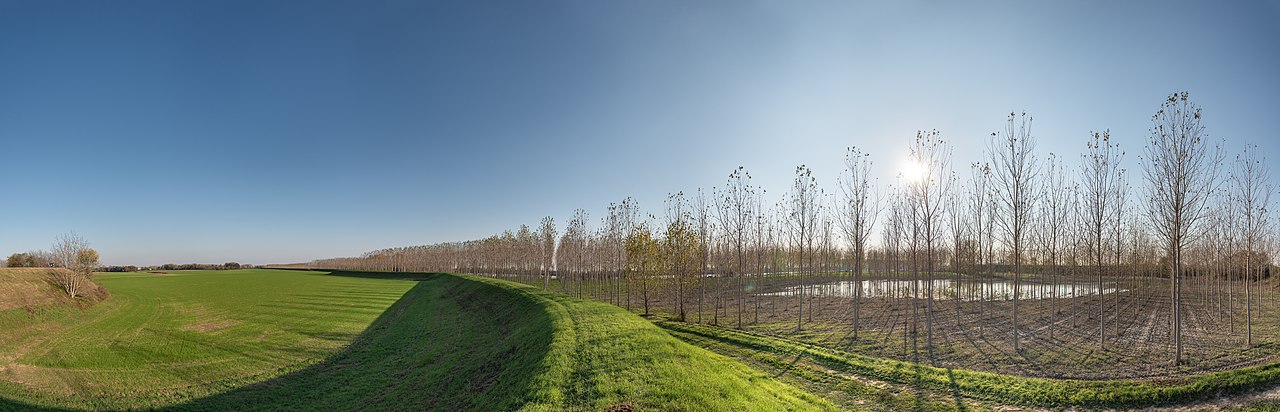
Po River Levee - Bagnolo San Vito, Mantua, Italy - November 16, 2018


Geomorphological Origins and Hydrological Significance
The Po River, Italy's longest, originates from the glacial meltwaters and springs of the Cottian Alps, specifically at Pian del Re beneath Monviso. Its course, extending 652 kilometers (405 miles) eastward, traverses the vast Po Valley, a geologically significant alluvial plain formed by centuries of sediment deposition. The river's trajectory along the 45th parallel north is a key geographical feature, influencing regional climate patterns and agricultural potential.
The Po drains an extensive basin of 74,000 km2 (29,000 sq mi), making it a crucial hydrological artery for Northern Italy. Its discharge rate is remarkably high, placing it among the top three Mediterranean rivers, comparable to the Rhône and Nile. This substantial water volume, however, necessitates extensive human intervention, with over half its length fortified by embankments to mitigate frequent and severe flooding, a persistent challenge shaping human settlement and land use.
Historical Evolution and Human Adaptation
The Po River has been a cornerstone of civilization in Northern Italy since antiquity. Its fertile floodplains were the cradle of Cisalpine Gaul during the Roman era, divided into Cispadane and Transpadane Gaul. The river served as a natural boundary and a vital transportation route, facilitating trade and the movement of peoples.
Major cities like Turin, Piacenza, Cremona, and Ferrara flourished along its banks, their growth intrinsically linked to the river's resources and connectivity. The development of the navigli, a sophisticated network of canals, further integrated the Po basin with inland centers like Milan. Notably, the involvement of Leonardo da Vinci in designing these waterways highlights the river's importance in Renaissance engineering and urban planning.
The continuous need to manage its powerful floods has driven centuries of hydraulic engineering, creating a landscape where natural forces and human ingenuity are in constant dialogue.
Economic Engine and Cultural Nexus
Economically, the Po River and its valley are the breadbasket of Italy. The river's waters are essential for irrigating the vast agricultural lands that produce significant quantities of grains, rice, and other crops. The fertile soil, enriched by alluvial deposits, supports a highly productive agricultural sector.
Furthermore, the river and its connected canal systems have historically been crucial for commerce, enabling the transport of goods between inland cities and the Adriatic coast. The Po Delta, a dynamic ecological region, is also economically significant, particularly for its fishing industry, with the area around Comacchio renowned for its eel production. Culturally, the Po has inspired art, literature, and music, reflecting its central role in the Italian identity and landscape.
Its presence defines the character of the region, influencing traditions, cuisine, and the very rhythm of life for its inhabitants.
The Po Delta
The Po River culminates in a vast and ecologically rich delta, a complex mosaic of wetlands, lagoons, and sandbanks formed by the deposition of sediment over millennia. This deltaic system, characterized by five main distributaries (including Po di Maestra and Po della Pila) and hundreds of smaller channels, represents one of Italy's most important natural areas. It serves as a critical habitat for a diverse array of flora and fauna, particularly migratory birds, making it a significant site for ornithological research and ecotourism.
The delta's unique environment supports specialized ecosystems adapted to fluctuating salinity and water levels. The area south of the delta, including Comacchio, is a testament to the symbiotic relationship between human activity and natural resources, particularly in traditional eel farming. The ongoing interplay between riverine processes, coastal dynamics, and human pressures makes the Po Delta a vital area for ecological study and conservation efforts.
Education and Scientific Inquiry Along the Po
The Po River serves as a living laboratory for scientific research and educational initiatives across various disciplines. Universities and research institutions located in cities along its course, such as Turin and Ferrara, conduct extensive studies on its hydrology, ecology, and geomorphology. These investigations contribute to a deeper understanding of river systems, flood management strategies, and the impact of climate change on water resources.
Educational programs often utilize the river and its delta as field study sites, offering students hands-on experience in environmental science, geography, and conservation. The historical significance of the Po, including its role in ancient civilizations and its impact on urban development, also makes it a subject of study in history and archaeology. Public awareness campaigns frequently highlight the importance of the Po's ecosystem and the need for its protection, fostering a sense of stewardship among local communities and beyond.
See also
Based on content from Wikipedia · Licensed under CC BY-SA 4.0