

Perdita (moon)
Images

Perdita (moon)


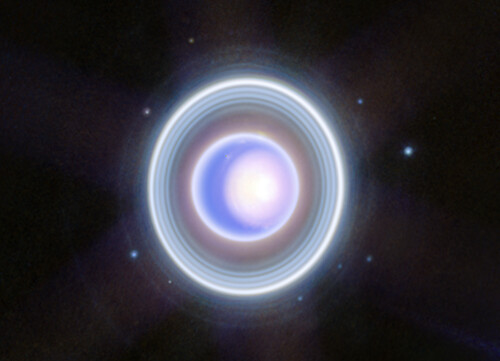
Characterizing Perdita
Perdita is classified as a moon, a natural satellite orbiting the seventh planet from the Sun, Uranus. Its significance lies not in its grandeur, but in its extreme subtlety. With an estimated diameter of approximately 68 kilometers (42 miles), Perdita ranks among the smaller of Uranus's known moons.
Its most striking characteristic is its exceptionally low albedo, meaning it reflects very little sunlight. This makes it one of the darkest known moons in the solar system, absorbing an estimated 97% of incident radiation. This property is crucial for understanding its composition, suggesting a surface rich in dark, possibly carbonaceous materials, overlaid with ice.
The faintness and small size of Perdita have made detailed surface mapping and compositional analysis incredibly challenging, requiring advanced observational techniques and prolonged study.
The Protracted Journey from Detection to Confirmation
The discovery narrative of Perdita is a fascinating example of how scientific understanding evolves. Initially identified in images acquired by the Voyager 2 probe during its 1986 Uranus encounter, its existence was tentative. The object appeared as a faint point of light, easily lost amidst the noise and resolution limits of the era's imaging technology.
For over a decade, its status as a confirmed moon remained in question. It wasn't until the late 1990s, with the deployment of more powerful ground-based telescopes like the Hubble Space Telescope and sophisticated image processing algorithms, that astronomers could definitively confirm Perdita's orbit and existence. This protracted confirmation period underscores the difficulties inherent in observing small, dark, and distant objects in the outer solar system, often requiring multiple independent observations and advanced analytical methods.
Compositional Clues and Surface Morphology
The extremely low albedo of Perdita strongly suggests a surface composition dominated by dark, non-reflective materials. While ice is a ubiquitous component of outer solar system moons, the dominance of dark material points towards the presence of tholins or other complex organic compounds, possibly delivered by cometary impacts over geological timescales. The lack of significant geological activity on such a small body implies that its surface morphology is likely ancient and heavily cratered, a testament to billions of years of bombardment by interplanetary debris.
Without direct imaging or spectral analysis from a dedicated mission, our understanding of Perdita's surface features remains largely inferential, based on its photometric properties and comparisons with other dark, small moons in the solar system.
Perdita's Orbital Dynamics and Gravitational Environment
Perdita completes a full revolution around Uranus in approximately 13 Earth days. This relatively short orbital period places it within the inner system of Uranus's moons. Its orbit is also characterized by its proximity to Uranus, subjecting it to significant tidal forces.
These forces, while not strong enough to deform Perdita into an irregular shape due to its small size, likely play a role in its orbital evolution and internal structure over eons. The gravitational influence of Uranus is the dominant factor shaping Perdita's existence, dictating its orbital path and potentially influencing its thermal history. Studying Perdita's orbit helps astronomers refine models of the Uranian system and understand the complex gravitational interactions among its numerous satellites.
Significance in the Context of the Uranian System
Perdita, despite its diminutive size and elusive nature, holds significance within the broader context of the Uranian system. Its discovery and subsequent confirmation contributed to our understanding of the sheer number and diversity of moons orbiting ice giants. As one of the fainter, smaller moons, it serves as a benchmark for the capabilities of observational astronomy and highlights the ongoing potential for discovering even smaller, fainter objects.
Its dark surface also offers a point of comparison for the reflectivity of other Uranian moons, helping scientists to categorize and understand the formation and evolution of these distant satellites. Studying Perdita contributes to the larger scientific endeavor of comprehending planetary system formation and the distribution of small bodies throughout our solar system.
See also
Based on content from Wikipedia · Licensed under CC BY-SA 4.0