

Parapsychology: The Study of Spooky Stuff!
Images
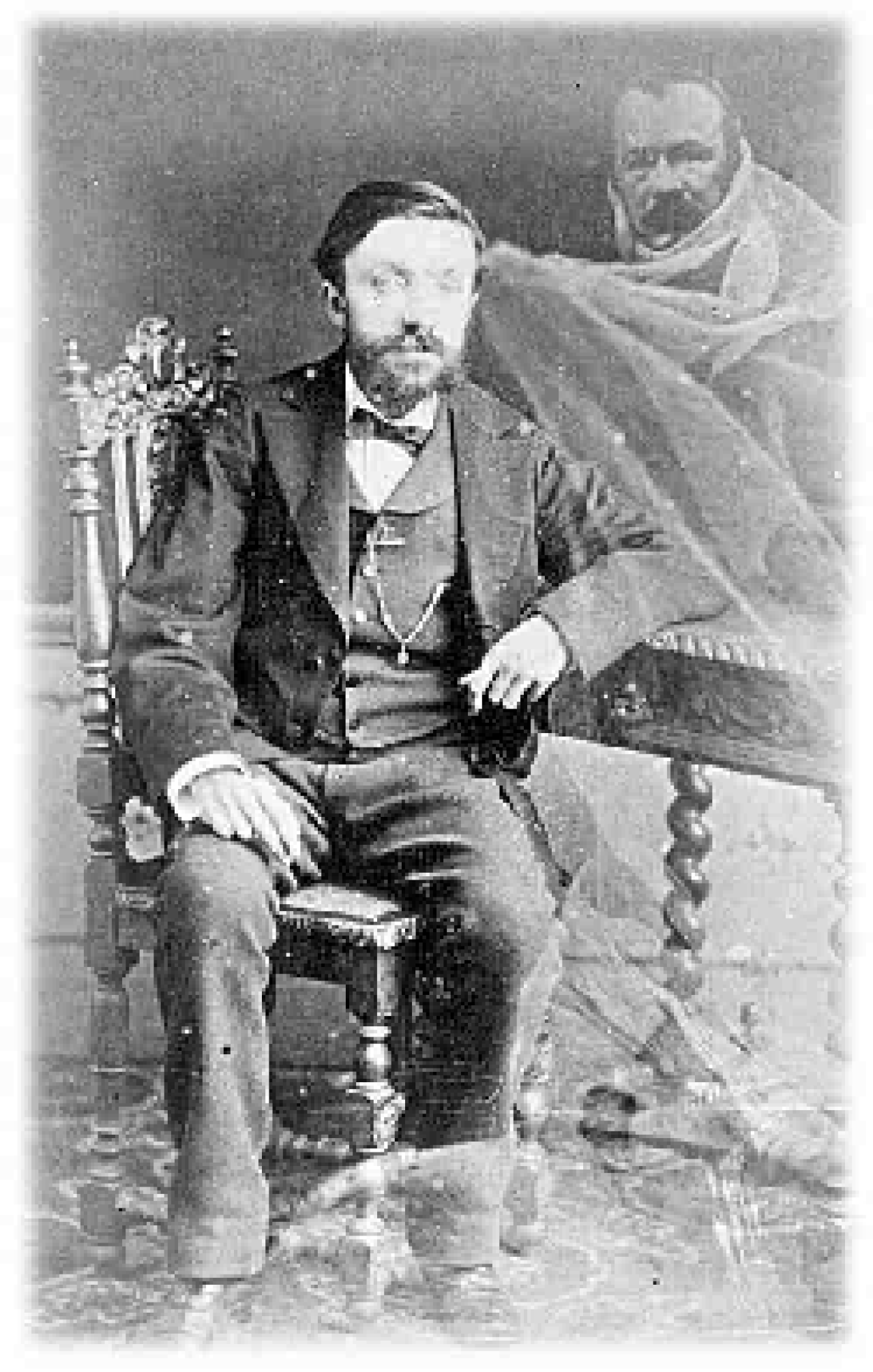
Parapsychology
Defining the Boundaries
Parapsychology is an interdisciplinary field that endeavors to study anomalous experiences and abilities that fall outside the purview of mainstream science. Its primary focus is on phenomena often categorized as 'psi,' which encompass extrasensory perception (ESP) – including telepathy, clairvoyance, and precognition – and psychokinesis (PK), the alleged ability to influence physical systems with the mind. Unlike pseudoscience, parapsychology aims for empirical investigation, employing rigorous experimental designs and statistical analysis to detect potential effects that exceed chance expectations.
Researchers often work within established scientific frameworks, adapting methodologies to test specific hypotheses related to these anomalous claims. The challenge lies in designing experiments that are robust against methodological flaws, fraud, and conventional explanations, while also developing theoretical models that could potentially account for any observed deviations from expected outcomes. This pursuit often involves collaboration with psychologists, physicists, and statisticians.
Historical Trajectory
The formal study of what is now termed parapsychology emerged in the late 19th century, deeply influenced by the spiritualist movement and a broader societal fascination with the occult and unexplained. Organizations like the Society for Psychical Research (SPR) were founded in the 1880s, aiming to investigate claims of ghosts, mediums, and psychic abilities with scientific rigor. Early research often involved detailed case studies and anecdotal evidence, but the field gradually shifted towards more controlled laboratory experimentation.
Key figures like J.B. Rhine at Duke University in the mid-20th century pioneered quantitative research methods, using card-guessing tests and dice experiments to search for evidence of ESP and PK. Despite periods of skepticism and controversy, research has continued, exploring various theoretical frameworks, from quantum mechanics to consciousness studies, in attempts to understand the nature of psi.
The Significance of Anomalous Research
The significance of parapsychological research extends beyond the mere validation of psychic claims. It fundamentally challenges our current understanding of consciousness, the mind-body connection, and the nature of reality itself. If reliable evidence for psi phenomena were to emerge, it could necessitate a paradigm shift in psychology, neuroscience, and even physics.
Such findings could illuminate the potential for consciousness to exist or interact independently of the physical brain, or suggest novel ways in which information can be transmitted. Furthermore, the study of anomalous experiences can provide valuable insights into human perception, belief systems, and the psychological factors that influence our interpretation of events. It encourages a more open-minded yet critical approach to knowledge, prompting us to consider phenomena that may lie at the fringes of our current scientific comprehension.
Investigating the Immaterial
Parapsychological research employs a diverse array of experimental paradigms designed to isolate and measure potential psi effects. In the realm of ESP, the Ganzfeld experiment is a prominent technique. Participants are placed in a state of mild sensory deprivation, with their eyes covered by halved ping-pong balls and their ears exposed to white noise, while an experimenter describes images or scenes.
The participant's task is to describe their impressions, and the accuracy of these descriptions is compared against chance. For precognition, researchers might ask participants to predict the outcome of future random events, such as the target in a subsequent ESP test or the results of a random number generator. Psychokinesis research often involves attempting to influence the output of random number generators (RNGs) or observing subtle effects on physical systems, such as the movement of micro-objects.
Statistical analysis is crucial, with researchers looking for results that are significantly beyond what could be attributed to random chance or experimental artifacts.
Case Studies and Contemporary Relevance
While parapsychology emphasizes empirical research, historical case studies and anecdotal accounts continue to fuel interest and suggest avenues for investigation. These include accounts of spontaneous psychical experiences, such as apparent precognitive dreams, deathbed visions, or instances of 'crisis apparitions' – sightings of a person at the moment of their death. In contemporary research, there's a growing interest in the potential applications of psi phenomena, though these remain highly speculative.
For instance, some researchers explore whether psi might play a role in intuition, creativity, or even in fields like remote sensing or security, albeit with limited empirical support. The field also grapples with the philosophical implications of its findings, prompting debates about the nature of consciousness, free will, and the relationship between mind and matter. The ongoing quest in parapsychology is to bridge the gap between anomalous experiences and a scientifically coherent understanding of reality.
See also
Based on content from Wikipedia · Licensed under CC BY-SA 4.0