

Orbital Mechanics: The Cosmic Dance!
Images
Orbital mechanics


The Gravitational Foundation
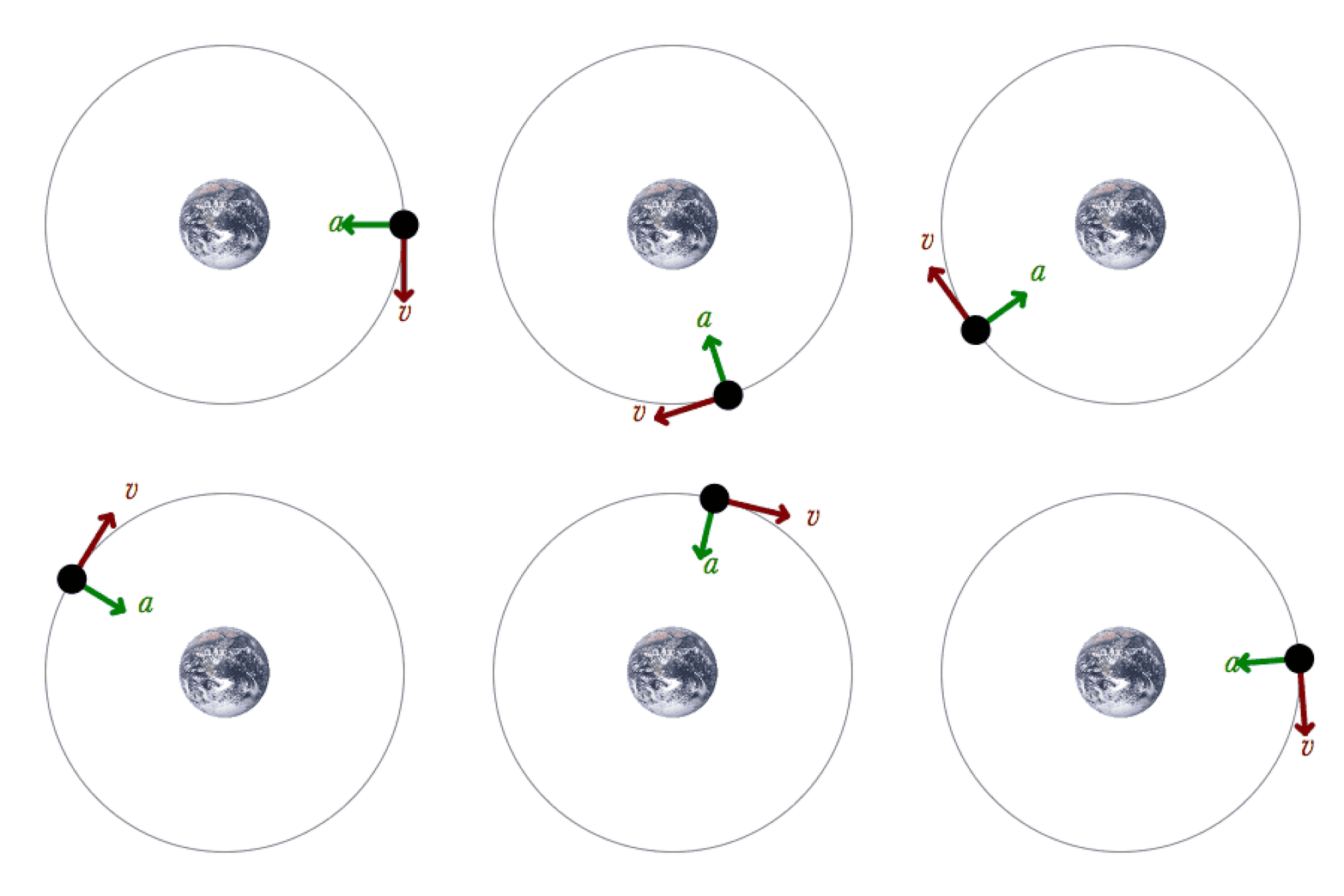
Orbital mechanics is fundamentally the study of how gravity dictates motion in the universe. At its core are Newton's Laws of Motion and his Law of Universal Gravitation. Newton's Second Law (F=ma) combined with his Law of Gravitation (F = G * (m1*m2)/r^2) allows us to describe the force acting between any two celestial bodies.
This force is always attractive and inversely proportional to the square of the distance between their centers. When this gravitational force provides the centripetal force required to keep an object moving in a curved path, an orbit is established. The resulting orbits are conic sections: ellipses (bound orbits), parabolas, and hyperbolas (unbound trajectories).
The specific shape and size of an orbit are determined by the object's specific mechanical energy and angular momentum relative to the central body. Understanding these parameters is crucial for predicting positions and planning maneuvers.
Historical Evolution
The quest to understand celestial motion spans millennia, evolving from early geocentric models (Ptolemy) to the heliocentric view championed by Copernicus. Johannes Kepler's three laws of planetary motion, derived from Tycho Brahe's meticulous observations, provided the first accurate empirical description of planetary orbits as ellipses, not perfect circles, and described their varying speeds. Isaac Newton's synthesis of Kepler's laws with his theory of universal gravitation provided the first theoretical explanation, demonstrating that orbital motion was a consequence of a universal physical law.
The 18th and 19th centuries saw the development of perturbation theory, which accounts for the gravitational influence of multiple bodies on each other's orbits, moving beyond the idealized two-body problem. This was essential for precise astronomical predictions and later for understanding the complex dynamics of multiple spacecraft in the solar system.
The Significance
Orbital mechanics is the indispensable science underpinning all space exploration and satellite operations. Without a profound understanding of orbital dynamics, launching spacecraft would be an exercise in futility. Mission designers use orbital mechanics to calculate launch windows, determine trajectories for interplanetary transfers (like Hohmann transfers), and execute complex orbital maneuvers such as rendezvous, docking, and gravity assists.
Satellites in Earth orbit are vital for global communication, navigation (GPS), weather forecasting, climate monitoring, and remote sensing. Understanding orbital decay, atmospheric drag, and the effects of solar radiation pressure is critical for maintaining these satellites in their operational orbits for their intended lifespans. Furthermore, orbital mechanics is fundamental to understanding the dynamics of the solar system, predicting asteroid trajectories, and planning future human missions to the Moon, Mars, and beyond.
How It Works
An orbit is precisely defined by a set of six orbital elements. These include the semi-major axis (defining the size of the ellipse), eccentricity (defining its shape), inclination (the tilt of the orbital plane relative to a reference plane), longitude of the ascending node (orientation of the plane), argument of periapsis (orientation of the ellipse within the plane), and true anomaly (the position of the object along the orbit at a specific time). These elements allow for the exact prediction of an object's position and velocity at any point in time.
Spacecraft maneuvers, such as changing orbit or course correction, are planned using principles of orbital mechanics. These maneuvers typically involve brief firings of thrusters to impart a change in velocity (delta-v). The resulting change in energy and angular momentum alters the orbital elements, moving the spacecraft to a new desired trajectory.
Concepts like the Tsiolkovsky rocket equation are essential for calculating the delta-v required for these maneuvers based on propellant mass and engine efficiency.
Advanced Concepts
While the two-body problem (one central body, one orbiting object) can be solved analytically, most real-world scenarios involve the N-body problem, where multiple celestial bodies exert gravitational influence. This problem generally does not have a closed-form analytical solution and must be solved using numerical integration methods. The deviations of actual orbits from idealized two-body orbits are called perturbations.
These can be caused by the gravity of other planets, the non-spherical shape of the primary body (e.g., Earth's oblateness), atmospheric drag, solar radiation pressure, and even tidal forces. Understanding and accurately modeling these perturbations is critical for long-duration missions, precise navigation, and predicting the long-term stability of orbits, such as those of satellites or even the solar system itself. Advanced astrodynamics involves sophisticated computational techniques to manage these complex interactions.
Go deeper
Frequently Asked Questions
What is orbital mechanics?+
Why do planets travel in ellipses instead of perfect circles?+
How do rockets stay in orbit around Earth?+
What is a Hohmann transfer and why is it used?+
How do satellites stay in their jobs for years?+
Based on content from Wikipedia · Licensed under CC BY-SA 4.0