

Venus's Speedy Spin Around the Sun!
Images

venus insight


![Transit of Venus 2004 [detail]](https://live.staticflickr.com/7219/7296580768_f7aa566354_n.jpg)


Venus's Orbit
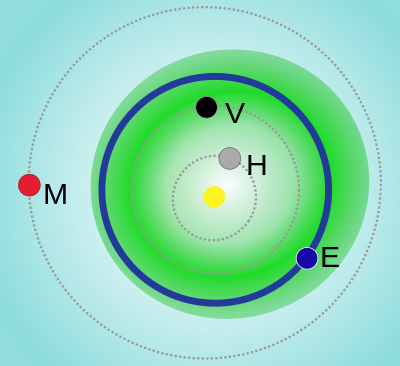
Venus possesses one of the most circular orbits of any planet in our solar system, a characteristic that significantly influences its thermal environment and orbital stability. With a semi-major axis of 0.723 astronomical units (AU), equivalent to approximately 108.2 million kilometers, Venus maintains a consistent distance from the Sun. Its orbital eccentricity is a mere 0.007, the lowest among all planets.
This near-perfect circularity means the difference between its closest approach to the Sun (perihelion) and its farthest point (aphelion) is minimal, spanning only about 1.46 million kilometers. This contrasts sharply with planets like Mercury or Mars, which have more pronounced elliptical orbits. The low eccentricity of Venus's orbit contributes to a more uniform solar irradiation across its surface throughout its orbital period, simplifying models of its climate compared to planets with highly eccentric paths.
This orbital precision is a key factor in understanding Venus's place within the solar system's gravitational architecture.
A Swift Year
Venus completes a full revolution around the Sun in a remarkably short period of 225 Earth days. This orbital period, often referred to as a Venusian year, is significantly shorter than Earth's 365.25 days. During this swift journey, Venus traverses a total orbital distance of approximately 679 million kilometers (422 million miles).
This rapid pace is a direct consequence of its closer proximity to the Sun and its orbital velocity. The concept of a Venusian year is crucial for understanding its atmospheric dynamics and potential for long-term climate studies, especially when compared to Earth's longer orbital cycle. The relatively short duration of its orbit also means that Venus experiences more 'years' within a single Earth year, a fascinating temporal comparison.
The Velocity of Venus
To maintain its orbit at such a close distance to the Sun and complete it so rapidly, Venus must achieve a substantial orbital velocity. Its average speed is approximately 35 kilometers per second, which equates to an astonishing 78,000 miles per hour. This high velocity is a critical component of the balance of forces governing its orbit; it counteracts the Sun's immense gravitational pull, preventing Venus from spiraling inward.
This speed is not constant; Venus moves slightly faster at perihelion and slower at aphelion, though the effect is minimized due to its low orbital eccentricity. Understanding this velocity is fundamental to orbital mechanics and provides a tangible measure of the dynamic forces at play in our solar system.
Implications of Venus's Orbital Characteristics
The unique orbital characteristics of Venus have profound implications for its environment and our understanding of planetary science. Its near-perfect circular orbit and consistent solar distance contribute to a relatively stable energy input from the Sun, although this is overshadowed by its runaway greenhouse effect. The short orbital period means Venus experiences more frequent solar cycles within a given Earth timeframe, which can be relevant for studying atmospheric phenomena.
Furthermore, Venus's orbit is crucial for understanding its synodic period with Earth, which is approximately 584 days. This period dictates how often Venus appears as a bright 'morning star' or 'evening star' in our sky, a phenomenon that has captivated observers for millennia. The study of Venus's orbit also provides valuable data for refining models of planetary formation and evolution.
See also
Frequently Asked Questions
How fast does Venus travel around the Sun?+
How long does a Venusian year last?+
Why is Venus's orbit so circular?+
How many Venus years fit into one Earth year?+
What is the synodic period between Venus and Earth?+
Based on content from Wikipedia · Licensed under CC BY-SA 4.0