

Oliver Reed
Images

Oliver Reed with wife 1968


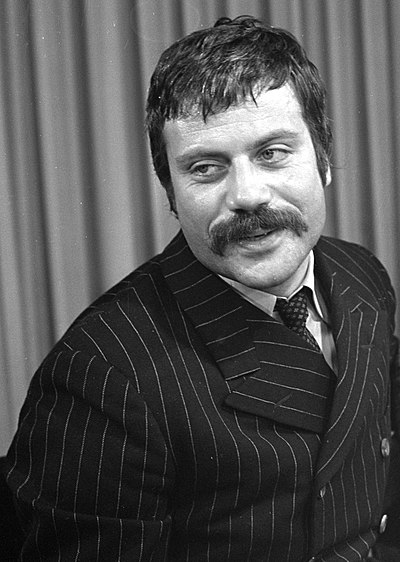


The Genesis of a Screen Presence
Robert Oliver Reed emerged as a significant force in British cinema during the late 1950s and early 1960s. His initial forays into acting were marked by a raw intensity that quickly set him apart. He gained considerable attention for his roles in the iconic Hammer Horror films, where his imposing physique and brooding charisma were perfectly suited to the genre's macabre narratives.
These early performances, though often in supporting roles, showcased a natural talent for embodying characters with a palpable sense of danger and allure. His breakthrough into more mainstream recognition came with his portrayal of the notorious Bill Sikes in Carol Reed's 1968 adaptation of 'Oliver!'. This role was particularly significant not only for its critical acclaim and the film's subsequent Academy Award for Best Picture but also for its personal connection, being directed by his uncle.
The success of 'Oliver!' solidified Reed's status as a leading man, capable of commanding the screen and delivering powerful, unforgettable performances that resonated with a wide audience. By 1971, his popularity was undeniable, with British exhibitors ranking him as the fifth most popular star, a testament to his widespread appeal and box office draw.
Versatility and Controversy
Oliver Reed's career was characterized by a remarkable willingness to explore a wide spectrum of roles, often pushing boundaries and challenging audience expectations. Beyond his early horror work and the iconic 'Oliver!', he demonstrated his acting prowess in a variety of genres. His role as La Bete in 'The Trap' (1966) showcased his ability to convey primal emotion, while his participation in Ken Russell's controversial and visually striking 'The Devils' (1971) as the tormented priest Urbain Grandier cemented his reputation for tackling complex and often disturbing subject matter.
The mid-1970s saw him embrace swashbuckling adventure, portraying the dashing Athos in Richard Lester's popular adaptations of 'The Three Musketeers' (1973) and 'The Four Musketeers' (1974). These films allowed him to display a lighter, more heroic side, proving his versatility. Later, he delved into the psychological horror of David Cronenberg's 'The Brood' (1979) as Dr.
Hal Raglan, and appeared in the quirky musical 'Tommy' (1975) as Uncle Frank. His final cinematic contribution was a powerful performance as Antonius Proximo in Ridley Scott's epic 'Gladiator' (2000). This role, filmed shortly before his death, earned him significant posthumous acclaim, including nominations for a BAFTA Award and a Screen Actors Guild Award, underscoring his enduring impact on the film industry.
The 'Hellraiser' Persona and Its Impact on Legacy
Oliver Reed cultivated a public image that was as legendary as his film roles, often described as a 'hellraiser.' This persona, fueled by his well-documented heavy drinking and penchant for a boisterous lifestyle, became inextricably linked with his on-screen presence. The British Film Institute observed that his collaborations with directors like Michael Winner and Ken Russell in the 1960s helped establish him as an 'emblematic Brit-flick icon.' However, this same lifestyle began to cast a shadow over his career from the mid-1970s onwards.
The BFI's poignant description of Reed having 'assumed Robert Newton's mantle as Britain's thirstiest thespian' highlights the public perception of his struggles with alcoholism. While this notoriety added to his mystique for some, it also presented significant professional challenges. Despite these personal battles, Reed's raw talent and magnetic charisma remained undeniable.
His ability to convey a sense of untamed energy and emotional depth made him a compelling figure on screen. His legacy is therefore a complex tapestry, woven from brilliant acting performances, a larger-than-life personality, and the enduring impact of his counter-cultural image on British cinema.
A Life Lived Large
Oliver Reed's career was a fascinating paradox: a highly skilled actor whose personal life often overshadowed his professional achievements, yet whose very persona amplified his on-screen impact. His ability to embody characters with a potent blend of masculinity, vulnerability, and often a touch of menace made him a standout performer. The fact that he was voted the fifth most popular star by British exhibitors in 1971, at the height of his career, demonstrates his immense connection with the public.
This popularity was not just about his acting but also about the larger-than-life character he presented to the world. His final role in 'Gladiator' is a poignant testament to his enduring talent; despite his personal struggles, he delivered a performance that was both powerful and nuanced, earning him posthumous recognition. This suggests that even in his later years, his passion for acting remained strong.
The BFI's description of him as an 'emblematic Brit-flick icon' and 'Britain's thirstiest thespian' encapsulates the dual nature of his legacy – a celebrated artist whose life was as dramatic and unforgettable as the films he starred in.
Beyond the Persona
Oliver Reed's career spanned over four decades, leaving an indelible mark on British and international cinema. His early work in Hammer Horror films established his commanding presence, while his role in 'Oliver!' brought him widespread acclaim and an Academy Award-winning film. He was a versatile actor, equally adept at portraying swashbuckling heroes, tormented figures, and gruff mentors.
His final performance in 'Gladiator' was a powerful reminder of his talent, earning him posthumous award nominations. The British Film Institute recognized him as an 'emblematic Brit-flick icon,' a testament to his significant cultural impact. His persona as a 'hellraiser,' while contributing to his legend, also presented challenges, leading to him being dubbed 'Britain's thirstiest thespian.' Despite these complexities, Reed's magnetic screen presence and raw energy continue to captivate audiences, solidifying his place as a unique and unforgettable figure in film history.
See also
Frequently Asked Questions
Who was Oliver Reed?+
What was his most famous role?+
What kinds of movies did he act in?+
Did he win any awards?+
Why was he called a "hellraiser"?+
Based on content from Wikipedia · Licensed under CC BY-SA 4.0