

Neusis Construction: Drawing with a Twist!
Images

Heptagonneusis


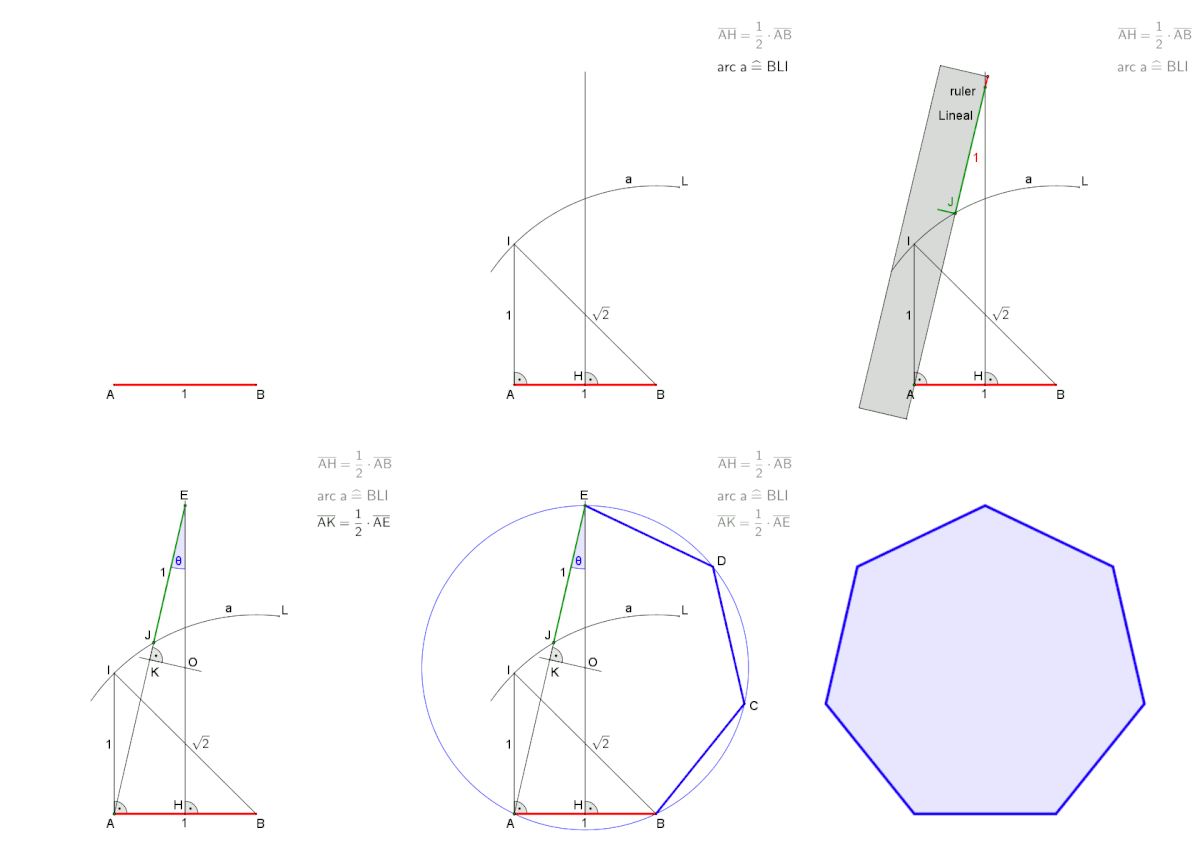


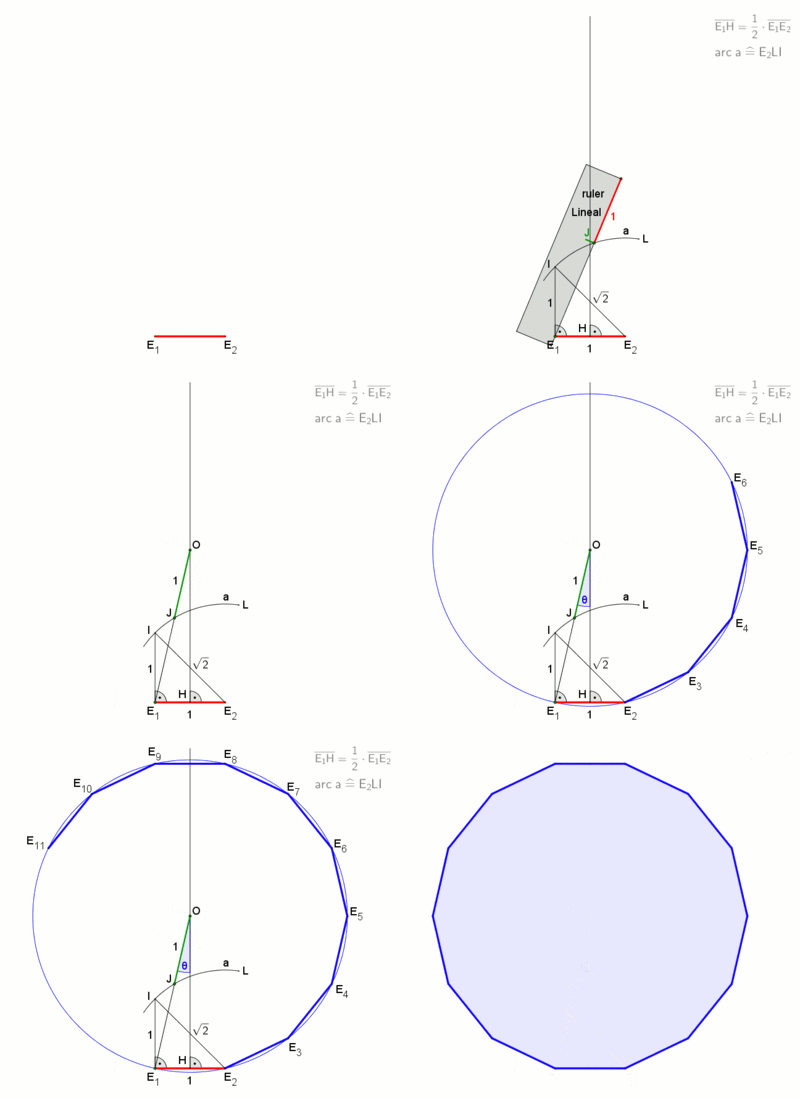

The Geometry of Inclination
Neusis construction, derived from the Greek word 'neuein' meaning 'to incline' or 'to lean towards,' represents a sophisticated geometric method employed by ancient mathematicians, notably during the Hellenistic period. Unlike constructions limited to the use of an unmarked straightedge and compass, neusis allows for a line segment to be moved such that one endpoint slides along a given curve or line, while the segment itself is directed towards a specific point.
This 'inclination' is the defining characteristic, enabling the solution of geometric problems that were intractable with Euclidean methods alone. The process often involves a ruler-like instrument that pivots at one point and has its other end constrained to touch a target, creating a dynamic and precise geometric manipulation. This method was not merely a theoretical curiosity but a practical approach to tackling some of the most challenging mathematical puzzles of antiquity, demonstrating a profound understanding of geometric relationships and constraints.
Solving the Unsolvable
The power of neusis construction lies in its ability to address problems that defied the limitations of classical Euclidean geometry. Foremost among these were the 'doubling the cube' and 'angle trisection' problems. Doubling the cube, the task of constructing a cube with twice the volume of a given cube, requires finding a length proportional to the cube root of 2.
Angle trisection, the division of an arbitrary angle into three equal parts, requires specific algebraic relationships. Standard compass and straightedge constructions are proven to be insufficient for these tasks, as they are limited to operations that correspond to solving quadratic equations. Neusis constructions, however, can generate lengths and angles that correspond to solutions of cubic equations, thus providing a pathway to solving these classical impossibilities. The method was documented and utilized by mathematicians such as Archimedes, Hippocrates of Chios, and Nicomedes, who explored its capabilities and applications.
The Mechanics and Variations of Neusis
The practical application of neusis construction involves a specific type of instrument, sometimes referred to as a 'neusis ruler' or 'marked ruler,' though the 'marking' aspect is debated among scholars, with some arguing that the 'inclination' itself was the key, not explicit markings for measurement. A common visualization involves a line segment AB, where point A is fixed or moves along a curve, and point B is constrained to lie on another curve or line, with the segment AB always passing through or being directed towards a specific point P.
This constraint creates a locus of possible positions for the line segment, and the intersection of these possibilities with other geometric elements yields the desired construction. Variations exist, such as the 'neusis of a line' and the 'neusis of a point,' each with slightly different constraints and applications, showcasing the flexibility and depth of this ancient technique.
Neusis Construction
The historical impact of neusis construction is significant, representing a crucial step in the evolution of mathematical thought. It demonstrated that geometric problems could be approached through methods beyond the strict confines of Euclidean postulates, opening avenues for algebraic geometry and the study of higher-order curves. While neusis constructions were eventually superseded by more abstract algebraic and analytical methods in modern mathematics, their legacy persists.
They serve as a testament to the ingenuity of ancient mathematicians, highlighting their ability to devise complex solutions using seemingly simple, yet precisely controlled, geometric operations. The study of neusis continues to inform our understanding of the history of mathematics and the fundamental principles of geometric construction, offering insights into the development of mathematical tools and the exploration of the limits of constructibility.
See also
Frequently Asked Questions
What is neusis construction?+
How does a neusis ruler help solve the doubling the cube problem?+
Why can neusis construction divide an angle into three equal parts?+
Who were some famous mathematicians that used neusis construction?+
What makes neusis construction different from ordinary compass and straightedge methods?+
Based on content from Wikipedia · Licensed under CC BY-SA 4.0