

N700 Series Shinkansen
Images
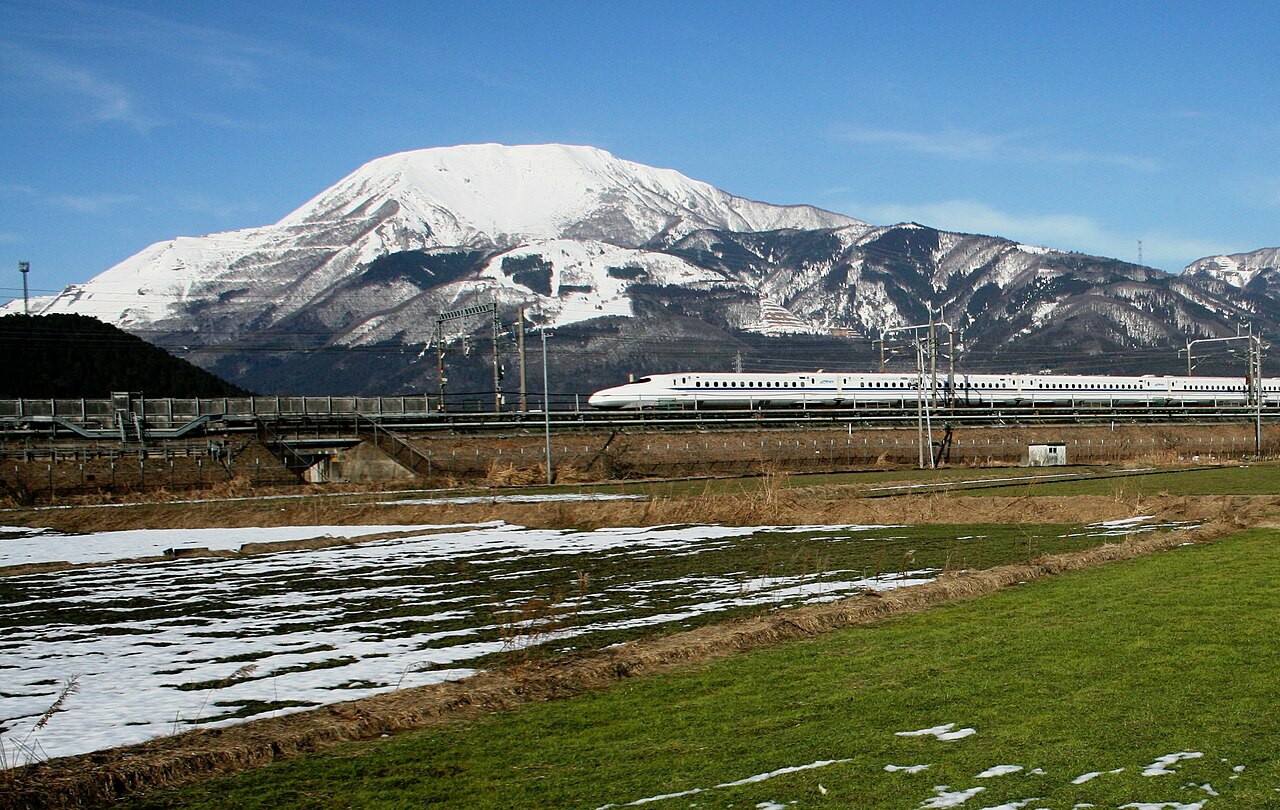
Mount Ibuki and N700 Series Shinkansen




Genesis and Collaborative Development of the N700 Series
The N700 Series Shinkansen, introduced in 2007, represents a pivotal advancement in the evolution of Japan's iconic bullet train network. This generation was the product of a strategic collaboration between two major railway operators, JR Central and JR West, underscoring a shared commitment to enhancing the Tōkaidō and San'yō Shinkansen lines. The development focused on optimizing performance metrics such as speed, acceleration, and energy efficiency, while also prioritizing passenger comfort and environmental considerations.
The N700 series was engineered to meet the increasing demand for faster and more reliable intercity travel, building upon the technological foundations laid by its predecessors, the 700 and 300 series. Its design incorporated lessons learned from decades of Shinkansen operation, pushing the boundaries of what was technically feasible in high-speed rail. The subsequent integration by JR Kyushu onto the Kyushu Shinkansen line further solidified its role as a versatile and essential component of Japan's national high-speed rail infrastructure.
The Physics of Speed
A defining characteristic of the N700 Series is its sophisticated active tilting system, a crucial innovation for maintaining high speeds on conventional track geometry. The train is capable of tilting up to one degree, a seemingly minor adjustment that significantly impacts its ability to negotiate curves. This tilting mechanism allows the N700 to maintain speeds of 270 km/h (168 mph) on curves with a radius as tight as 2,500 meters, a substantial improvement over non-tilting trains that would be restricted to much lower speeds.
This capability is vital for reducing journey times on the Tōkaidō Shinkansen, which features numerous curves. The system operates dynamically, with onboard computers analyzing track conditions and adjusting the tilt angle in real-time to counteract centrifugal forces, thereby enhancing passenger comfort by minimizing perceived lateral acceleration. Complementing the tilting system is an advanced aerodynamic profile, featuring a distinctive 'dual-hood' nose design that reduces air resistance and noise, particularly important at the high speeds achieved by the N700 series.
Performance Metrics
Beyond its tilting capabilities, the N700 Series excels in its acceleration performance. With a maximum acceleration rate of 2.6 km/h/s, it can achieve a speed of 270 km/h in approximately three minutes. This rapid acceleration is critical for minimizing dwell times at intermediate stations and maintaining schedule integrity on busy lines.
The N700 series also incorporates advancements in energy efficiency, utilizing lighter materials and more efficient traction systems. The subsequent development of the N700A variant represented an incremental but significant evolution. The N700A featured further refinements, including enhanced braking systems and improved control electronics, allowing for higher operating speeds on certain sections.
Notably, the N700A could achieve 285 km/h (177 mph) on 3,000 m radius curves, which led to the maximum operating speed on the Tōkaidō Shinkansen being raised to 285 km/h. In a strategic move to standardize and upgrade the fleet, all existing N700 series sets have been retrofitted with N700A improvements and are now classified as 'N700A', ensuring a consistent level of performance and safety across the operational fleet.
Socio-Economic Impact and Future Trajectories
The operational efficiency of the N700 Series Shinkansen has profound socio-economic implications for Japan. By drastically reducing travel times, such as the fastest Tokyo-Osaka 'Nozomi' service taking just 2 hours and 22 minutes, these trains facilitate business connectivity, boost tourism, and promote regional development. The ability to commute or travel between major metropolitan areas in a matter of hours transforms logistical possibilities and enhances the quality of life for millions.
The introduction of the N700S in July 2020 marks the next chapter, representing the latest generation of Shinkansen technology. Designed as a 'standard' model adaptable to various lines and international markets, the N700S incorporates further innovations in safety, efficiency, and passenger experience, including a new lithium-ion battery system for limited self-propelled operation during power outages. The planned gradual replacement of N700 series trains by the N700S underscores Japan's continuous pursuit of excellence and its role as a global leader in high-speed rail innovation.
See also
Frequently Asked Questions
What is the N700 Shinkansen?+
How fast can the N700 travel on curves?+
What special feature helps the N700 stay comfortable on curves?+
Who helped build the N700 Shinkansen?+
What makes the N700 more energy efficient?+
Based on content from Wikipedia · Licensed under CC BY-SA 4.0