

The Amazing Mellotron!
Images

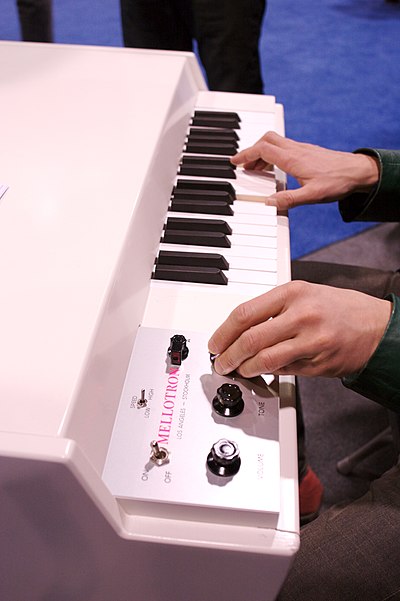
Mellotron (1972) playing




The Genesis of a Sonic Revolution
The Mellotron, developed in Birmingham, England, in 1963 by the brothers Frank and Leslie Bradley, stands as a landmark in musical instrument innovation. It was a sophisticated evolution of the American Chamberlin instrument, but crucially, the Mellotron was engineered for more efficient mass production. At its core, the Mellotron is an electro-mechanical keyboard that utilizes analog magnetic tape technology to reproduce sounds.
Each of the instrument's keys is linked to a length of quarter-inch magnetic tape, pre-recorded with the sound of a specific instrument or voice, such as a flute, cello, or choir. Upon pressing a key, a capstan rotates, pulling the tape across a playback head, thus reproducing the recorded sound. Releasing the key activates a spring mechanism that retracts the tape to its original position, ready for the next playback.
This system allowed for a polyphonic (multiple notes at once) performance of sampled sounds, a groundbreaking concept for its time. Early models, designed for domestic use, even featured automatic accompaniments, and its novelty attracted early adopters from various social circles, including royalty.
From Pop Charts to Psychedelic Soundscapes
The Mellotron's unique sonic character quickly found its way into the heart of popular music, profoundly influencing the sound of the late 1960s and 1970s. Its ability to authentically replicate orchestral instruments, particularly strings and flutes, provided musicians with a powerful new palette for creating rich, layered textures. Manfred Mann's 1966 hit 'Semi-Detached, Suburban Mr.
James' is often cited as one of the first pop songs to feature the Mellotron, showcasing its potential. However, it was The Beatles' iconic use of the Mellotron on 'Strawberry Fields Forever' in 1967 that cemented its place in music history. The ethereal, haunting flute intro became instantly recognizable and demonstrated the instrument's capacity for creating atmospheric and psychedelic soundscapes.
This pivotal moment inspired countless other artists to explore the Mellotron's capabilities, integrating its distinctive timbre into their own recordings and performances.
The Progressive Rock Staple and the M400 Era
The Mellotron became an indispensable fixture in the progressive rock movement, a genre that thrived on sonic experimentation and complex musical arrangements. Keyboardists in bands like The Moody Blues, King Crimson, Yes, and Genesis leveraged the Mellotron's ability to conjure lush, orchestral textures and otherworldly sounds. Mike Pinder, the keyboardist for The Moody Blues, was particularly instrumental in popularizing the instrument, using it extensively on albums like 'Days of Future Passed' (1967) and subsequent releases, often employing it to create vast, symphonic backdrops.
During the 1970s, the Mellotron's popularity led to the development of more streamlined models designed for touring musicians. The M400, introduced in 1975, became the best-selling model, simplifying the sound selection and accompaniment features to enhance portability and reliability for live performances. This made the Mellotron accessible to a wider range of musicians, solidifying its status as a defining instrument of the progressive rock era.
Technological Shift, Enduring Appeal, and Digital Echoes
The rise of digital synthesizers and samplers in the 1980s, offering greater sonic fidelity, polyphony, and programmability, led to a decline in the Mellotron's mainstream popularity and the cessation of its production in 1986. Instruments like the Fairlight CMI and the Yamaha DX7 provided new sonic frontiers that the analog Mellotron could not easily replicate. Nevertheless, the Mellotron's unique sonic fingerprint and nostalgic charm never truly faded.
In the 1990s, a resurgence of interest in vintage analog sounds saw bands such as Oasis, The Smashing Pumpkins, Muse, and Radiohead reintroducing the Mellotron into their music. This renewed appreciation led to the resurrection of the original manufacturer, Streetly Electronics, which began producing new Mellotrons. In 2007, they released the M4000, a model that combined the beloved M400 layout with the multi-bank selection of earlier instruments, demonstrating the Mellotron's enduring legacy and its continued relevance in contemporary music production.
See also
Frequently Asked Questions
What is a Mellotron and how does it work?+
Why was the Mellotron popular in the 1960s and 1970s?+
How did the Mellotron help musicians play many notes at once?+
Where did the Mellotron come from and who made it?+
What happened to the Mellotron when digital instruments appeared?+
Based on content from Wikipedia · Licensed under CC BY-SA 4.0