

Matthew Brettingham
Images

Doric Temple at Blickling Hall




From Craftsmanship Roots to Architectural Acclaim
Matthew Brettingham's trajectory from a craftsman's son in Norwich to one of England's most celebrated architects of the mid-18th century is a compelling narrative of talent and opportunity. His early career as a surveyor provided him with invaluable practical knowledge, honed through restorations and civic projects in his hometown, including work on Norwich Cathedral and its castle. This foundational experience in surveying and construction management was crucial.
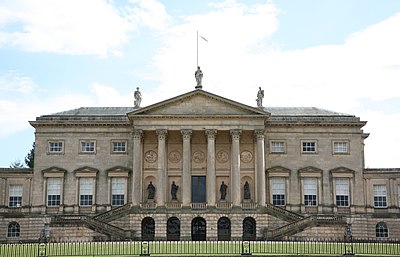
His appointment as Clerk of Works at Holkham Hall in 1743 marked a pivotal moment, thrusting him into the supervision of one of the era's most ambitious country house projects. This commission not only showcased his organizational skills but also his burgeoning architectural vision, setting the stage for a career defined by aristocratic patronage and significant commissions, predominantly in East Anglia, but also extending to notable sites like Kedleston Hall in Derbyshire.
Revolutionizing Urban Living
Beyond his celebrated country estates, Brettingham made a profound impact on urban domestic architecture, particularly in London. He was instrumental in transforming the design of the grand townhouse, drawing heavily on the principles of Italian urban palazzi and the architectural treatises of Andrea Palladio. Brettingham adapted these classical models to suit the specific social and functional requirements of the British aristocracy in the Georgian period.
His designs for townhouses like Norfolk House and Cumberland House were characterized by sophisticated spatial arrangements and a refined aesthetic that facilitated lavish entertaining. He understood that these residences were not merely dwellings but stages for social display and political maneuvering, creating interiors that were both opulent and highly functional for the era's complex social rituals. This innovation in townhouse design was a significant contribution to the urban landscape.
The Palladian Zenith and the Dawn of Neoclassicism
Brettingham's architectural language was deeply rooted in Palladianism, a style that emphasized symmetry, proportion, and classical motifs. His country houses and townhouses exemplified this aesthetic, offering a sense of order, harmony, and timeless grandeur. However, the architectural landscape is dynamic, and as Brettingham neared the zenith of his career, stylistic preferences began to shift.
The emergence of Neoclassicism, championed by younger architects like Robert Adam, introduced a new sensibility. Neoclassical architecture often favored a more restrained, archaeological approach, drawing directly from Greek and Roman precedents with a greater emphasis on delicate ornamentation and a lighter touch. This transition meant that while Brettingham's work was highly esteemed in its time, it was eventually perceived as belonging to an earlier, albeit still admired, stylistic phase, leading to his reputation being somewhat eclipsed by the rising stars of the new movement.
Enduring Influence and Historical Reappraisal
Although much of Brettingham's London work has been lost to time and urban development, his legacy endures through his surviving country houses and his significant influence on architectural practice. He was a key figure in disseminating Palladian ideals and demonstrating their adaptability to the English context. His ability to manage complex building projects and deliver designs that met the exacting standards of his aristocratic clients speaks to his professionalism and skill.
While the advent of Neoclassicism led to a period where his style was less fashionable, modern architectural historians increasingly recognize his crucial role in shaping the Georgian built environment. He represents a vital link in the evolution of English architecture, a builder whose innovative spirit and mastery of classical principles left an indelible mark on the country's architectural heritage.
The Brettingham Dynasty
Matthew Brettingham's influence extended beyond his own lifetime through his son, also named Matthew Brettingham. The younger Brettingham also pursued a career in architecture, continuing the family's legacy in the building trades. This continuation highlights the importance of apprenticeship and inherited knowledge in the architectural profession of the era.
The father's success undoubtedly provided a strong foundation and network for his son's endeavors. While the younger Brettingham may not have achieved the same level of widespread fame as his father, his involvement in the architectural world underscores the enduring impact of Matthew Brettingham the Elder's work and his establishment of a respected architectural practice that spanned generations, contributing to the rich tapestry of British architectural history.
See also
Based on content from Wikipedia · Licensed under CC BY-SA 4.0