

Malaysia Airlines Flight 370
Images
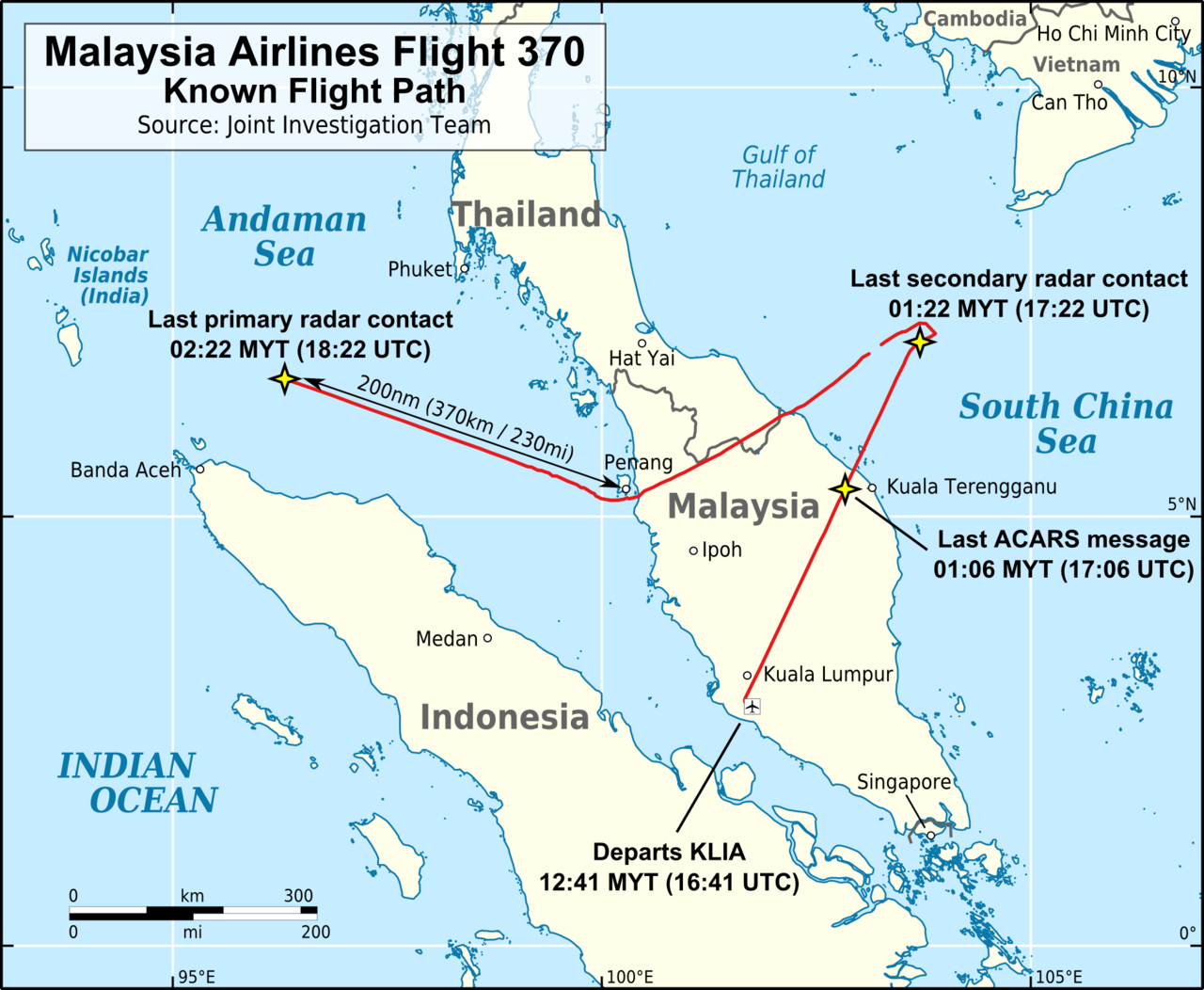
File:MH370 flight path with English labels.png


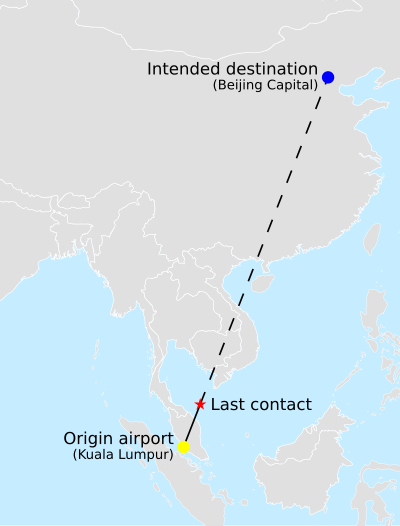


The Unraveling of a Routine Flight
Malaysia Airlines Flight 370 (MH370), a Boeing 777-200ER registered as 9M-MRO, departed Kuala Lumpur International Airport on March 8, 2014, bound for Beijing Capital International Airport. Approximately 38 minutes into the flight, while over the South China Sea, the aircraft made its final communication with air traffic control.
Shortly thereafter, it vanished from secondary surveillance radar. However, primary radar data from the Malaysian military indicated a significant deviation from its planned flight path. The aircraft turned westward, crossed the Malay Peninsula, and continued over the Andaman Sea, eventually disappearing from radar coverage approximately 200 nautical miles northwest of Penang Island.
This abrupt cessation of communication and the dramatic, unexplained course alteration marked the beginning of an unprecedented aviation mystery.
The Monumental Quest for Answers
The disappearance of MH370 initiated the most expensive search operation in aviation history. Initial efforts focused on the South China Sea and the Andaman Sea. However, a sophisticated analysis of automated satellite communication 'pings' from the aircraft, specifically from Inmarsat satellites, suggested a far more southerly trajectory over the southern Indian Ocean. This novel approach redirected the search to an immense area of ocean, covering 120,000 square kilometers.
Despite extensive underwater searches conducted over several years, including a significant effort by private contractor Ocean Infinity, the main wreckage of the aircraft could not be located. The sheer scale of the search and the lack of definitive findings underscore the complexity of the situation.
Debris as Silent Witnesses
While the aircraft's main body remained elusive, several pieces of debris, confirmed to have originated from MH370, began washing ashore in the western Indian Ocean during 2015 and 2016. These discoveries, including a flaperon and other aircraft components, provided tangible evidence that the plane had indeed traveled a vast distance and likely met its end in the ocean. These findings were crucial in validating the satellite data that guided the southern Indian Ocean search.
However, the location of the debris did not pinpoint the exact crash site, leaving the final moments of the flight shrouded in uncertainty.
The Lingering Questions and Lasting Impact
The Malaysian Ministry of Transport's final report in July 2018 remained inconclusive, highlighting the challenges faced by Malaysian air traffic control in attempting to re-establish contact. While various theories, including hijacking scenarios and potential crew involvement, have been investigated, no consensus has been reached. The Australian Transport Safety Bureau (ATSB) initially proposed a hypoxia event as a likely cause, but this remains debated.
The absence of a definitive explanation for MH370's disappearance has led to significant advancements in aviation safety regulations. These include enhanced battery life for underwater locator beacons, extended recording times for flight data and cockpit voice recorders, and new standards for aircraft position reporting over open oceans, all aimed at preventing a recurrence of such a profound mystery.
The Economic and Emotional Toll
The search for MH370 was not only a technical and logistical challenge but also an immense financial undertaking. Malaysia bore the largest share of the underwater search costs, followed by Australia and China. Beyond the financial burden, the disappearance has had a profound emotional impact, particularly on the families of the 227 passengers and 12 crew members.
The prolonged uncertainty and lack of closure have been incredibly difficult, making MH370 a case that continues to resonate deeply within the global community and the aviation industry.
See also
Based on content from Wikipedia · Licensed under CC BY-SA 4.0