

Magnetocaloric Effect
Images
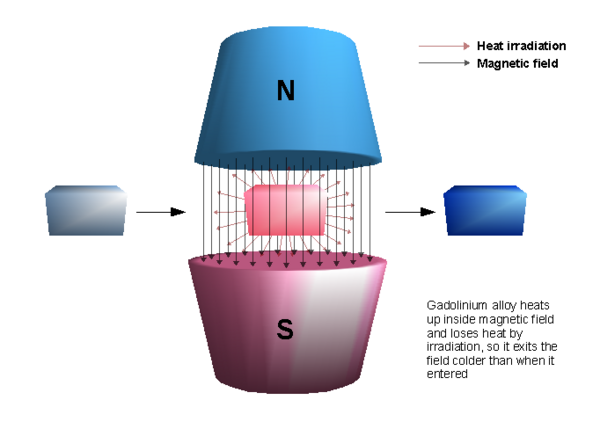
Magnetocaloric effect


Thermodynamic Underpinnings of Magnetocaloric Materials
The magnetocaloric effect (MCE) is a thermodynamic phenomenon observed in certain magnetic materials, characterized by a reversible change in temperature upon the application or removal of an external magnetic field. This effect arises from the coupling between the magnetic and lattice degrees of freedom within the material. In essence, applying a magnetic field induces magnetic ordering by aligning the magnetic moments of the constituent atoms.
This ordering process leads to a decrease in magnetic entropy. According to the laws of thermodynamics, this decrease in magnetic entropy must be compensated by an increase in another form of entropy, typically the lattice vibrational entropy, which manifests as the release of heat and a rise in the material's temperature. Conversely, when the magnetic field is removed, the magnetic moments become disordered, magnetic entropy increases, and the material absorbs heat from its surroundings, leading to a drop in temperature, often below its initial state.
Chronicles of Discovery and Early Refrigeration
The initial observation of the magnetocaloric effect dates back to 1881, when German physicist Emil Warburg first documented the temperature change in iron when subjected to a magnetic field. However, a comprehensive understanding and exploration of its potential took several decades. In 1917, Pierre Weiss and Auguste Piccard conducted further investigations.
The theoretical framework was significantly advanced by the work of Peter Debye in 1926 and William Giauque in 1927, who proposed the fundamental principles governing magnetic cooling. The practical application of MCE for achieving ultra-low temperatures began to materialize with the construction of the first working magnetic refrigerators by various research groups starting in 1933. This was a monumental achievement, as magnetic refrigeration provided the first viable method for reaching temperatures below 0.3 Kelvin, a regime previously inaccessible by other means like pumping helium-3 vapor.
Mechanisms of Magnetic Entropy Change and Heat Transfer
The magnitude of the magnetocaloric effect is directly related to the change in magnetic entropy (ΔS_mag) induced by the magnetic field. Materials with a sharp magnetic phase transition near their operating temperature exhibit a larger MCE. This is because the transition involves a significant change in magnetic order.
The process of magnetic refrigeration typically involves a thermodynamic cycle, often a modified Brayton or Stirling cycle. In a typical MCE refrigeration cycle, a magnetocaloric material is magnetized, causing it to heat up and reject heat to a heat sink. Then, it is demagnetized while thermally isolated, causing it to cool down.
Subsequently, it absorbs heat from the cold source. Finally, it is magnetized again, completing the cycle. Efficient heat transfer within the magnetocaloric material and between the material and the heat reservoirs is critical for the overall performance of the refrigerator.
Significance and Emerging Applications in Modern Technology
The magnetocaloric effect holds substantial promise for developing next-generation cooling technologies that are more energy-efficient and environmentally benign than conventional vapor-compression systems. These systems avoid the use of greenhouse gases and can potentially achieve higher coefficients of performance. Beyond domestic refrigeration, MCE is vital for scientific research requiring ultra-low temperatures, such as in quantum computing, superconductivity studies, and particle physics experiments.
The development of advanced magnetocaloric materials, including Heusler alloys, perovskites, and intermetallic compounds, continues to drive progress in this field, aiming for materials that exhibit large MCE over wider temperature ranges and at lower magnetic field strengths, making magnetic refrigeration more practical and cost-effective.
See also
Frequently Asked Questions
What is the magnetocaloric effect?+
How does a magnet make a material hot or cold?+
Why does the material cool when the magnet is removed?+
When did scientists first notice this effect?+
What could magnetocaloric refrigerators do for the environment?+
Based on content from Wikipedia · Licensed under CC BY-SA 4.0