

The Long March: An Epic Journey!
Images

Long March 5
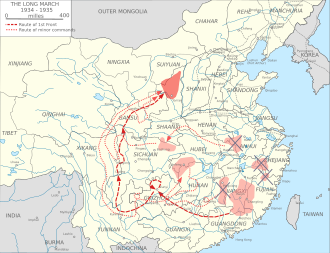




Context of the Retreat
The Long March was not an isolated event but a desperate response to escalating conflict during the Chinese Civil War. By 1934, the Chinese Communist Party (CCP) and its military arm, the Red Army, were facing severe pressure from Chiang Kai-shek's Kuomintang (KMT) forces. The KMT had launched its Fifth Encirclement Campaign, a massive military operation aimed at eradicating the Communist base in the Jiangxi Soviet.
Despite initial successes in establishing Soviet-style governance, the CCP's military position became untenable. The decision to abandon their headquarters in Ruijin and embark on a strategic withdrawal was a recognition of the KMT's overwhelming superiority in conventional warfare at that moment. This retreat, initiated in October 1934, was intended to preserve the core of the Red Army and relocate to a more defensible position, ultimately leading them to Yan'an in Shaanxi province.
The Grueling Traverse
The 6,000-mile journey was an odyssey of survival against overwhelming odds. The Red Army traversed some of the most unforgiving terrain in China, including rugged mountains, vast grasslands, and treacherous river crossings. The crossing of the Xiang River in December 1934 proved particularly devastating, reducing the First Front Red Army from approximately 86,000 to just 36,000 soldiers.
The strategic direction of the march was a constant point of contention. Initial plans to move through Hunan were thwarted by KMT defenses, leading to a crucial debate. Mao Zedong, who was not yet a member of the Politburo, advocated for a route through Guizhou, a suggestion that was eventually adopted. This decision marked a significant shift in strategic thinking and began to elevate Mao's influence within the party.
The Zunyi Conference and the Rise of Mao Zedong
The arduous journey provided the backdrop for a pivotal political event: the Zunyi Conference in January 1935. Held during a brief respite from KMT pursuit, this conference addressed the military failures and leadership issues plaguing the Red Army. It resulted in a significant redistribution of power, diminishing the influence of Soviet-backed leaders like Otto Braun and Bo Gu, and firmly establishing Mao Zedong as the de facto leader of the CCP.
This consolidation of power was critical. Mao's strategic acumen, demonstrated through his guerrilla warfare tactics and ability to navigate the complex political landscape, earned him immense prestige. The Long March, therefore, became not just a military retreat but a crucible that forged Mao's leadership and cemented his ideological direction for the party.
Divergent Paths and the Symbolic End at Yan'an
The Long March was not a single, monolithic event but comprised several separate marches undertaken by different Red Army fronts. The First Front Army, under Mao's growing influence, eventually reached Yan'an in October 1935, marking the symbolic end of the main march. However, other fronts, such as the Fourth Front Army led by Zhang Guotao, also undertook their own marches.
Disagreements over strategy and routes led to a split between Mao's First Front Army and Zhang's Fourth Front Army, with the latter suffering heavy losses. While the First Front Army's arrival in Yan'an with around 8,000 survivors became the iconic narrative, the Long March's true legacy lies in its role as a foundational myth for the CCP. It demonstrated the party's resilience, its ability to adapt and survive against overwhelming odds, and provided the narrative of heroic struggle that would be central to its eventual victory and the establishment of the People's Republic of China.
Enduring Significance and Historical Reinterpretation
The Long March is revered in Chinese history as a testament to the Communist Party's determination and Mao Zedong's leadership. It is often portrayed as a heroic epic, a symbol of national salvation and revolutionary spirit. The immense sacrifices made during the march are emphasized to legitimize the CCP's rule.
However, historical analysis also highlights the immense human cost, the strategic blunders, and the internal power struggles that characterized the event. The narrative of the Long March has been instrumental in shaping Mao's cult of personality and has been continuously reinterpreted to serve contemporary political objectives. Its legacy continues to be a subject of study, offering insights into military strategy, political maneuvering, and the construction of national identity in modern China.
Go deeper
Frequently Asked Questions
What was the Long March and why did it happen?+
How did the Long March help Mao Zedong become a leader?+
Why did the Red Army lose so many soldiers during the Long March?+
Where did the Red Army finally reach after the Long March?+
Were there different groups in the Long March?+
Based on content from Wikipedia · Licensed under CC BY-SA 4.0