

Leo VI
Images

Emperor Leo VI detail (cropped 4to3)

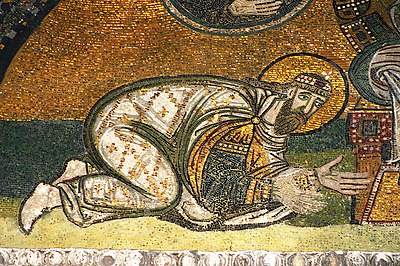


The Philosopher-King
Leo VI, born in 866 AD, inherited a complex political landscape within the Byzantine Empire. As the son of Basil I, founder of the Macedonian dynasty, his early life was marked by the precariousness of imperial succession, including periods of co-emperorship and even imprisonment. Despite these challenges, Leo cultivated an exceptional intellect, immersing himself in classical literature, philosophy, theology, and law.
This rigorous education profoundly shaped his worldview and his approach to governance. He ascended to sole emperorship in 886 AD, inheriting an empire that, while powerful, required astute leadership to navigate internal politics and external threats. Leo's reign, spanning over a quarter-century, would be characterized not by military conquest, but by a deep commitment to intellectualism and legal reform, earning him the enduring epithet 'the Wise'.
Codifying Justice
Perhaps Leo VI's most impactful contribution was his ambitious undertaking to revise and codify Byzantine law. Building upon earlier legal traditions, most notably Justinian's Corpus Juris Civilis, Leo initiated the creation of the 'Basilika' (meaning 'Imperial Laws'). This monumental work, comprising sixty books, aimed to update, clarify, and organize the existing legal framework. It was written in Greek, the vernacular language, making the law more accessible to a wider audience than the Latin-based earlier codes.
The 'Basilika' addressed a vast array of legal matters, including constitutional law, criminal law, family law, property rights, and procedural law. Its comprehensive nature and systematic approach provided a stable and sophisticated legal foundation for the empire, influencing legal thought and practice for centuries, even beyond the Byzantine era.
A Literary Emperor
Beyond his administrative and legal achievements, Leo VI was a prolific author whose writings offer invaluable insights into Byzantine intellectual and religious life. His theological works, such as his 'Homilies' and treatises on the Holy Spirit, demonstrate his deep engagement with complex doctrinal issues and his efforts to articulate and defend Orthodox Christianity. He also penned historical and political works, including his 'Tactica,' a military manual that reflects the strategic thinking of the era, and his 'Novels,' which supplemented and amended the 'Basilika.' His literary output extended to poetry and even a collection of prophecies, showcasing the breadth of his intellectual curiosity.
These works not only reveal his personal erudition but also highlight the vibrant intellectual culture of Constantinople during his reign.
Legacy and Historiography
Leo VI's reign represents a pivotal moment in Byzantine history, characterized by a deliberate shift towards intellectual and legal consolidation rather than aggressive expansion. His emphasis on law and learning fostered a sense of order and cultural continuity. The 'Basilika' served as a cornerstone of Byzantine jurisprudence, and his literary works continue to be primary sources for understanding the period.
While some historians have debated the effectiveness of his foreign policy or the completeness of his legal reforms, there is broad consensus on his intellectual prowess and his dedication to scholarship. Leo VI's legacy is that of a ruler who understood that true imperial strength lay not only in military might but also in the cultivation of justice, knowledge, and a sophisticated cultural identity, making him a truly unique figure in the annals of Byzantine emperors.
See also
Based on content from Wikipedia · Licensed under CC BY-SA 4.0