

Irregular Galaxies: The Wild Stars of Space!
Images

Irregular galaxy




Defining Irregularity
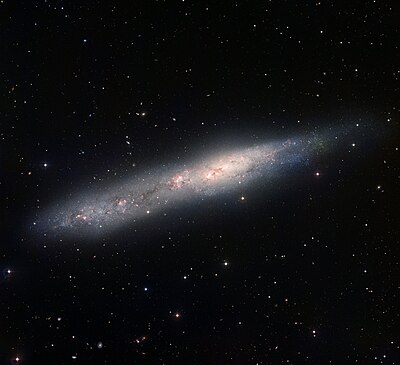
Irregular galaxies represent a fascinating departure from the well-defined morphological classes of spiral and elliptical galaxies, as categorized by the Hubble sequence. Lacking the characteristic features such as a prominent nuclear bulge or discernible spiral arm structure, these galaxies present a chaotic and often asymmetrical appearance. Their classification as 'irregular' stems from this absence of a regular, predictable form.
This lack of organized structure has profound implications for their internal dynamics. Specifically, irregular galaxies generally do not exhibit the large-scale density waves that are a hallmark of spiral galaxies and are instrumental in triggering and organizing star formation. Consequently, they serve as invaluable natural laboratories for astrophysicists seeking to study star formation processes in environments free from the complex influences of these density waves, offering a purer glimpse into the fundamental mechanisms of stellar birth and evolution.
Genesis of Chaos
The irregular morphology of these galaxies is not typically an intrinsic property from their inception but rather a consequence of dynamic interactions within the cosmic environment. A primary mechanism for their formation is strong gravitational perturbation. When galaxies, particularly massive ones, approach each other closely, their mutual gravitational forces can induce significant tidal distortions.
These forces can stretch, warp, and even tear apart the galactic structures, leading to the characteristic chaotic appearance of irregular galaxies. Furthermore, galaxy collisions and mergers are potent drivers of irregularity. The violent, high-energy interactions during these events can completely disrupt the original ordered structures of the participating galaxies, scattering their constituent stars, gas, and dust into a disorganized, irregular configuration.
These merger events can also trigger intense bursts of star formation, often referred to as starbursts, further contributing to the dynamic nature of irregular galaxies.
Irregular Galaxies as Cosmic Laboratories for Star Formation
The significance of irregular galaxies extends beyond their intriguing morphology; they are pivotal in our understanding of star formation. The absence of organized density waves, which in spiral galaxies channel gas and dust into specific regions (spiral arms) to form stars, means that star formation in irregular galaxies can occur more diffusely throughout their volume. This provides astronomers with a unique opportunity to observe and study the fundamental processes of star birth without the complicating factor of wave-driven triggers.
By analyzing the distribution and properties of young stars and star-forming regions within irregular galaxies, scientists can gain insights into the initial conditions and environmental factors that govern stellar evolution. This comparative study between irregular and regular galaxies helps refine models of galaxy evolution and the universal rate of star production.
Size, Environment, and Evolutionary Pathways
While the term 'irregular' might suggest a uniform size, irregular galaxies exhibit a range of masses. Many are classified as dwarf irregular galaxies, possessing significantly lower stellar masses, often around one-tenth that of larger galaxies like the Milky Way. These smaller systems are particularly vulnerable to environmental influences.
Their lower gravitational binding energy makes them more susceptible to tidal stripping by larger neighboring galaxies or interactions with intergalactic gas clouds. These interactions can further shape their morphology, potentially leading to their eventual assimilation into larger galaxies or complete disruption. However, there are notable exceptions, such as UGC 6697, a massive irregular galaxy that challenges the typical size association.
The study of these diverse irregular galaxies, from the smallest dwarfs to larger, more massive examples, provides crucial data points for understanding the full spectrum of galactic evolution and the diverse pathways galaxies can take.
The Broader Cosmic Context and Future Research
Irregular galaxies, comprising an estimated quarter of all galaxies, are not mere cosmic oddities but integral components of the universe's structure and evolution. Their prevalence underscores the dynamic nature of the cosmos, where gravitational interactions and mergers are common occurrences that shape galactic populations. Ongoing research continues to focus on detailed spectroscopic analysis of irregular galaxies to map their star formation rates, chemical compositions, and kinematic properties.
Advanced observational facilities, such as the James Webb Space Telescope, are providing unprecedented views of these galaxies, allowing for the study of early star formation and the chemical enrichment of their interstellar medium. Understanding the formation and evolution of irregular galaxies is key to a comprehensive picture of how galaxies form, grow, and interact over cosmic timescales, contributing to our broader understanding of cosmology and the universe's history.
See also
Frequently Asked Questions
What makes an irregular galaxy look different from a spiral or elliptical galaxy?+
Why do irregular galaxies often have no spiral arms?+
How can collisions between galaxies turn them into irregular galaxies?+
What do astronomers learn from studying irregular galaxies?+
Are irregular galaxies always small?+
Based on content from Wikipedia · Licensed under CC BY-SA 4.0