

Indian Institutes of Technology
Images

Indian Institutes of Technology






Founding Vision and Evolution of Excellence
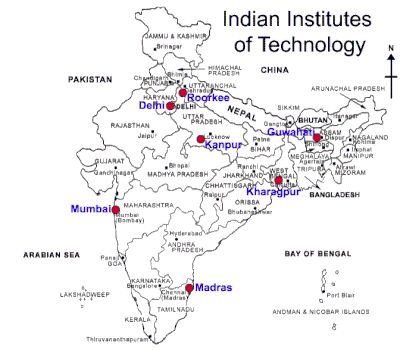
The Indian Institutes of Technology (IITs) represent a cornerstone of India's post-independence drive for technological self-sufficiency and global competitiveness. The genesis of the IIT system traces back to the recommendations of the Sarkar Committee in 1946, which envisioned establishing higher technical institutions on the lines of the Massachusetts Institute of Technology. The first IIT was established in Kharagpur in 1951, followed by others in Bombay (now Mumbai), Madras (now Chennai), Kanpur, and Delhi in the subsequent years.
These initial institutions were carefully planned to foster advanced education and research in engineering and technology, aiming to produce a skilled workforce capable of driving industrial development. The IITs were granted the status of 'Institutions of National Importance' by an Act of Parliament, underscoring their critical role in the nation's progress. Over the decades, the network has expanded significantly, with new IITs being established to cater to the growing demand for high-quality technical education and to spread their influence across different regions of India.
The IIT Advantage
The IITs are globally recognized for their exceptionally rigorous academic standards and highly competitive admission process, primarily through the Joint Entrance Examination (JEE). This selectivity ensures that the student body comprises the nation's brightest minds, fostering an environment of intense intellectual engagement and peer learning. The curriculum is continuously updated to remain at the cutting edge of scientific and technological advancements, with a strong emphasis on foundational principles coupled with practical application and research.
Faculty members are often leading researchers in their fields, contributing significantly to global scientific discourse and innovation. This academic rigor translates into graduates who are not only technically proficient but also possess strong analytical, problem-solving, and critical thinking skills, making them highly sought after by top multinational corporations, research institutions, and startups worldwide.
Catalysts for Innovation and Entrepreneurship
Beyond their role as educational powerhouses, the IITs are vibrant hubs for innovation and entrepreneurship. The institutions actively encourage students and faculty to pursue research and development, often leading to patents and the creation of new technologies. Many IITs have established Technology Innovation Hubs and incubation centers that provide resources, mentorship, and funding to aspiring entrepreneurs.
This ecosystem has nurtured a remarkable number of successful startups, many of which have become unicorns (companies valued at over $1 billion) and are making significant contributions to various sectors, including e-commerce, fintech, edtech, and deep technology. The entrepreneurial spirit fostered within the IITs is a key driver of India's economic growth and its emergence as a global technology leader, with alumni consistently demonstrating a capacity to disrupt industries and create new markets.
Addressing Grand Challenges and Shaping the Future
The research conducted at the IITs is often directed towards addressing some of the world's most pressing challenges. From developing sustainable energy solutions and advanced materials to pioneering work in artificial intelligence, quantum computing, and biotechnology, IIT researchers are at the forefront of scientific discovery. Their contributions are vital in areas such as healthcare, environmental sustainability, and national security.
For instance, IITs are actively involved in developing low-cost medical devices, advanced water purification systems, and efficient renewable energy technologies. The institutions also play a crucial role in national initiatives, collaborating with government agencies and industries to drive technological progress and innovation across the country. The influence of IITs extends to shaping policy, contributing to scientific discourse, and inspiring future generations of scientists and engineers to tackle complex global issues.
See also
Frequently Asked Questions
What is an IIT?+
When was the first IIT founded?+
How do students get into an IIT?+
What do IIT students learn and do?+
Why are IITs important for India and the world?+
Based on content from Wikipedia · Licensed under CC BY-SA 4.0