

Igneous Rock: Fire Rocks from Deep Inside Earth!
Images
Igneous rock
Genesis of Igneous Rocks
Igneous rocks represent a primary rock type, formed through the cooling and solidification of silicate melts. The journey begins with magma, which is generated by the partial melting of existing crustal or mantle rocks. This melting is typically triggered by one of three fundamental processes: an increase in ambient temperature (e.g., during mantle plume upwelling or crustal assimilation), a decrease in confining pressure (decompression melting, common at mid-ocean ridges and rift zones), or a change in rock composition (e.g., addition of water or CO2, which lowers the melting point, prevalent at subduction zones).
The resulting magma's composition, temperature, and the rate at which it cools and solidifies dictate the mineralogy and texture of the final igneous rock. Understanding these processes is key to deciphering plate tectonics and the thermal evolution of terrestrial planets.
Intrusive vs. Extrusive Formations
The geological setting of magma solidification leads to the classification of igneous rocks into intrusive (plutonic) and extrusive (volcanic) types. Intrusive rocks form when magma cools slowly beneath the Earth's surface, allowing ample time for large mineral crystals to grow, resulting in coarse-grained textures (phaneritic). These bodies can range from massive batholiths, covering hundreds of square kilometers, to smaller dikes (vertical intrusions) and sills (horizontal intrusions).
Extrusive rocks, conversely, form from lava that erupts onto the surface and cools relatively quickly. This rapid cooling often results in fine-grained (aphanitic) textures, or even glassy textures if cooling is extremely rapid, as seen in obsidian. Volcanic landforms like shield volcanoes, stratovolcanoes, and lava plateaus are direct products of extrusive igneous activity.
Mineralogy and Texture
The mineral composition and texture of an igneous rock are its defining characteristics, providing clues about its origin and cooling history. Minerals crystallize from magma in a specific order, known as the Bowen's Reaction Series, based on their melting points. Mafic minerals (rich in magnesium and iron, like olivine and pyroxene) crystallize at higher temperatures, while felsic minerals (rich in feldspar and silica, like quartz and muscovite) crystallize at lower temperatures.
Texture refers to the size, shape, and arrangement of mineral grains. Common textures include phaneritic (coarse-grained), aphanitic (fine-grained), porphyritic (large crystals in a fine-grained matrix), and glassy. Variations in these features allow geologists to classify igneous rocks into specific types like granite, basalt, rhyolite, and andesite, and to infer the conditions under which they formed.
Geological Significance and Economic Importance
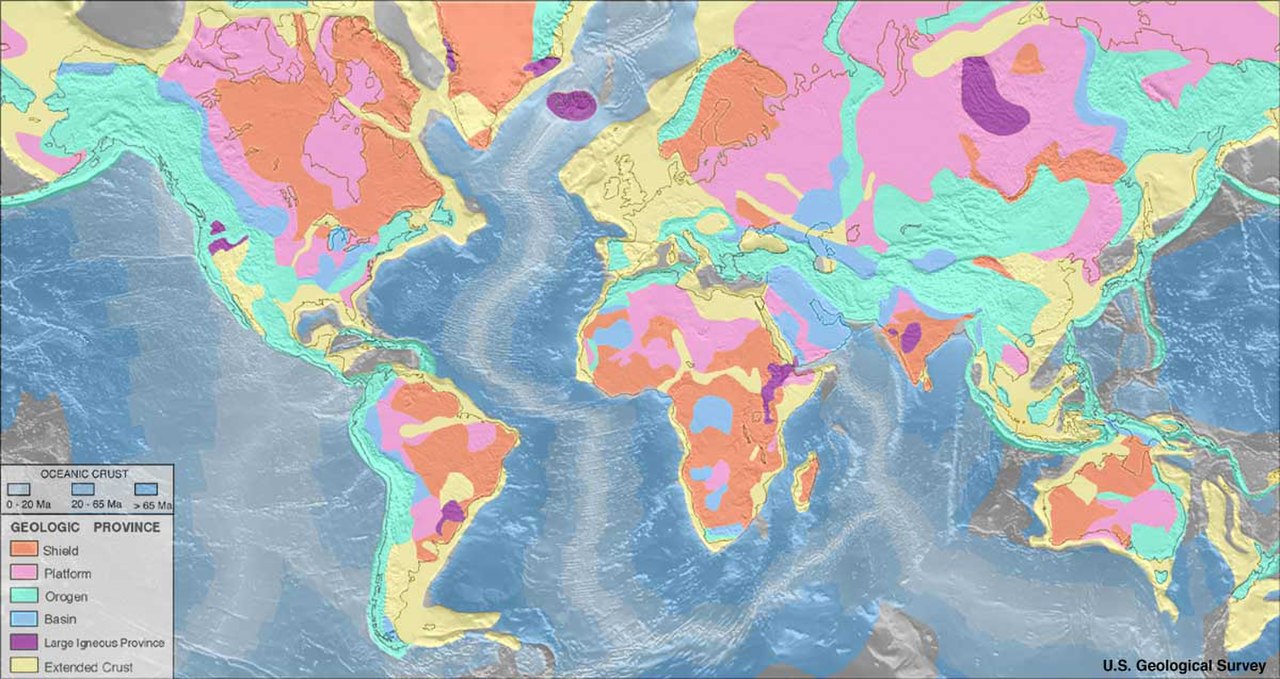
Igneous rocks are fundamental to the Earth's crust and play a vital role in geological processes. They form the bedrock of continents (shields and platforms) and are integral to oceanic crust formation at mid-ocean ridges. Orogenic belts, formed by tectonic collisions, often contain significant igneous intrusions and volcanic sequences.
Large Igneous Provinces (LIPs) represent massive outpourings of magma that can profoundly influence global climate and trigger mass extinctions. Economically, igneous rocks are invaluable. Many metallic ore deposits, such as those of copper, gold, silver, and platinum, are associated with igneous intrusions and hydrothermal activity.
Building materials like granite and basalt are widely quarried for construction, roads, and decorative purposes. Studying igneous rocks also aids in geothermal energy exploration and understanding volcanic hazards.
Go deeper
Frequently Asked Questions
What are igneous rocks and how do they form?+
How do intrusive and extrusive igneous rocks differ?+
Why do some igneous rocks have big crystals while others have tiny ones?+
What are some common igneous rocks that kids might see?+
Are igneous rocks useful for people?+
Based on content from Wikipedia · Licensed under CC BY-SA 4.0