

Harpy Eagle
Images

Harpy Eagle


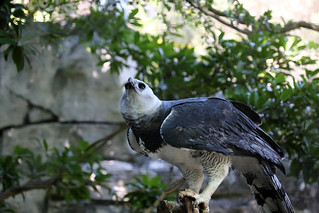


Anatomy of a Rainforest Tyrant
The Harpy Eagle (Harpia harpyja) stands as one of the largest and most powerful extant species of eagles. Its formidable physical attributes are finely tuned for its role as an apex predator in the dense Neotropical rainforest canopy. Females, significantly larger and more robust than males, can reach weights of up to 9 kilograms (20 pounds) and boast an impressive wingspan that can extend to 2.3 meters (7.5 feet).
This broad wingspan, while not optimized for high-speed aerial pursuits in open skies, is exceptionally adapted for agile maneuvering through the complex, three-dimensional environment of the rainforest. Its most striking features are its talons, which can measure up to 13 centimeters (5 inches) in length – comparable to the claws of a large grizzly bear. These talons, coupled with immense crushing power, enable the Harpy Eagle to subdue and carry prey that often outweighs smaller raptors.
The eagle's facial disc, reminiscent of an owl's, aids in directing sound to its ears, enhancing its ability to detect prey hidden by foliage.
Habitat Specificity and Range
The Harpy Eagle's distribution is intrinsically linked to the presence of extensive, undisturbed tropical lowland rainforests across Central and South America. Its range historically spanned from southern Mexico to northern Argentina, but it has been extirpated from many areas due to habitat fragmentation and loss. The species requires vast tracts of primary forest, characterized by a multi-layered canopy and emergent trees that provide crucial perching and nesting sites.
These emergent trees, often exceeding 40 meters (130 feet) in height, offer unobstructed views for hunting and secure locations for their massive nests. The Harpy Eagle's dependence on such specific habitat conditions makes it highly vulnerable to anthropogenic pressures. Areas with significant human activity, such as logging, agriculture, and cattle ranching, are typically devoid of healthy Harpy Eagle populations, underscoring its role as an indicator species for pristine forest ecosystems.
Dietary Specialization and Ecological Impact
As a highly specialized carnivore, the Harpy Eagle's diet predominantly consists of arboreal mammals, with sloths and monkeys forming the bulk of its prey. Studies indicate that these two groups can account for over 80% of their diet in some regions. This dietary focus places the Harpy Eagle in a unique ecological position, exerting significant top-down control on populations of these forest-dwelling animals.
By preying on these species, Harpy Eagles help regulate their numbers, which in turn influences forest dynamics, such as seed dispersal and vegetation structure. Their hunting strategy involves patient observation from high perches, followed by a swift, powerful dive to capture prey. The ability to tackle prey as large as howler monkeys highlights the extraordinary strength and predatory prowess of this raptor.
This apex position means that the health of Harpy Eagle populations is a direct reflection of the health and biodiversity of their rainforest habitat.
Reproduction, Lifespan, and Population Dynamics
The reproductive cycle of the Harpy Eagle is characterized by its slow pace, contributing to its vulnerability. Females typically lay one or two eggs, but usually only one chick survives due to sibling rivalry or resource limitations. The incubation period is around 55 days, and the eaglet remains in the nest for approximately 6 to 9 months.
Following fledging, the young eagle continues to be dependent on its parents for food for an extended period, sometimes up to two years. This prolonged parental care means that a breeding pair may only successfully raise one chick every two to three years. Harpy Eagles are estimated to live for 30 to 40 years in the wild, a testament to their resilience and the stability of their environment.
This slow reproductive rate, combined with habitat loss and occasional hunting, results in low population densities and a conservation status of Near Threatened.
Conservation Imperatives and Future Outlook
The conservation status of the Harpy Eagle as Near Threatened underscores the urgent need for protective measures. The primary threat is habitat destruction and fragmentation, driven by deforestation for agricultural expansion, cattle ranching, logging, and infrastructure development. As these forests shrink and become more fragmented, Harpy Eagles lose critical hunting grounds, nesting sites, and corridors for movement.
Their large territorial requirements mean that effective conservation necessitates the protection of extensive, interconnected forest landscapes. Conservation strategies include establishing protected areas, promoting sustainable land-use practices in buffer zones, combating illegal hunting, and conducting public awareness campaigns to foster local support for raptor conservation. The future of the Harpy Eagle is inextricably linked to the fate of the world's remaining tropical rainforests, making its survival a critical barometer for the health of these vital global ecosystems.
See also
Frequently Asked Questions
What does a Harpy Eagle look like?+
How big is a Harpy Eagle?+
What does a Harpy Eagle eat?+
Where does a Harpy Eagle live?+
Why are Harpy Eagles important?+
Based on content from Wikipedia · Licensed under CC BY-SA 4.0