

Haber process
Images

Haber process






Genesis of an Industrial Revolution
The Haber process, later optimized into the Haber-Bosch process by Carl Bosch, emerged from a critical need for a sustainable source of fixed nitrogen. Prior to its development, nitrogen for fertilizers and explosives was primarily derived from natural sources like guano and saltpeter, which were becoming scarce and geographically limited. Fritz Haber, a brilliant but controversial chemist, sought to synthesize ammonia (NH3) directly from atmospheric nitrogen (N2) and hydrogen (H2).
His initial laboratory success in 1909 demonstrated the feasibility of this reaction under high pressure and temperature, using a catalyst. This was a monumental achievement, as atmospheric nitrogen is notoriously inert due to its strong triple bond, making it difficult to break apart and react. Haber's work laid the scientific foundation for an industrial process that would fundamentally alter human capacity for food production and, unfortunately, warfare.
The Industrial Symphony
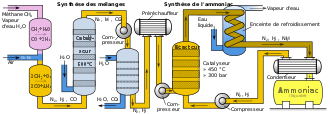
The Haber-Bosch process is a prime example of applied chemical engineering, transforming a laboratory reaction into a massive industrial operation. The core reaction, N2 + 3H2 ⇌ 2NH3, is exothermic and reversible. To achieve a favorable equilibrium yield of ammonia, the process operates at high temperatures (typically 400-500 °C) to increase reaction rate, but this is counteracted by Le Chatelier's principle which favors reactants at lower temperatures.
Therefore, a compromise temperature is used in conjunction with a highly efficient catalyst, usually based on iron promoted with oxides of potassium, aluminum, and calcium. Extremely high pressures (150-250 atmospheres or more) are employed to shift the equilibrium towards the product side, as the reaction involves a decrease in the number of moles of gas. The unreacted gases are recycled, maximizing efficiency.
Hydrogen is typically sourced from steam reforming of natural gas, a process that itself requires significant energy input and generates CO2.
The Double-Edged Sword
The significance of the Haber-Bosch process cannot be overstated. It is widely credited with enabling the dramatic increase in global food production throughout the 20th century, supporting a population boom from roughly 1.6 billion in 1900 to over 7 billion today. Without synthetic fertilizers derived from this process, it is estimated that the Earth could only support about half its current population.
However, the process also has profound environmental and ethical implications. Its reliance on fossil fuels for hydrogen production makes it a significant contributor to greenhouse gas emissions. Furthermore, the overuse of nitrogen fertilizers leads to eutrophication of waterways, soil degradation, and the release of nitrous oxide, a potent greenhouse gas.
Historically, the ammonia produced was also crucial for the manufacture of explosives, playing a significant role in World War I, highlighting the dual-use nature of this powerful technology.
Modern Relevance and Future Directions
Today, the Haber-Bosch process remains the primary method for ammonia synthesis, consuming an estimated 1-2% of the world's total energy supply. Ongoing research focuses on making the process more sustainable. This includes developing more energy-efficient catalysts that can operate at lower temperatures and pressures, and exploring alternative sources of hydrogen, such as electrolysis powered by renewable energy (green hydrogen).
Innovations in precision agriculture also aim to optimize fertilizer application, reducing waste and environmental impact. As the global population continues to grow and the imperative to address climate change intensifies, the Haber-Bosch process stands at a critical juncture, demanding continuous innovation to balance its indispensable role in food security with the urgent need for environmental stewardship.
Go deeper
Frequently Asked Questions
What is the Haber process?+
Why did scientists create the Haber process?+
How does the Haber process make ammonia?+
Where does the hydrogen come from in the Haber process?+
Why is the Haber process important for food?+
Based on content from Wikipedia · Licensed under CC BY-SA 4.0