

Gear
Images

Gear


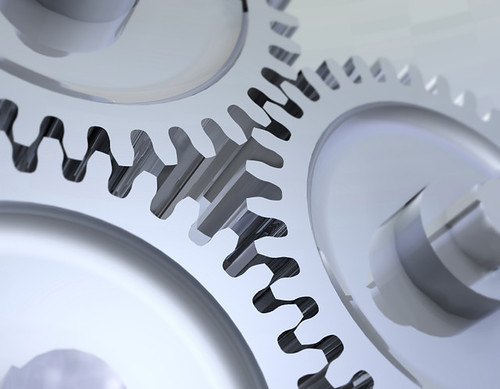
The Mechanics of Motion Transfer
Gears are fundamental mechanical components designed to transmit rotational motion and torque between shafts. Their operation relies on the precise meshing of teeth, which are essentially projections on the circumference of a wheel. When two gears mesh, the teeth of one drive the teeth of the other, creating a synchronized rotation.
The relationship between the number of teeth on two meshing gears, known as the gear ratio, is critical. This ratio dictates how the speed and torque are altered. For instance, if gear A has 20 teeth and meshes with gear B with 40 teeth, gear B will rotate at half the speed of gear A but with twice the torque.
This principle allows for the creation of gear trains, a series of interconnected gears that can achieve significant speed reductions or increases, or complex changes in direction. Different types of gears, such as spur gears (parallel shafts), bevel gears (intersecting shafts), worm gears (perpendicular shafts), and helical gears (parallel shafts with angled teeth), offer unique solutions for specific engineering challenges. Spur gears are common for simple speed reduction, while bevel gears are essential for changing direction, like in vehicle differentials.
The design and material of gears are crucial for efficiency, durability, and noise reduction, with modern manufacturing techniques enabling incredibly precise and robust gear systems.
A Journey Through Time
The history of gears spans millennia, showcasing human ingenuity in harnessing mechanical advantage. While precise origins are debated, early evidence points to their use in ancient civilizations. The Antikythera mechanism, dating back to the 2nd or 1st century BCE, is a remarkable testament to Hellenistic engineering, featuring an intricate system of at least 30 bronze gears used to model astronomical cycles.
This suggests a sophisticated understanding of gear cutting and application. Archimedes is also credited with early gear designs. During the Middle Ages, gears were vital in watermills and windmills, powering essential tasks like grinding grain and pumping water.
The Renaissance saw further advancements, with Leonardo da Vinci sketching numerous gear mechanisms. However, it was the Industrial Revolution that truly propelled gear technology forward. The demand for more powerful and precise machinery in factories led to innovations in metallurgy and manufacturing processes, enabling the mass production of standardized, high-quality gears.
This era saw the development of more complex gear types and the establishment of principles that underpin modern gear design, transforming industries and society.
The Versatility of Gears
Gears are indispensable tools for controlling mechanical energy due to their multifaceted capabilities. Their primary function is the transmission of rotational motion, but their true power lies in their ability to modify this motion. By strategically combining gears of different sizes, engineers can precisely control the output speed and torque.
This is fundamental to the operation of almost all motorized vehicles. In a car's transmission, a complex arrangement of gears allows the engine's high-speed, low-torque output to be converted into the lower-speed, higher-torque output needed to move the vehicle from a standstill, and then adjusted for efficient cruising. Gears also excel at changing the direction of rotation.
Spur gears, when meshed directly, reverse the direction of rotation. Bevel gears allow for power transmission between shafts at angles, typically 90 degrees, which is crucial for steering systems and differentials. Furthermore, gears can be used to convert rotary motion into linear motion, as seen in screw jacks or certain types of actuators.
The ability to achieve these diverse mechanical transformations with relative simplicity and high efficiency makes gears a cornerstone of mechanical engineering.
Gears in the Modern World
Today, gears are integral to nearly every facet of technology, from the microscopic to the astronomical. In micro-robotics and medical devices, tiny, precision-engineered gears enable the intricate movements required for minimally invasive surgery or the operation of micro-scale machines. The automotive industry relies heavily on gears for transmissions, differentials, steering systems, and engine timing, constantly seeking improvements in efficiency and durability.
In aerospace, gears are critical for controlling aircraft flight surfaces, operating landing gear, and in the complex mechanisms of spacecraft, including robotic arms and propulsion systems. Industrial automation heavily utilizes gears in robotic arms, conveyor systems, and heavy machinery, where precise control of speed and force is paramount. Even in consumer electronics, gears are found in hard drives, printers, and optical drives, facilitating precise mechanical operations.
The ongoing development of advanced materials, lubrication techniques, and manufacturing processes continues to push the boundaries of gear performance, enabling new technological frontiers.
Go deeper
Frequently Asked Questions
What is a gear?+
How do gears change speed and torque?+
What are some different kinds of gears?+
Why are gears important in cars?+
Where did people first use gears?+
Based on content from Wikipedia · Licensed under CC BY-SA 4.0