

Galaxy Clusters: Cosmic Neighborhoods!
Images

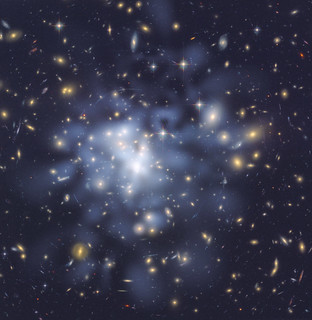
Gravitational Lens in Galaxy Cluster RCS2 032727-132623




Defining the Titans
Galaxy clusters represent the pinnacle of cosmic structure formation, serving as the largest known gravitationally bound entities in the universe. These colossal systems are not merely aggregations of galaxies but complex ecosystems comprising hundreds to thousands of individual galaxies, an extensive reservoir of extremely hot, X-ray emitting intergalactic gas, and a dominant component of dark matter. The typical mass of a cluster ranges from 10^14 to 10^15 solar masses, a scale so immense that it dwarfs smaller structures like galaxy groups.
Their formation is a direct consequence of the hierarchical structure formation model, where smaller structures merge over cosmic time to form larger ones. The distribution and properties of galaxy clusters are sensitive probes of the underlying cosmological parameters, including the density of matter and dark energy, making them crucial for testing our understanding of the universe's evolution and composition.
The Gravitational Architects
The binding force of a galaxy cluster is its immense gravitational potential, generated by the collective mass of its constituent galaxies, hot gas, and, most significantly, dark matter. The intergalactic medium (IGM) within clusters is a plasma heated to tens to hundreds of millions of Kelvin, detectable through its X-ray emission. This hot gas constitutes a substantial fraction of the cluster's baryonic mass, often exceeding the mass of stars within the galaxies themselves.
Dark matter, which interacts only gravitationally and electromagnetically (or not at all), is inferred from its gravitational effects, such as the high velocities of galaxies within the cluster and gravitational lensing. Early studies, notably by Fritz Zwicky in the 1930s on the Coma Cluster, revealed discrepancies between the observed luminous mass and the mass required to gravitationally bind the cluster, leading to the hypothesis of unseen matter – dark matter.
Modern observations confirm that dark matter dominates the mass budget of galaxy clusters.
Cosmic Laboratories
Galaxy clusters are indispensable tools for modern cosmology and astrophysics. Their sheer mass and gravitational influence enable phenomena like gravitational lensing, where the cluster's gravity acts as a lens, magnifying and distorting the light from background galaxies. This allows astronomers to study extremely distant objects and probe the distribution of mass, including dark matter, within the cluster.
Furthermore, the study of galaxy evolution within clusters provides insights into how galaxies interact, merge, and are influenced by their environment. Processes like ram-pressure stripping, where gas is stripped from galaxies as they move through the hot IGM, can quench star formation. Clusters also serve as laboratories for studying the properties of dark matter and dark energy, and their abundance and clustering patterns are key observables for constraining cosmological models, such as the Lambda-CDM model.
From Discovery to Superclusters
The recognition of galaxy clusters as distinct cosmic structures evolved over time. Early astronomical catalogs noted apparent groupings of nebulae (galaxies). Fritz Zwicky's pioneering work in the 1930s on the Coma Cluster was pivotal; he calculated the cluster's virial mass based on galaxy velocities and found it to be orders of magnitude greater than the luminous mass, leading him to postulate the existence of 'dunkle Materie' (dark matter).
For decades, his findings were largely overlooked. By the mid-20th century, with advancements in observational astronomy and the development of X-ray astronomy, the existence of hot gas in clusters was confirmed, providing further evidence for their massive nature. The discovery of superclusters in the 1980s, which are collections of galaxy groups and clusters, revealed that even galaxy clusters are not the largest structures, but rather components of an even grander cosmic web, challenging earlier notions of clusters being the ultimate cosmic building blocks.
Observational Techniques and Future Prospects
The study of galaxy clusters relies on a suite of advanced observational techniques. Optical telescopes are used to identify and count galaxies, measure their velocities, and study their morphology. X-ray observatories, such as Chandra and XMM-Newton, are crucial for mapping the distribution and temperature of the hot intracluster medium, providing estimates of the total baryonic mass and probing the cluster's gravitational potential. Radio telescopes can detect diffuse emission from the IGM and study magnetic fields.
Gravitational lensing studies, using both ground-based and space telescopes, map the distribution of total mass, including dark matter. Future missions and observatories, like the Euclid space telescope and the Vera C. Rubin Observatory, are designed to survey vast numbers of galaxy clusters and their distribution across cosmic time, providing unprecedented data to refine cosmological models, understand the nature of dark matter and dark energy, and map the large-scale structure of the universe with greater precision.
See also
Frequently Asked Questions
What is a galaxy cluster?+
Why do galaxy clusters have so much hot gas?+
How do scientists know galaxy clusters have dark matter?+
What can we learn from galaxy clusters?+
What is gravitational lensing and why does it happen in clusters?+
Based on content from Wikipedia · Licensed under CC BY-SA 4.0