

Food Webs: The Ultimate Eat-or-Be-Eaten Game!
Images

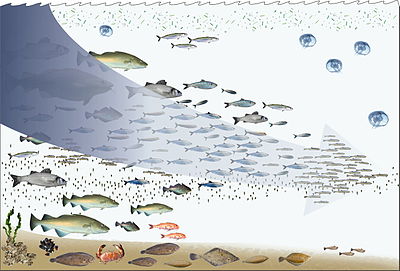
Food web and trophic level of the Chengjiang and Burgess Shale - journal.pbio.0060102.g001




Foundations of Feeding
A food web is a graphical representation of the feeding relationships within an ecological community, illustrating the flow of energy and nutrients. At its base are autotrophs, primarily photosynthetic organisms like plants and phytoplankton, which convert solar energy into chemical energy. These producers form the foundation upon which all other life in the ecosystem depends.
Heterotrophs, or consumers, obtain energy by feeding on other organisms. This category is further divided into herbivores (primary consumers), carnivores (secondary, tertiary, or quaternary consumers), and omnivores. The concept of trophic levels, pioneered by Charles Elton and later elaborated by Raymond Lindeman, categorizes organisms based on their feeding position.
Lindeman's work on trophic dynamics highlighted the crucial role of energy transfer efficiency between levels, typically around 10%, meaning a significant amount of energy is lost as heat at each step. This energy loss dictates the maximum length of food chains within a web.
The Web's Resilience
The structure of a food web is critical for ecosystem stability and resilience. Unlike linear food chains, food webs are characterized by multiple interconnected pathways, providing redundancy. If one food source becomes scarce, consumers often have alternative prey, preventing catastrophic population collapses.
This complex network of interactions, described by Darwin as an 'entangled bank' and a 'web of life', demonstrates the profound interdependence of species. Ecologists analyze the topology of these networks, identifying patterns such as keystone species – organisms that have a disproportionately large effect on their environment relative to their abundance. The removal of a keystone species can trigger cascading extinctions and fundamentally alter ecosystem structure, underscoring the delicate balance maintained by these intricate feeding relationships.
Diversity of Diet
Food webs encompass an astonishing diversity of life and feeding strategies. Organisms range from microscopic bacteria and viruses to the largest terrestrial and marine animals. Beyond the strict categories of autotrophs and heterotrophs, some organisms exhibit mixotrophy, deriving energy from both photosynthesis and consuming other organisms, such as certain protists or carnivorous plants.
The interactions within food webs include herbivory, carnivory, scavenging, and parasitism, each playing a distinct role in nutrient cycling and population regulation. Apex predators, situated at the top of the food web, often exert top-down control, influencing populations at lower trophic levels. The scale of these interactions is immense, from the smallest soil microbes recycling nutrients to the vast oceanic food webs supporting marine biodiversity.
Ecological Modeling
Modern ecology utilizes food web analysis as a fundamental tool for understanding and modeling ecosystem dynamics. Ecologists often simplify real-world complexity by aggregating species into 'trophic species' – groups of species that share the same predators and prey within the food web. These simplified representations are essential for developing quantitative models that explore consumer-resource dynamics and test hypotheses about community structure.
Network theory provides a mathematical framework for analyzing the topological properties of food webs, revealing universal patterns in species richness, connectance, and the distribution of interactions. Research into scaling laws, for instance, seeks to predict relationships between the structure of food web linkages and the number of species present, offering insights into the fundamental principles governing ecological communities across diverse environments.
Historical Roots and Modern Relevance
The conceptualization of food webs has evolved significantly since early naturalists like John Bruckner described nature as a 'continued web of life' and Charles Darwin mused about 'complex relations'. Charles Elton's seminal 1927 work, 'Animal Ecology', introduced concepts of food cycles and trophic levels, laying the groundwork for future research. Raymond Lindeman's 1942 paper on trophic dynamics further solidified the understanding of energy flow.
Today, the study of food webs remains vital for conservation biology, environmental management, and understanding the impacts of climate change and human activities on ecosystems. By mapping and analyzing these intricate networks, scientists gain crucial insights into ecological health and the interconnectedness that sustains life on Earth.
See also
Frequently Asked Questions
What is a food web?+
Why do food webs have many paths instead of just one chain?+
How does energy move from plants to big animals in a food web?+
What happens if a keystone species disappears from a food web?+
Are there animals that can do both photosynthesis and eating?+
Based on content from Wikipedia · Licensed under CC BY-SA 4.0