

Ferrari FF
Images

Ferrari FF


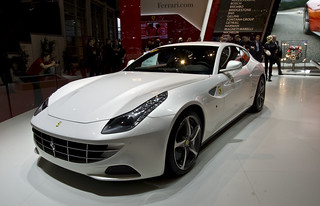


The FF's Strategic Evolution
The Ferrari FF, produced from 2011 to 2016, represented a pivotal moment in Ferrari's product strategy, deliberately expanding the brand's appeal beyond its traditional two-seater sports car niche. The 'FF' designation, standing for 'Ferrari Four,' was a clear indicator of its dual focus: seating for four occupants and the introduction of a sophisticated four-wheel-drive system in a production Ferrari. This was a calculated move to cater to a segment of the luxury market seeking high performance combined with enhanced usability and all-weather capability.
The FF succeeded the 612 Scaglietti, but it was a radical departure in terms of design and engineering. Development commenced in 2007, with a design team led by Lowie Vermeersch and Flavio Manzoni tasked with creating a vehicle that was both aesthetically striking and functionally versatile. Its debut at the 2011 Geneva Motor Show marked the introduction of the 'shooting brake' body style to Ferrari's lineup, a three-door configuration characterized by an elongated roofline and a large rear tailgate, offering a significant increase in cargo volume and passenger space compared to traditional Ferrari coupes.
This design choice was crucial in positioning the FF as a true grand tourer, capable of accommodating four adults comfortably for extended journeys without compromising the brand's inherent sporting DNA.
Powertrain and Performance
At the heart of the Ferrari FF lies a formidable 6.3-liter naturally aspirated V12 engine, a powerplant that epitomizes Ferrari's heritage of high-revving, sonorous engines. This engine produced a substantial 650 horsepower (490 kW) and 504 lb-ft (683 N⋅m) of torque. Such output enabled the FF to achieve a remarkable top speed of 335 km/h (208 mph), solidifying its status as the world's fastest four-seater car upon its release.
Its acceleration was equally impressive, capable of sprinting from 0 to 100 km/h (62 mph) in just 3.7 seconds. This performance was meticulously managed by a seven-speed dual-clutch transmission, engineered for rapid and seamless gear changes, contributing to both exhilarating acceleration and efficient cruising. The FF shared its engine architecture with the F12berlinetta, a testament to Ferrari's engineering efficiency and the shared platform development that allowed for the integration of such a potent V12 into a more practical body style.
The engine's placement, set back significantly within the chassis, contributed to an optimal front-to-rear weight distribution, crucial for maintaining Ferrari's renowned handling dynamics.
The Significance of the FF
The Ferrari FF's significance extends beyond its impressive performance figures and unique design; it represented a strategic pivot for Ferrari, demonstrating the brand's willingness to innovate and adapt to evolving market demands. By introducing a four-wheel-drive system and a practical four-seat configuration, Ferrari broadened its appeal to a demographic that might have previously found its offerings too extreme or impractical for daily use. The FF proved that a Ferrari could successfully blend supercar performance with the versatility required for a grand tourer, capable of handling diverse road conditions and carrying passengers and luggage with ease.
This was a crucial step in solidifying Ferrari's position in the ultra-luxury GT segment. The innovative 4RM (Rinnovata 4 Motrici) all-wheel-drive system was a particular engineering triumph, being approximately 50% lighter than conventional AWD systems and designed to deliver power to the front wheels only when traction demanded it, thus preserving the characteristic rear-wheel-drive feel that Ferrari enthusiasts cherish. The FF's critical reception, including accolades like Top Gear's 'Estate Car of the Year' in 2011, underscored its success in achieving this ambitious balance of performance, practicality, and desirability.
Engineering the FF
The engineering behind the Ferrari FF was a complex interplay of tradition and cutting-edge technology. The aforementioned 4RM all-wheel-drive system was a paradigm shift for Ferrari, designed to enhance stability and traction without significantly compromising the car's dynamic character. It featured a separate two-speed transfer case that could engage the front wheels, working in conjunction with the rear transaxle.
This system was electronically controlled, intelligently distributing torque to optimize grip in various conditions, from dry asphalt to snow and ice. The chassis was constructed primarily from aluminum alloys, a hallmark of Ferrari's lightweight construction philosophy, ensuring rigidity and minimizing overall mass despite the added complexity of the AWD system and the larger body. The suspension system employed magnetorheological dampers, allowing for adaptive damping rates to suit driving conditions and driver input, further enhancing both ride comfort and handling precision.
The interior was meticulously crafted, featuring premium materials and advanced infotainment systems, reflecting its role as a luxury grand tourer. The FF's design, while polarizing for some traditionalists, was a bold statement that successfully integrated a more practical silhouette with Ferrari's signature aggressive styling cues, setting the stage for its successor, the GTC4Lusso.
See also
Frequently Asked Questions
What is a Ferrari FF?+
Why does the Ferrari FF have four seats?+
How fast can the Ferrari FF go?+
What makes the Ferrari FF special compared to other Ferraris?+
Who designed the Ferrari FF?+
Based on content from Wikipedia · Licensed under CC BY-SA 4.0