

F-shape barrier
Images
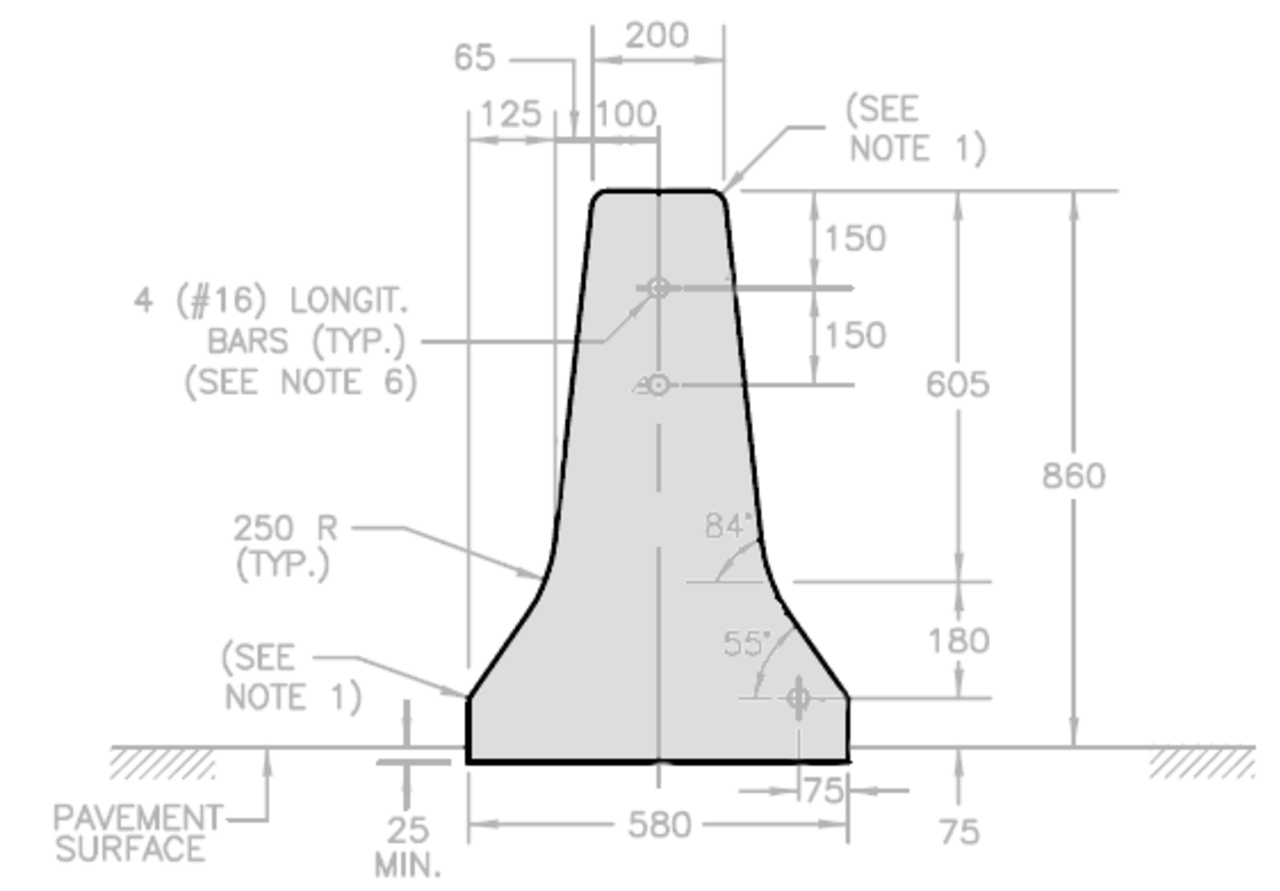
F-shape barrier
Genesis of the F-Shape
The F-shape barrier represents a significant advancement in passive traffic safety, emerging from a deliberate, data-driven design process. Unlike incremental improvements to existing designs, its conception was rooted in a comprehensive parametric study. This involved systematically varying geometric parameters of barrier profiles through sophisticated computer simulations.
The objective was to identify a design that offered enhanced safety performance over established standards, such as the ubiquitous Jersey barrier. The simulation labeled 'F' demonstrated superior results, indicating a potential for reduced vehicle excursion and improved occupant protection. Subsequent full-scale crash testing validated these computational findings, confirming the F-shape's efficacy and paving the way for its potential adoption.
The barrier's name is a direct legacy of this scientific methodology, a reminder that its identity stems from empirical validation rather than purely aesthetic or descriptive origins.
Aerodynamic and Kinematic Advantages
The superior performance of the F-shape barrier is primarily attributed to its refined geometry, particularly the height and placement of its critical 'slope break point.' Compared to the standard Jersey barrier, the F-shape features a lower slope break point, positioned at 255 mm (10.0 in) above the road surface, which is 75 mm (3.0 in) lower than its predecessor. This seemingly minor adjustment has profound implications for vehicle dynamics during an impact.
A lower break point reduces the tendency for the vehicle's front end to lift significantly upon contact. This minimized lift is crucial because it prevents the vehicle from becoming airborne or rolling over, thereby maintaining better tire contact with the road surface. This controlled redirection capability is a key factor in its enhanced safety profile, offering a more predictable and less violent interaction between the vehicle and the barrier.
Economic and Practical Considerations
Despite the demonstrable safety benefits of the F-shape barrier, its widespread adoption has faced practical and economic hurdles. The Jersey barrier, having been in use for decades, benefits from established manufacturing processes and significant industry investment in casting forms. Contractors possess the necessary equipment and expertise, making the transition to a new barrier profile a costly undertaking.
Furthermore, the Jersey barrier met existing crash-test criteria, meaning there was no immediate regulatory imperative to switch. The F-shape's design is closely related to the Jersey barrier, allowing for a relatively simple modification of existing forms. This adaptability is particularly relevant in contexts like asphalt resurfacing, where increased road height can inadvertently transform a Jersey barrier into a more F-shape-like configuration, enhancing safety for lighter vehicles.
However, this also highlights a trade-off, as increased asphalt layers can reduce the effective working height of the barrier, potentially diminishing its effectiveness for heavier vehicles.
Global Variations and Future Implications
The F-shape barrier's influence extends beyond its initial development. Regions like British Columbia have adopted variations, such as the Ministry of Transportation and Transit's Concrete Median Barrier, which, while based on the F-shape principles, may incorporate slightly different dimensions to suit local conditions or standards. The United Kingdom's concrete step barrier also shares conceptual similarities in its approach to vehicle redirection.
The ongoing evolution of barrier design underscores a continuous effort to balance safety, cost-effectiveness, and implementability. As vehicle technology advances and traffic volumes increase, the principles embodied by the F-shape barrier – precise geometric control to manage vehicle dynamics – will likely continue to inform the development of future traffic safety infrastructure, ensuring roads remain as safe as possible.
See also
Frequently Asked Questions
What is an F-shape barrier?+
How does the F-shape barrier keep cars safe?+
Why is the slope break point lower on the F-shape barrier?+
Are F-shape barriers used everywhere like Jersey barriers?+
How does the F-shape barrier help in road resurfacing?+
Based on content from Wikipedia · Licensed under CC BY-SA 4.0