

Electromagnetism: The Invisible Force!
Images
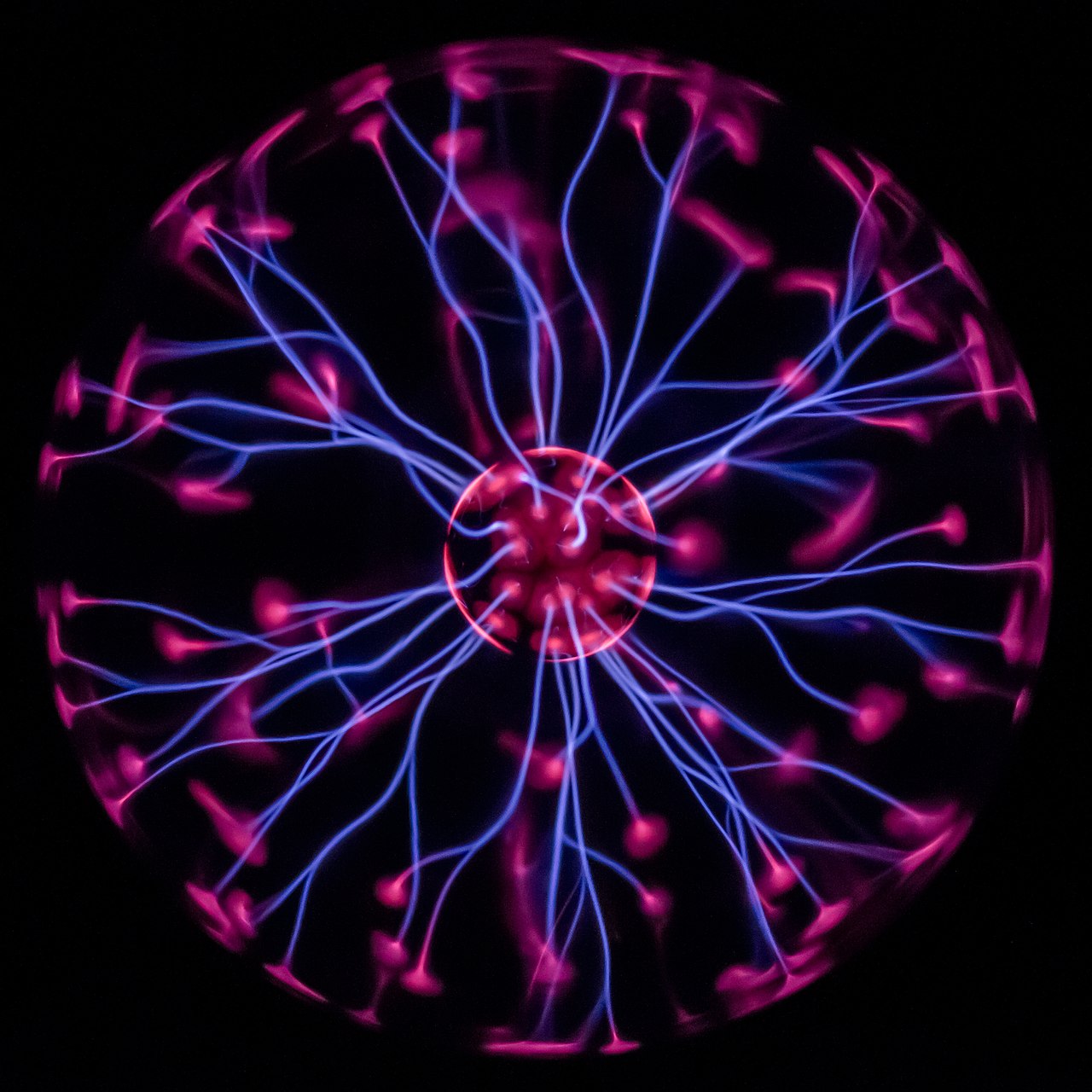
Electromagnetism


The Interplay of Electric Charges and Fields
Electromagnetism is one of the four fundamental forces of nature, describing the interaction between electrically charged particles via electromagnetic fields. This interaction is the dominant force governing the behavior of atoms and molecules, dictating their structure and how they bond. At its core, electromagnetism is a unification of electrostatics, which deals with stationary charges, and magnetism, which concerns moving charges.
Electric forces manifest as attraction between opposite charges and repulsion between like charges, governed by Coulomb's Law. Magnetic forces arise from the motion of charges, described by Ampère's force law. The Lorentz force law provides a comprehensive description of the force experienced by a charged particle in electromagnetic fields.
These fields are not merely descriptive but are dynamic entities that mediate the interaction, propagating at the speed of light.
A Historical Odyssey
The study of electromagnetism spans millennia, with ancient civilizations observing phenomena like static electricity and lodestone's magnetic properties. However, a rigorous scientific understanding began to emerge in the 18th century. Pioneers like Charles-Augustin de Coulomb quantified electrostatic forces, while Michael Faraday's experiments revealed the interconnectedness of electricity and magnetism, including electromagnetic induction.
The pivotal moment arrived in the 1860s with James Clerk Maxwell's formulation of a unified theory. His four partial differential equations elegantly described all known electromagnetic phenomena and, remarkably, predicted the existence of self-propagating electromagnetic waves. Maxwell's work demonstrated that light itself is an electromagnetic wave, a profound insight that laid the groundwork for modern physics and technology.
The Indispensable Role in Matter and Life
Electromagnetism is fundamental to the existence of matter as we know it. The electrostatic attraction between positively charged atomic nuclei and negatively charged electrons is what binds atoms together. These forces also enable atoms to form chemical bonds, creating molecules, including the complex macromolecules like proteins that form the basis of all life.
Beyond structural integrity, magnetic interactions involving electron spin and angular momentum play a crucial role in chemical reactivity, a field explored in spin chemistry. The ability of atoms and molecules to interact and form stable structures is entirely dependent on electromagnetic principles, making it the bedrock of chemistry, biology, and material science.
The Engine of Modern Civilization
The impact of electromagnetism on modern society is immeasurable. It is the driving force behind electrical energy production, transformation, and distribution, powering our homes and industries. It enables the creation and detection of light, heat, and sound, fundamental to our sensory experience and technological applications. Communication technologies, from fiber optics to wireless networks, rely entirely on electromagnetic waves.
Furthermore, electromagnetism is critical for countless devices and processes, including sensors, computation, electrolysis, electroplating, and the mechanical motors and actuators that perform work. It is the invisible infrastructure upon which much of our technological advancement is built.
Evolution and Future Frontiers
The classical theory of electromagnetism, as described by Maxwell's equations, has been continuously refined by modern physics. The relativistic nature of electromagnetic fields, where their description depends on the observer's motion, was a key inspiration for Albert Einstein's theory of special relativity in 1905. The development of quantum mechanics led to Quantum Electrodynamics (QED), which quantifies electromagnetic interactions.
In QED, electromagnetic force is mediated by photons, the quanta of light, and describes interactions as exchanges of these particles. This quantum view is essential for understanding phenomena at the atomic and subatomic levels, and ongoing research continues to explore the deeper connections between electromagnetism and other fundamental forces, pushing the boundaries of our understanding of the universe.
Go deeper
Frequently Asked Questions
What is electromagnetism?+
How does electromagnetism make lights work?+
Who proved that light is an electromagnetic wave?+
Why do magnets stick to metal?+
How does electromagnetism help us talk on phones or watch TV?+
Based on content from Wikipedia · Licensed under CC BY-SA 4.0