

Eisenstadt
Images

Thomas Steiner Eisenstadt


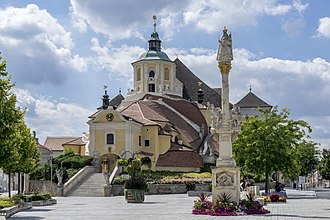
Geographical Context and Regional Significance
Eisenstadt's geographical positioning at the base of the Leitha Mountains is more than just picturesque; it situates the city within a transitional zone between the rolling Pannonian Basin and the Alpine foothills. This location has historically facilitated trade and cultural exchange. As the capital of Burgenland, Eisenstadt functions as the administrative nexus for a state known for its unique cultural blend, influenced by its proximity to Hungary and Slovenia.
The climate, characterized by continental influences with warm summers and cold winters, supports a diverse agricultural landscape in the surrounding region, which in turn impacts the local economy. The city's relatively compact size and the presence of the Leitha Mountains contribute to a distinct microclimate and a sense of enclosure, fostering a strong community identity.
A Tapestry of Empires
The historical narrative of Eisenstadt is deeply intertwined with the grand sweep of European empires. From 1648 to 1921, it was Kismarton, an integral part of the Kingdom of Hungary under the vast Habsburg dominion. This period was defined by its role as the primary residence and administrative center for the influential Eszterházy family.
Their patronage transformed Eisenstadt into a significant cultural hub, most notably attracting and supporting the composer Joseph Haydn. Haydn's tenure as Kapellmeister (music director) for the Eszterházy princes from 1761 to 1790 was a golden age, during which he composed a substantial portion of his oeuvre, including symphonies, operas, and chamber music, solidifying Eisenstadt's place in classical music history. The post-World War I redrawing of European borders led to the cession of Burgenland to Austria in 1921, culminating in Eisenstadt's designation as the state capital in 1925, marking a pivotal shift in its political and cultural allegiance.
Cultural Resonance
Eisenstadt's cultural identity is profoundly shaped by its historical association with the Eszterházy family and, consequently, with Joseph Haydn. The Esterházy Palace, a magnificent Baroque structure, stands as a testament to the family's wealth and influence, and it continues to be a focal point for cultural events, particularly concerts celebrating Haydn's music. This enduring musical legacy attracts scholars, musicians, and tourists, positioning Eisenstadt as a key destination on the classical music circuit.
Beyond music, the city preserves its historical architecture and traditions, reflecting a unique synthesis of Austrian and Hungarian influences. The population, while modest, engages in a variety of cultural activities, from local festivals to academic discourse, contributing to a dynamic yet intimate cultural scene that cherishes its heritage while embracing contemporary Austrian life.
The Engine of Governance and Education
As the capital of Burgenland, Eisenstadt serves as the primary seat of regional government, housing key administrative bodies responsible for public policy, social services, and infrastructure development across the state. This governmental function imbues the city with a sense of purpose and importance, attracting professionals in public administration and related fields. Furthermore, Eisenstadt has strategically cultivated its role as an educational center.
The presence of three higher education institutions-including the Burgenland University of Applied Sciences-underscores a commitment to fostering intellectual capital and specialized skills. These institutions not only provide advanced academic and vocational training but also contribute to the city's research landscape and economic diversification, preparing its populace for the demands of the modern workforce and contributing to the region's overall development.
Economic Landscape and Future Prospects
Eisenstadt's economy is characterized by a dual focus on public administration and specialized services, bolstered by its role as a regional capital. The public sector is a significant employer, providing stability and employment opportunities. Complementing this is a growing service industry, catering to the needs of the local population, students, and tourists drawn by its historical and cultural attractions, particularly the Esterházy Palace and Haydn's legacy.
While not a major industrial center, the surrounding Burgenland region benefits from agriculture and viticulture, with Eisenstadt serving as a commercial and logistical hub. The city's educational institutions also play an indirect economic role by training a skilled workforce and fostering innovation. Future economic development likely hinges on leveraging its unique cultural heritage, enhancing its appeal as a tourist destination, and further developing its higher education and research capabilities to attract specialized industries and talent.
Go deeper
Frequently Asked Questions
What is Eisenstadt?+
Where is Eisenstadt located?+
Why is Joseph Haydn important to Eisenstadt?+
What is the Esterházy Palace?+
What does Eisenstadt do for its people?+
Based on content from Wikipedia · Licensed under CC BY-SA 4.0