

Eddy Currents: Swirling Electricity!
Images

Eddy current




The Genesis of Eddy Currents
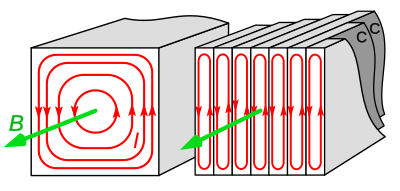
Eddy currents, also known as Foucault currents, are circulating electrical currents induced within a conductor by a changing magnetic field. This phenomenon is a direct consequence of Faraday's Law of Induction. When a conductor, typically a metallic object, is exposed to a time-varying magnetic flux, an electromotive force (EMF) is generated around closed paths within the conductor.
This EMF drives the flow of electric current, known as eddy currents. The magnitude of these currents is proportional to the rate of change of the magnetic flux and the conductivity of the material. The eddy currents, in turn, generate their own magnetic fields, which oppose the change in flux that created them, a principle described by Lenz's Law.
This opposition manifests as a retarding force, leading to braking effects, or as resistive heating (Joule heating) within the conductor due to the current flowing through its inherent resistance.
Historical Context
While Michael Faraday laid the foundational principles of electromagnetic induction, it was Léon Foucault who, in 1851, specifically identified and studied the circulating currents induced in metallic bodies. Foucault's experiments involved rotating metallic discs in magnetic fields, observing the significant drag forces and heating that occurred. He meticulously demonstrated that these effects were due to induced electrical currents within the disc itself, which he termed 'courants de Foucault' or eddy currents.
His work provided crucial experimental validation for Faraday's theories and highlighted the practical implications of electromagnetic induction. Foucault's meticulous measurements and clear explanations were instrumental in advancing the understanding of electromagnetism and its potential applications, paving the way for future technological innovations.
Transformative Applications
The ability of eddy currents to generate opposing forces and heat makes them invaluable in numerous technological applications. Electromagnetic brakes, widely used in high-speed trains, roller coasters, and industrial machinery, utilize eddy currents to provide smooth, contactless deceleration. Powerful electromagnets induce eddy currents in a conductive rotor or track, creating a magnetic drag that dissipates kinetic energy as heat.
In non-destructive testing (NDT), eddy current techniques are employed to detect surface and near-surface flaws, such as cracks, voids, and material degradation, in conductive materials like metals. By analyzing the impedance changes of a coil carrying eddy currents, inspectors can identify minute defects without damaging the component. Furthermore, induction heating, a cornerstone of modern manufacturing and cooking, relies on eddy currents to rapidly heat conductive materials for processes like forging, annealing, and, most familiarly, in induction cooktops.
Advanced Roles
Beyond braking and flaw detection, eddy currents serve critical roles in material characterization and advanced sensing. The frequency and amplitude of induced eddy currents are highly sensitive to the electrical conductivity, magnetic permeability, and geometry of the material being tested. This sensitivity allows for precise measurement of material properties, such as hardness, alloy composition, and heat treatment status.
In the realm of particle accelerators, eddy currents are sometimes deliberately generated in vacuum chambers to help control and shape particle beams. Researchers also explore eddy current phenomena in areas like magnetic levitation (maglev) systems, where controlled eddy currents can induce repulsive forces for levitation. The ongoing development of sophisticated eddy current probes and signal processing techniques continues to expand their utility in fields ranging from aerospace to automotive engineering and beyond.
See also
Frequently Asked Questions
What are eddy currents?+
How do eddy currents help stop moving trains?+
Why do eddy currents make metal hot?+
How do scientists use eddy currents to find cracks in metal?+
Who first discovered eddy currents and when?+
Based on content from Wikipedia · Licensed under CC BY-SA 4.0