

Earthquake
Images
Earthquake
The Mechanics of Earthquakes
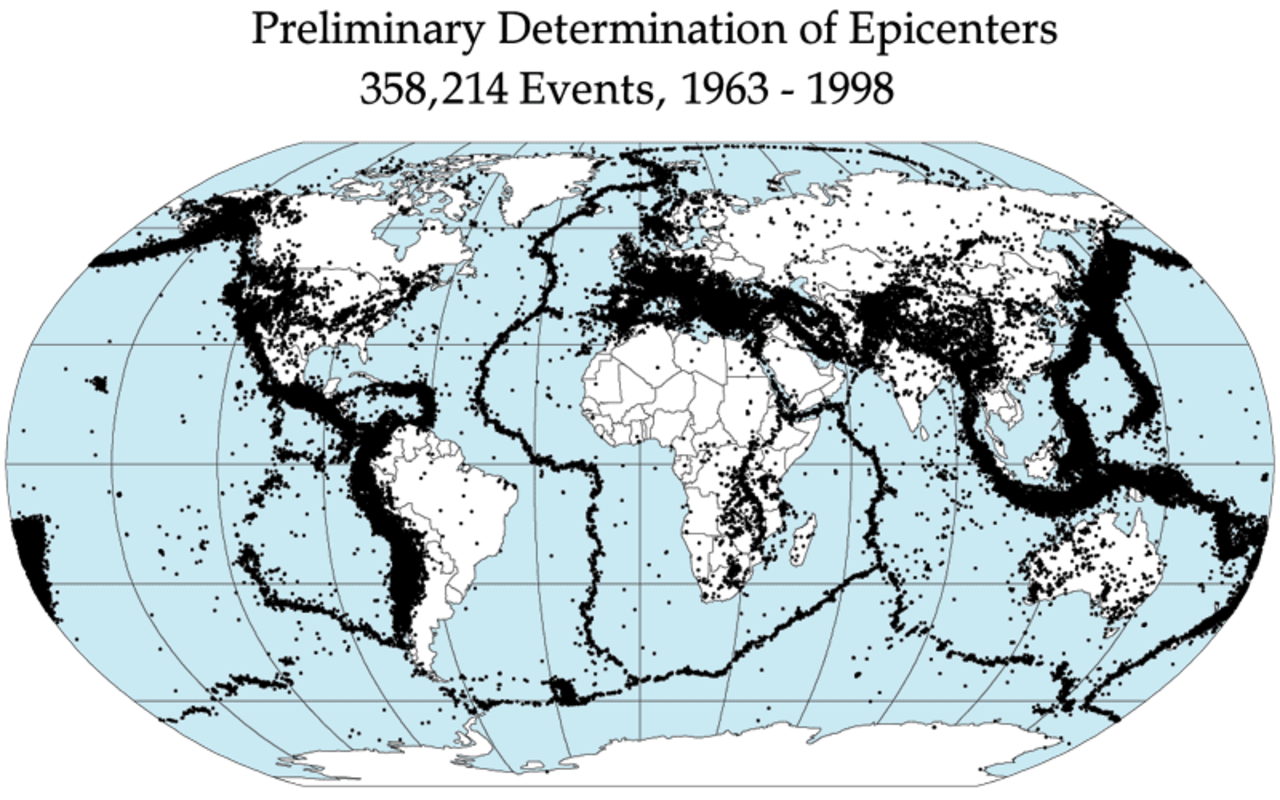
Earthquakes are fundamentally a consequence of the Earth's dynamic lithosphere, specifically the movement and interaction of tectonic plates. These plates, vast segments of the Earth's crust and upper mantle, are in constant motion, driven by convection currents in the mantle. Most earthquakes originate along geological faults, which are planar or curviplanar surfaces where one block of rock moves relative to another.
The primary cause is the sudden release of accumulated strain energy. As plates attempt to move past each other, friction can cause them to lock, leading to a buildup of elastic stress. When this stress exceeds the rock's strength or the friction holding the blocks together, a rupture occurs, propagating from the hypocenter (focus).
This rupture releases stored elastic energy in the form of seismic waves. These waves, including P-waves (compressional), S-waves (shear), surface waves (Love and Rayleigh), travel through and along the Earth's surface, causing ground motion. The magnitude of an earthquake is a measure of the energy released, often quantified by the Richter scale or the moment magnitude scale, which is more accurate for larger events.
The seismicity of a region refers to the frequency, type, and size of earthquakes experienced there.
A Chronicle of Cataclysm
The impact of earthquakes on human civilization is profound and stretches back millennia. Historically, they have been responsible for immense loss of life and the destruction of cities, shaping the course of empires and cultures. The 1556 Shaanxi earthquake in China stands as a stark reminder of their destructive potential, with an estimated death toll exceeding 830,000, likely exacerbated by widespread habitation in loess caves that collapsed.
The 1960 Valdivia earthquake in Chile, the largest ever recorded at magnitude 9.5, caused widespread devastation across South America and generated a trans-Pacific tsunami. Beyond direct destruction, earthquakes have influenced mythology, religious beliefs, and societal development, prompting the development of early warning systems and architectural adaptations. Studying historical seismic events provides invaluable data for understanding earthquake recurrence intervals and regional seismic hazards.
The Multifaceted Consequences of Seismic Events
The effects of earthquakes extend far beyond the immediate ground shaking. Ground shaking can lead to structural failure of buildings and infrastructure, posing a direct threat to human life. Soil liquefaction is another significant hazard, occurring in areas with loose, saturated sandy soils where the shaking causes the soil to lose its strength and behave like a liquid, leading to the sinking or tilting of structures. Earthquakes occurring beneath the ocean floor can displace large volumes of water, generating tsunamis – colossal waves that can travel across entire ocean basins and cause catastrophic coastal flooding.
Furthermore, seismic activity can trigger secondary geological hazards such as landslides and rockfalls, particularly in mountainous regions. The cumulative impact necessitates comprehensive risk management strategies, including seismic retrofitting of existing structures and advanced earthquake engineering for new constructions.
Induced Seismicity and Extraterrestrial Quakes
While most earthquakes are natural geological phenomena, human activities can also induce seismic events. Activities like deep mining, the injection of fluids into the Earth's crust (e.g., for hydraulic fracturing or geothermal energy extraction), and underground nuclear weapons testing can alter stress conditions and trigger earthquakes, often referred to as induced seismicity. Understanding these human-induced events is crucial for environmental safety and regulatory oversight.
Moreover, the study of seismology has extended beyond Earth. Instruments deployed on the Moon have detected moonquakes, and seismometers on Mars have recorded marsquakes. These extraterrestrial seismic events provide critical insights into the internal structure, thermal evolution, and geological activity of other celestial bodies, suggesting that the fundamental processes driving planetary geology are universal.
Go deeper
Frequently Asked Questions
What causes an earthquake?+
How do scientists measure how strong an earthquake is?+
Why do earthquakes sometimes make buildings fall?+
Can earthquakes create tsunamis?+
What are some ways people try to protect buildings from earthquakes?+
Based on content from Wikipedia · Licensed under CC BY-SA 4.0