

Down House
Images

upside down house


Domesticity and Discovery
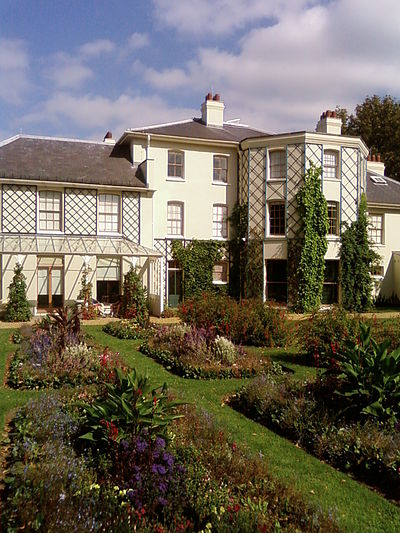
Relocating to Down House in 1842, Charles Darwin sought a deliberate retreat from the intellectual and social pressures of London, establishing a home that would become inextricably linked with his scientific legacy. This substantial country house, situated in the village then known as Down, provided not only a nurturing environment for his large family but also the essential space and tranquility required for sustained scientific inquiry.
For over forty years, Darwin transformed Down House and its extensive grounds into his primary research base. The property facilitated a unique synthesis of domestic life and groundbreaking scientific endeavor. His daily routines, including the famous 'sand walk' around the estate, were structured to allow for constant observation and contemplation of the natural world, integrating his family life with his profound intellectual pursuits.
This harmonious coexistence of personal and professional spheres within the same locale is a defining characteristic of Darwin's time at Down House.
The Intellectual Forge
While Darwin conceived the fundamental principles of evolution by natural selection prior to his move to Down House, it was within its walls and gardens that this revolutionary theory was rigorously developed, refined, and ultimately codified. His study at Down House became the nerve center for this monumental intellectual undertaking. Here, he meticulously organized his vast collections, conducted experiments on plant propagation and animal breeding, and engaged in extensive correspondence with a global network of scientists.
The house provided the intellectual infrastructure-the library, the specimens, the quiet spaces-necessary to transform his initial insights into a comprehensive scientific framework. The detailed observations made within the estate's gardens, from the behavior of earthworms to the variations in pigeon breeds, served as empirical anchors for his abstract theories, demonstrating the power of focused, long-term research conducted in a stable environment.
Dissemination and Legacy
Down House is indelibly associated with the publication of 'On the Origin of Species' in 1859, a work that fundamentally altered humanity's understanding of life. The meticulous research, extensive writing, and critical revisions that culminated in this seminal text were largely undertaken at Down House. The house facilitated Darwin's engagement with the scientific community, serving as a hub for visitors and correspondence that shaped the reception and ongoing development of his ideas.
Beyond this singular achievement, Down House remained Darwin's base for subsequent research into topics such as human evolution, plant movement, and the role of earthworms in soil formation, all of which were documented in numerous other books published during his tenure. The house thus represents not just the genesis of evolutionary theory but its continuous evolution under Darwin's prolific pen.
A Monument to Scientific Thought
Recognized as a UNESCO World Heritage site, Down House stands as a globally significant monument to scientific discovery and the history of evolutionary biology. Its preservation by English Heritage ensures that this crucial locus of scientific thought remains accessible for educational and research purposes. The restoration efforts have meticulously recreated the atmosphere of Darwin's time, allowing visitors to connect directly with the environment that fostered his genius.
This tangible link to Darwin's life and work is invaluable for understanding the scientific process and the profound impact of his contributions. Down House serves as a powerful reminder that major scientific advancements often arise from dedicated individuals working within supportive domestic and intellectual landscapes, making it a vital site for understanding the trajectory of modern science.
The Enduring Relevance of Down House
The significance of Down House extends far beyond its historical context. It continues to be a vital educational resource, illustrating the principles of scientific inquiry, the nature of evidence-based reasoning, and the long-term impact of groundbreaking theories. In an era increasingly concerned with biodiversity, conservation, and the interconnectedness of ecosystems, Darwin's work, developed at Down House, remains profoundly relevant.
The house offers a unique perspective on how meticulous observation and deep contemplation can lead to paradigm-shifting insights. It underscores the importance of preserving environments conducive to scientific thought and encourages a deeper appreciation for the natural world, a core tenet of Darwin's life and work. Down House is thus not merely a relic of the past but a living testament to the enduring power of scientific curiosity and intellectual perseverance.
See also
Frequently Asked Questions
What is Down House?+
Why did Charles Darwin move to Down House?+
How did Darwin use Down House to study evolution?+
When was "On the Origin of Species" published from Down House?+
Is Down House open to visitors today?+
Based on content from Wikipedia · Licensed under CC BY-SA 4.0