

The Amazing Cross!
Images
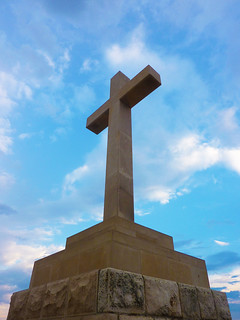
Cross


The Geometry of Meaning
The cross, fundamentally a geometric construct of two intersecting lines, typically perpendicular, possesses a remarkable capacity for symbolic representation. Its basic form, whether a standard Latin cross or an X-shaped saltire, has been a visual language across cultures for millennia. While its most prominent association today is with Christianity, its historical trajectory reveals a much broader application.
Pre-Christian societies in Europe and Western and Southern Asia utilized various cross forms as potent religious and cultural emblems. These early uses demonstrate that the cross's inherent structure lent itself to conveying fundamental concepts, making it a versatile signifier that could be readily adopted and reinterpreted by evolving belief systems. Its simplicity is its strength, allowing for deep and varied layers of meaning to be attached over time.
Ancient Roots
The cross's symbolic lineage predates its Christian identity significantly. In Ancient Egypt, the Ankh, a cross with a looped top, served as a hieroglyph representing 'life' and was integral to religious practices, particularly in the worship of deities like Aten. Furthermore, the Ankh was frequently depicted in conjunction with a circle or oval, symbolizing the sacred marriage or the union of divine masculine and feminine principles.
The Egyptian amulet known as the Nefer, featuring a cross and orb, exemplifies this, acting as an amulet of blessedness and a charm for sexual harmony. These ancient applications underscore the cross's early role in representing fundamental aspects of existence, fertility, and cosmic balance, establishing a rich symbolic foundation before its later Christian appropriation.
Christianity's Enduring Emblem
The cross's transformation into the preeminent symbol of Christianity marks a pivotal moment in its history. From an early stage in the religion's development, the cross became inextricably linked to the crucifixion of Jesus Christ. This event is central to Christian theology, representing ultimate sacrifice, atonement for sins, and the promise of resurrection and eternal life.
The widespread adoption and veneration of the cross by Christians-seen in churches, art, liturgy, and personal adornment-solidify its status as the faith's most recognizable and powerful emblem. Its enduring presence across the globe testifies to the profound impact of Christian beliefs on global culture and history, making it a symbol recognized by billions.
The Cross in Modern Context and Cultural Resonance
Beyond its religious significance, the cross continues to resonate in contemporary society. It appears in secular contexts, such as in the emblem of the Red Cross, symbolizing humanitarian aid and neutrality. Its geometric form is also referenced in art, design, and even scientific diagrams.
The historical depth of the cross, encompassing ancient fertility symbols, Egyptian life-givers, and the central tenet of Christianity, provides a rich tapestry for understanding human symbolism and belief systems. Its ability to transcend its original meanings and adapt to new contexts highlights the enduring power of simple forms to carry complex and profound messages across generations and cultures.
Go deeper
Frequently Asked Questions
What is a cross?+
Why did the cross become important in Christianity?+
How did people use the cross before Christianity?+
Where can we see the cross today besides churches?+
What does the cross symbolize for different cultures?+
Based on content from Wikipedia · Licensed under CC BY-SA 4.0