

Classical Mechanics: How Things Move!
Images
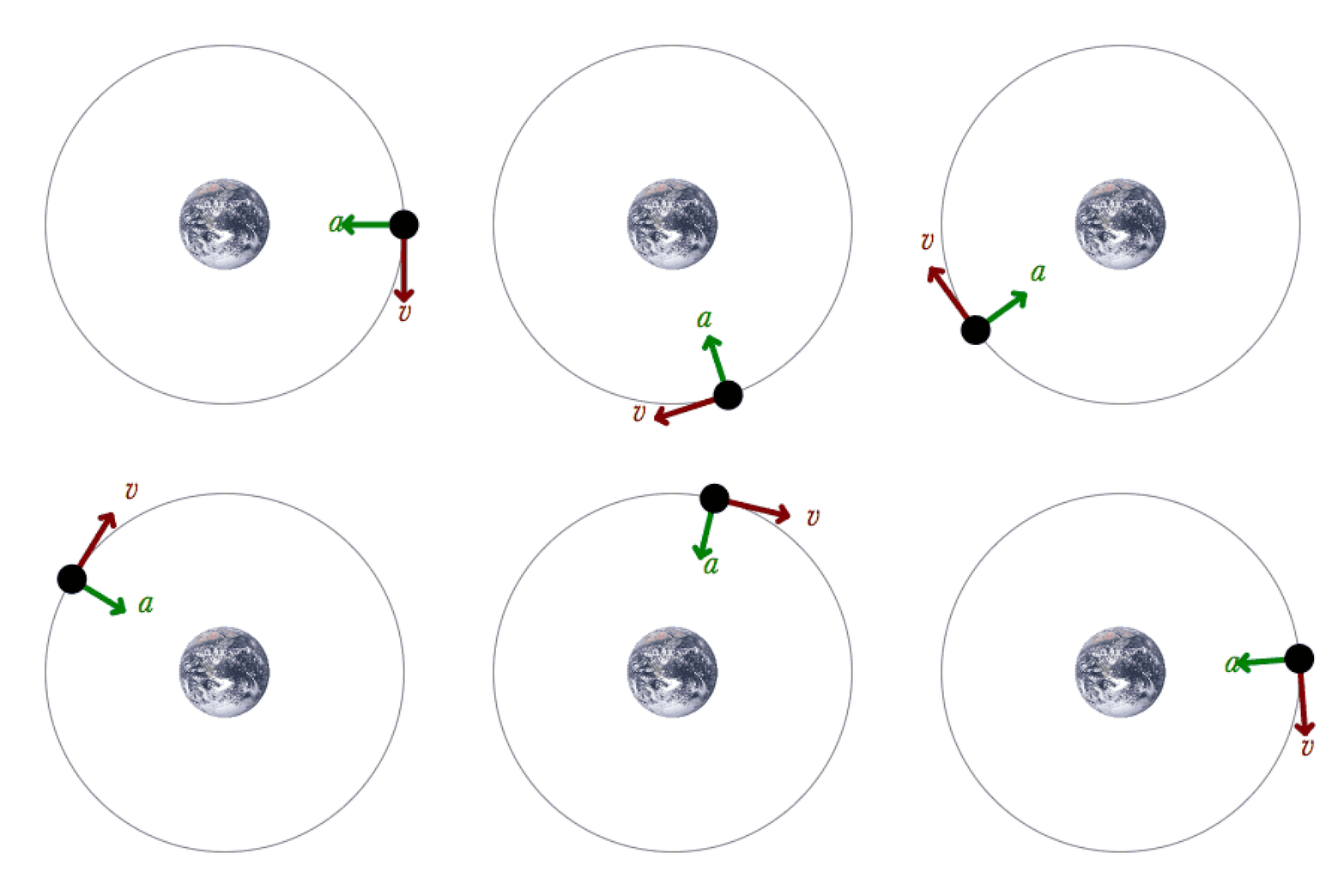
Classical mechanics


The Newtonian Paradigm
Classical mechanics, often referred to as Newtonian mechanics, provides a comprehensive framework for understanding the motion of objects at macroscopic scales. It is built upon a set of fundamental laws that describe the relationship between forces and motion. At its core, it posits a deterministic universe where, given the initial conditions (position and velocity) of a system and all the forces acting upon it, its future state can be precisely calculated.
This deterministic nature was a profound philosophical shift, suggesting a clockwork universe governed by immutable laws. It encompasses concepts like inertia, momentum, energy, and work, providing a unified language to describe phenomena ranging from the simple fall of an apple to the complex orbits of planets and stars.
The Genesis of Classical Mechanics
The study of motion has a long history, with early ideas attributed to philosophers like Aristotle, who proposed that objects naturally sought their resting state and that continuous force was needed to maintain motion. This view persisted for centuries until thinkers like Galileo Galilei began to challenge it through experimentation, introducing concepts like inertia. However, it was Isaac Newton who synthesized these ideas and formulated his three laws of motion and the law of universal gravitation in his seminal work, 'Principia Mathematica' (1687).
These laws provided a powerful, unified mathematical description of both terrestrial and celestial mechanics, resolving long-standing questions about planetary orbits and establishing a new era in physics.
The Enduring Significance and Practical Applications
Classical mechanics remains profoundly significant, not only as a historical cornerstone of physics but also as an indispensable tool for modern engineering and technology. Its principles are fundamental to the design and analysis of mechanical systems, including vehicles, aircraft, and spacecraft. The development of sophisticated simulations for everything from car crash tests to weather patterns relies heavily on classical mechanics.
Furthermore, it serves as the essential pedagogical foundation for more advanced physics, such as quantum mechanics and relativity, which are necessary to describe phenomena at very small or very high speeds and energies. Understanding classical mechanics is crucial for comprehending the behavior of the physical world at scales we experience daily.
Illustrative Principles
Consider the motion of a projectile, like a thrown baseball. Classical mechanics allows us to calculate its trajectory by considering the initial velocity, the angle of projection, and the constant downward acceleration due to gravity. The concept of conservation of energy is also central; the total energy of a system, which is the sum of its kinetic (energy of motion) and potential (stored energy) energy, remains constant if no external forces do work.
For instance, as a pendulum swings, its potential energy at the highest point is converted into kinetic energy at the lowest point, and vice versa, with the total energy remaining unchanged in an ideal scenario. These principles are applied in designing everything from amusement park rides to the mechanics of musical instruments.
Beyond Newton
While Newton's laws are incredibly powerful, the field evolved with the development of more abstract and generalized formulations, known as analytical mechanics. This includes Lagrangian and Hamiltonian mechanics, which use scalar quantities (energy) rather than vector quantities (force) to describe motion. These approaches are particularly useful for complex systems with many degrees of freedom and are essential for understanding advanced topics in physics and engineering, including the behavior of fields and the transition to quantum mechanics.
They offer alternative, often more elegant, mathematical pathways to solve problems that might be intractable with Newtonian methods alone.
Go deeper
Frequently Asked Questions
What is classical mechanics?+
Why do planets orbit the Sun?+
How does a ball roll when you push it?+
What is inertia?+
Why does a pendulum swing back and forth?+
Based on content from Wikipedia · Licensed under CC BY-SA 4.0