

Catalan Vault
Images

Barcelona Sagrada Familia


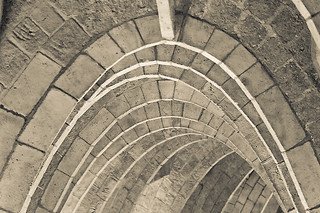


The Genesis and Evolution of the Thin-Tile Vault
The Catalan vault, or 'volta catalana', represents a sophisticated evolution of ancient Roman vaulting techniques, adapted and refined over centuries. While its origins are rooted in the broader Mediterranean architectural tradition, it became particularly prominent and synonymous with Catalonia, Spain, due to its widespread adoption and innovative application in the region. The defining characteristic of this construction method is its 'timbrel vault' or 'thin-tile' approach.
Unlike traditional vaults that rely on heavy centering for support during construction, the Catalan vault's initial layer of lightweight bricks is laid lengthwise, spanning the void. These bricks, often referred to as 'timbrels' due to their thinness and shape, are set in a thin bed of mortar. Once this first layer cures sufficiently, it gains enough structural integrity to support subsequent layers, allowing the vault to be built up incrementally without extensive temporary scaffolding.
This method significantly reduces material usage and construction time, offering a highly efficient and economical solution for creating vaulted ceilings and floors.
Structural Ingenuity and Aesthetic Versatility
The structural brilliance of the Catalan vault lies in its ability to distribute loads effectively through its shallow, parabolic-like curve. This gentle arc, a departure from the deeper, more imposing curves of Gothic or Romanesque vaults, allows for a lighter overall structure while maintaining significant load-bearing capacity. This makes it an ideal solution for creating intermediate floors in buildings, effectively serving as both a ceiling and a structural floor.
The aesthetic potential of the Catalan vault is equally compelling. Its relatively flat profile can create a sense of openness and spaciousness in interior environments. Furthermore, its construction lends itself to decorative finishes, allowing for intricate patterns or integration with other architectural elements.
The work of pioneering Catalan architects such as Antoni Gaudí and Josep Puig i Cadafalch, and the Valencian architect Rafael Guastavino, who championed this technique internationally, demonstrated its adaptability and aesthetic appeal, integrating it into iconic structures that blend functionality with artistic expression.
Dissemination and Enduring Legacy
The Catalan vault's journey is a testament to the power of architectural innovation to transcend geographical boundaries. While deeply embedded in the vernacular architecture of Catalonia and other Mediterranean regions, its principles were carried across continents by skilled architects and builders. A significant chapter in its global dissemination occurred with its introduction to New Spain (colonial Mexico).
Here, the technique was adopted and adapted, continuing to be a viable construction method in parts of contemporary Mexico. This enduring presence highlights the practicality and robustness of the Catalan vault. The very fact that its stability has been a subject of formal study, with research preserved in archives like that of the Institute of Catalan Studies, underscores its recognized architectural and engineering merit.
The term 'Catalan vault' itself, formalized in 1904, signifies its distinct identity and the recognition of its unique contribution to architectural history.
Comparative Analysis and Construction Mechanics
To fully appreciate the Catalan vault, it is useful to compare it with other vaulting systems. Unlike barrel vaults or groin vaults, which often require substantial centering for their entire span during construction, the Catalan vault's method of building in successive layers, with each layer providing support for the next, is revolutionary. The 'timbrel' brick, typically thin and made of fired clay, is crucial.
Its lightness and shape allow for easy manipulation and placement without the need for heavy formwork. The mortar acts as both a bonding agent and a thin, continuous support layer. This technique is fundamentally different from the voussoir construction common in many other arches and vaults, where individual wedge-shaped stones or bricks are precisely cut and assembled.
The Catalan vault's success relies on the cumulative strength of multiple thin layers rather than the precise geometry of individual structural elements. This makes it particularly well-suited for areas where skilled masonry might be less available or where rapid construction is a priority.
The Catalan Vault in Modern Context and Related Disciplines
While often associated with historical architecture, the principles of the Catalan vault remain relevant in contemporary construction, particularly in heritage restoration and in architectural designs that seek to evoke historical styles or prioritize sustainable building practices. Its efficiency in material use and reduced reliance on complex formwork align with modern construction's focus on sustainability and cost-effectiveness. Furthermore, the study of the Catalan vault intersects with several academic disciplines.
Structural engineering analyzes its load-bearing capabilities and stress distribution. Architectural history traces its development and influence. Materials science examines the properties of the bricks and mortars used.
The ongoing interest in this construction method, evidenced by its continued study and application, solidifies its status not just as a historical artifact but as a living architectural innovation with lasting significance.
See also
Frequently Asked Questions
What is a Catalan vault?+
How does a Catalan vault stay strong without big scaffolding?+
Why is it called a "thin-tile" or "timbrel" vault?+
Where did the Catalan vault start and where is it used now?+
Who are some famous architects that liked the Catalan vault?+
Based on content from Wikipedia · Licensed under CC BY-SA 4.0