

Calculator
Images

Calculator


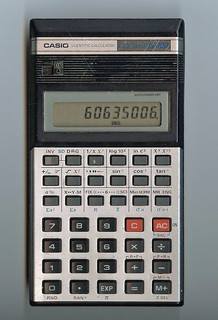


From Mechanical Gears to Silicon Chips
The quest for automated calculation predates the electronic age by centuries. Early mechanical calculators, such as Wilhelm Schickard's 'Calculating Clock' (c. 1623) and Blaise Pascal's 'Pascaline' (1642), were ingenious devices employing gears, levers, and ratchets to perform arithmetic. These machines, while groundbreaking, were complex, expensive, and prone to mechanical failure.
The development of electromechanical calculators in the late 19th and early 20th centuries, using electric motors to drive mechanical components, offered incremental improvements. The true revolution began with the advent of electronics. Early electronic calculators, emerging in the 1950s and 60s, utilized vacuum tubes and later transistors.
These were often room-sized, power-hungry, and prohibitively expensive, primarily used by large corporations and government agencies. The pivotal moment was the development of the integrated circuit (IC) in the late 1950s and its subsequent miniaturization. This allowed for the creation of compact, affordable, and powerful electronic calculators.
By the 1970s, pocket calculators became commonplace, fundamentally altering how individuals interacted with mathematics and computation.
The Algorithmic Engine
At the heart of every electronic calculator lies a specialized microprocessor, essentially a single-chip computer. This processor executes a series of algorithms-predefined computational procedures-to perform mathematical operations. Input from the keypad, which consists of switches that complete electrical circuits when pressed, is converted into binary signals. These signals are interpreted by the processor according to its internal logic gates and instruction set.
For basic arithmetic, algorithms like addition via binary full adders are employed. More complex functions, such as trigonometric calculations or logarithms, rely on sophisticated numerical methods like Taylor series expansions or lookup tables stored in the calculator's memory. The output is then processed by a display driver, which translates the binary results into the alphanumeric characters seen on the LCD or LED screen.
The efficiency and speed of these algorithms, coupled with advancements in semiconductor technology, enable calculators to perform calculations that would be exceedingly time-consuming or impractical by hand.
Ubiquitous Utility
The calculator's impact extends far beyond academic settings. In science and engineering, precise and rapid calculation is non-negotiable for research, design, and analysis. From simulating complex physical phenomena to calculating structural loads, calculators and their descendants (computers) are indispensable tools.
In finance, they facilitate everything from stock market analysis to personal budgeting, enabling informed economic decisions. Educationally, calculators have democratized mathematical understanding. While concerns about over-reliance exist, they allow students to explore higher-level concepts and engage with more complex problems without being bogged down by manual computation.
Furthermore, the development of calculators spurred innovation in microelectronics and computer science, laying the foundational technologies for the digital revolution, including personal computers and smartphones. They represent a critical step in humanity's ongoing endeavor to augment cognitive abilities through technology.
A Spectrum of Calculation
The calculator landscape is diverse, catering to a wide array of user needs. Basic four-function calculators handle fundamental arithmetic operations and are prevalent in general office environments and for simple personal use. Scientific calculators offer an extensive range of functions, including logarithms, exponentials, trigonometric functions, and statistical analysis, making them essential for secondary and tertiary education in STEM fields.
Graphing calculators represent a significant advancement, capable of plotting functions, solving equations graphically, and performing matrix operations, often used in advanced mathematics and physics courses. Programmable calculators allow users to write and store custom programs, extending their functionality. Financial calculators are specialized for business and investment calculations, featuring functions for loan amortization, interest rates, and cash flow analysis.
The integration of calculator functionality into smartphones and computers via software applications has further broadened accessibility, blurring the lines between dedicated devices and general-purpose computing platforms.
Go deeper
Frequently Asked Questions
What is a calculator and how does it help us with math?+
How did calculators change from old machines to the ones we use today?+
Why are calculators important for science and money?+
How does a calculator turn our button presses into numbers on the screen?+
Are there any tricks that make calculators work faster?+
Based on content from Wikipedia · Licensed under CC BY-SA 4.0