

Boltzmann Constant
Images

Boltzmann2




The Statistical Foundation of Temperature
The Boltzmann constant (k_B) is a fundamental constant of nature that bridges the microscopic world of particles and the macroscopic world of observable temperature. It serves as the proportionality factor in the equipartition theorem, which states that, in thermal equilibrium, each degree of freedom of a system contributes, on average, 1/2 k_B T to its total energy, where T is the absolute temperature. This means k_B directly quantifies the average thermal energy per particle per degree of freedom.
Its incredibly small value, precisely defined as 1.380649 × 10^-23 joules per kelvin, reflects the vast number of particles in macroscopic systems and the minuscule energy associated with individual particle motion at a given temperature. This constant is the cornerstone of statistical mechanics, providing the mathematical link between the statistical behavior of large ensembles of particles and the thermodynamic properties we observe.
Defining the Kelvin and Beyond
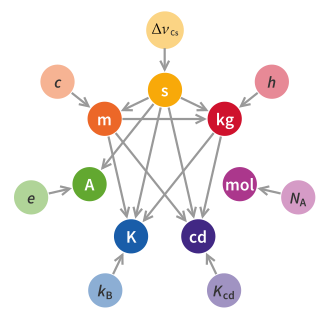
In a landmark 2019 revision of the International System of Units (SI), the Boltzmann constant was elevated to the status of a 'defining constant.' This means its value is now fixed exactly, and it is used to define the SI base unit of thermodynamic temperature, the kelvin. Previously, the kelvin was defined based on the triple point of water. Now, the kelvin is defined such that when the Boltzmann constant is set to its exact value, the temperature of the triple point of water is 273.16 K.
This redefinition ensures that the kelvin is based on fundamental physical constants, enhancing the stability and universality of temperature measurements. Beyond defining the kelvin, k_B is crucial in Planck's law for black-body radiation, Boltzmann's entropy formula (S = k_B ln W), and in calculating thermal noise in electronic components.
Historical Context and Conceptual Evolution
The conceptualization of the Boltzmann constant is deeply intertwined with the development of statistical mechanics by Ludwig Boltzmann in the late 19th century. Boltzmann's groundbreaking work established the kinetic theory of gases and proposed that temperature is a measure of the average kinetic energy of the constituent particles. He introduced the concept of entropy as a measure of the number of microstates (W) corresponding to a given macrostate, linking it to probability through the formula S = k_B ln W.
This formula revealed that k_B is the factor that converts the dimensionless logarithm of probability into a quantity with units of energy per temperature, akin to entropy. Initially, k_B was an experimentally determined value, but its fundamental importance led to its exact definition in the modern SI system, solidifying its role as a universal constant.
Applications and Implications in Modern Science
The Boltzmann constant finds ubiquitous application across diverse scientific disciplines. In solid-state physics, it governs the behavior of electrons in semiconductors and the thermal vibrations of crystal lattices. In astrophysics, it's essential for understanding the temperature and energy distribution in stellar atmospheres and interstellar gas clouds.
In biophysics, it plays a role in modeling molecular interactions and diffusion processes. Furthermore, the constant is critical in fields like information theory and cosmology. Its precise value and role in relating energy to temperature underscore its status as one of the most important physical constants, enabling quantitative predictions and deeper understanding of physical phenomena from the quantum realm to the cosmic scale.
Go deeper
Frequently Asked Questions
What is the Boltzmann constant?+
Why do scientists use the Boltzmann constant?+
How does the Boltzmann constant help us understand heat?+
Where is the Boltzmann constant used in everyday science?+
When did the Boltzmann constant become a defining constant?+
Based on content from Wikipedia · Licensed under CC BY-SA 4.0