

Bellcrank
Images
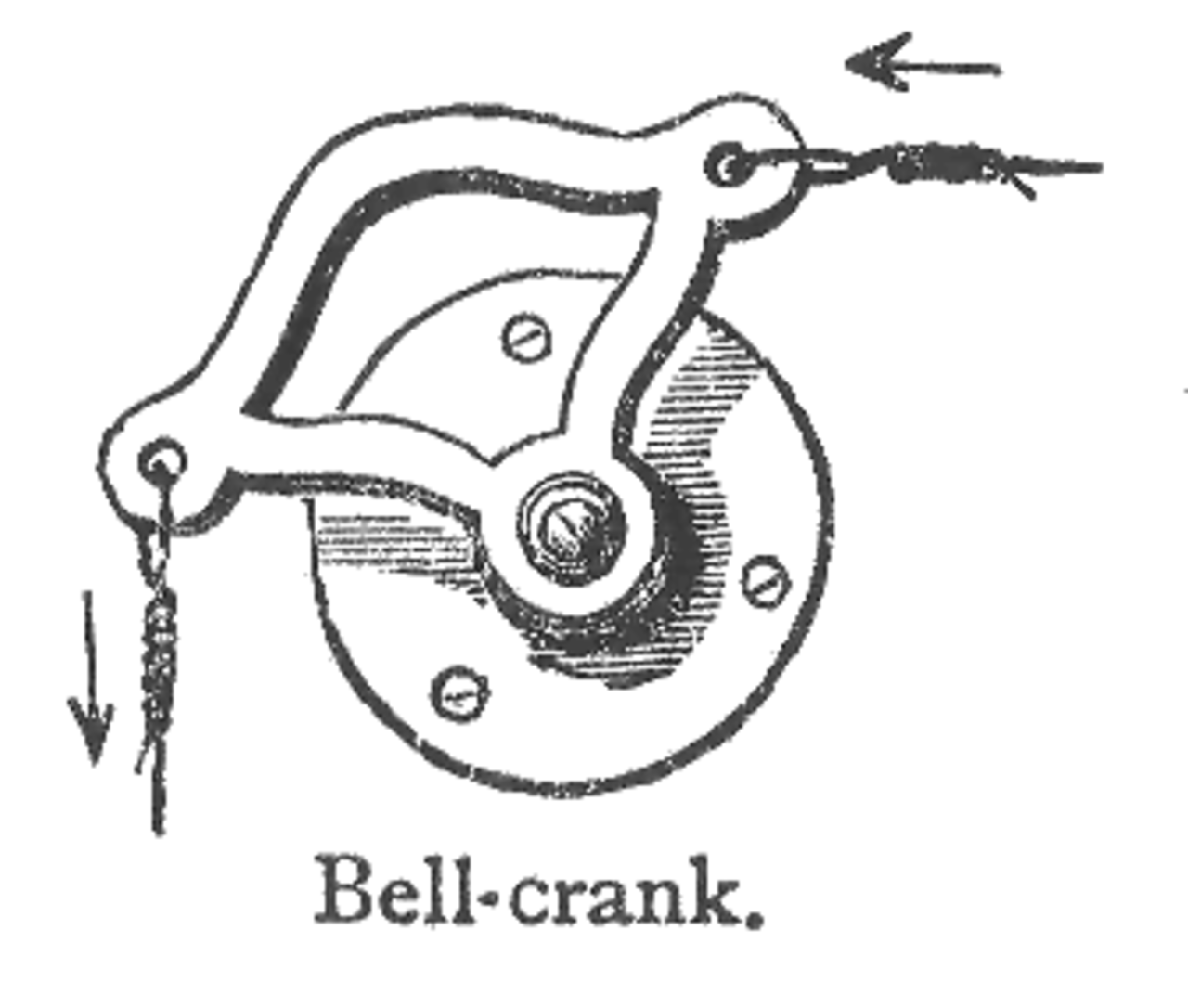
Bellcrank


The Bellcrank
The bellcrank stands as a fundamental element in mechanical engineering, characterized by its ability to alter the direction of applied force through an angular displacement. Functionally, it is a specific type of lever system where the input and output motions are not collinear. The defining feature is its central pivot, or fulcrum, around which rotation occurs.
This rotation translates an input force applied to one arm into an output force acting on the second arm, but at a predetermined angle. While bellcranks can theoretically achieve any angular change from 0 to 360 degrees, the most prevalent configurations are the 90-degree (orthogonal) and 180-degree (reversing) bellcranks. These specific angles are highly practical for converting linear motion into perpendicular linear motion or for reversing the direction of a force, respectively.
The design and application of bellcranks are crucial for creating efficient and effective mechanical linkages, enabling complex movements from simple inputs.
From Ancient Bells to Modern Mechanisms
The nomenclature 'bellcrank' directly references its historical genesis. Its earliest documented and most intuitive application was in the mechanism for sounding bells. Prior to its widespread adoption, striking a bell might have involved cumbersome direct pulls or pushes.
The bellcrank revolutionized this by allowing a vertical force, such as pulling a rope downwards, to be converted into a horizontal force that effectively struck the bell's clapper. This innovation not only simplified operation but also optimized the force applied, leading to a more resonant and consistent sound. This foundational use exemplifies how a simple mechanical advantage, when applied thoughtfully, can solve practical challenges and lay the groundwork for more sophisticated mechanical systems that would emerge over centuries of technological development.
The Indispensable Role of Bellcranks in System Dynamics and Control
The profound significance of the bellcrank lies in its capacity to facilitate indirect force transmission and directional control within mechanical systems. In an era where precision and efficiency are paramount, bellcranks provide engineers with a versatile tool to manage and redirect forces. Consider the ubiquitous bicycle brake: a rider's lever action is translated by a bellcrank into the precise force required to engage the brake pads with the wheel rim, a critical function for safety and control.
Beyond this common example, bellcranks are integral to automotive steering columns, throttle linkages, aircraft flight control surfaces (like ailerons and elevators), and various industrial automation systems. Their ability to decouple input and output directions allows for optimized ergonomic design and functional complexity, making them essential components in a vast spectrum of modern engineering applications.
Deconstructing the Bellcrank
The operational principle of a bellcrank is rooted in the fundamental laws of statics and dynamics, specifically leverage and rotational motion. A typical bellcrank comprises two arms joined at a central pivot. When a force is applied to one arm, it generates a torque around the fulcrum, causing angular acceleration.
This rotation then imparts a force on the second arm. The relationship between the input and output forces, and their directions, is governed by the geometry of the bellcrank-specifically, the lengths of the arms and the angle between them. For a 90-degree bellcrank, the input force vector is transformed into an output force vector perpendicular to it.
If the arms are of equal length, the magnitude of the force is theoretically conserved (ignoring friction), but its direction is altered. This kinematic transformation is predictable and controllable, allowing for precise mechanical design.
Ubiquitous Applications
The pervasive nature of the bellcrank is a testament to its utility across a broad range of mechanical disciplines. In automotive engineering, they are critical for steering mechanisms, enabling the conversion of steering wheel rotation into wheel articulation, and in throttle or clutch linkages. Aviation relies heavily on bellcranks for actuating control surfaces, translating pilot inputs into precise movements of ailerons, elevators, and rudders, thereby influencing flight dynamics.
In robotics, bellcranks are employed to create complex articulated joints and end-effector movements. They also feature in industrial machinery for material handling, manufacturing processes, and power transmission systems. Even in consumer electronics and appliances, bellcranks can be found, demonstrating their adaptability and enduring relevance in translating simple inputs into functional outputs across the technological landscape.
See also
Frequently Asked Questions
What is a bellcrank?+
How does a bellcrank change the direction of force?+
Why were bellcranks used to ring bells?+
Where can we see bellcranks in everyday life?+
What angles are most common for bellcranks and why?+
Based on content from Wikipedia · Licensed under CC BY-SA 4.0