

Barometer: The Amazing Air Pressure Finder!
Images
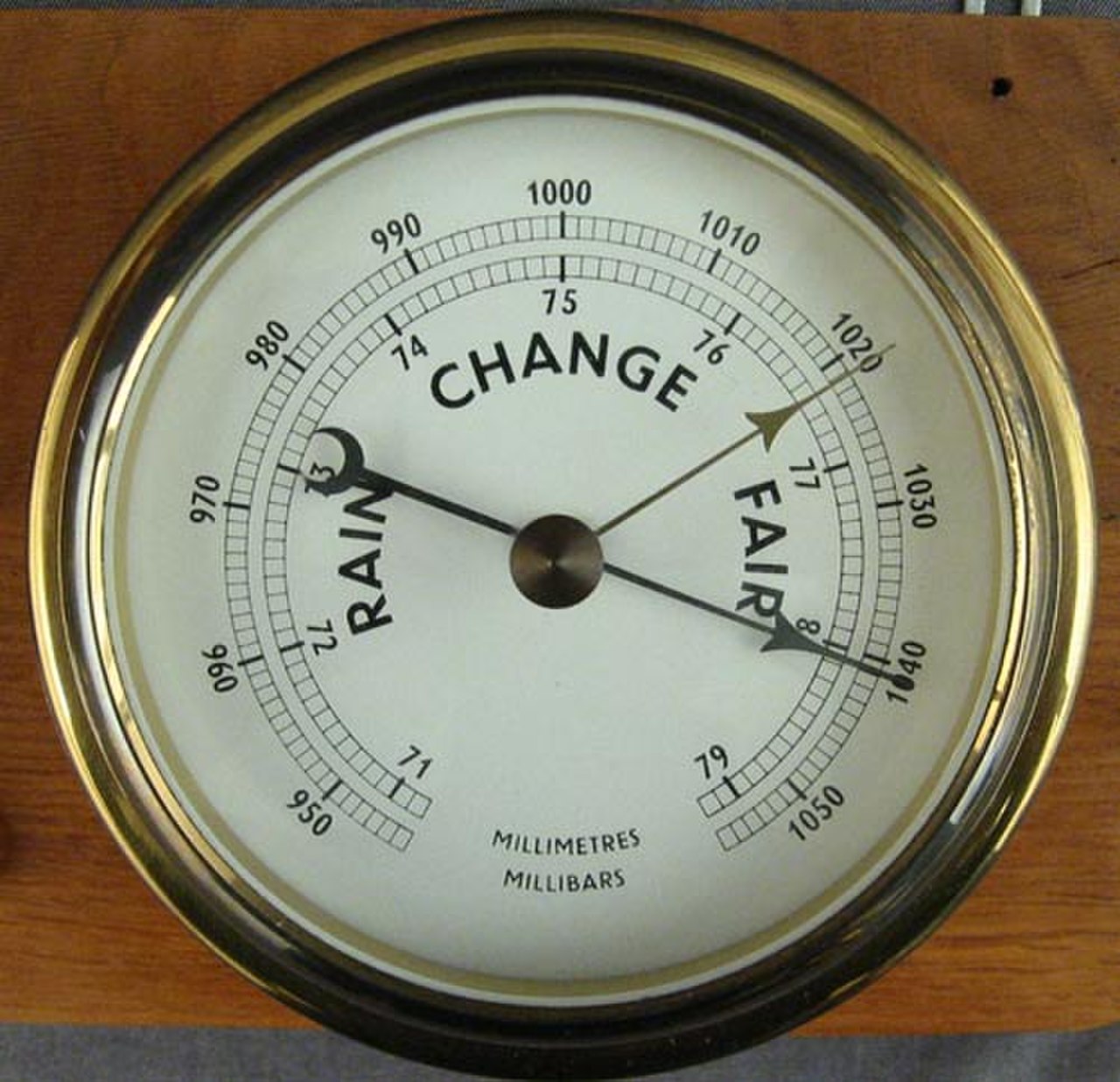
Barometer


The Unseen Weight
Atmospheric pressure is the force exerted by the weight of the air column above a given point on the Earth's surface. This pressure is not static; it fluctuates due to variations in air temperature, humidity, and the movement of air masses. These fluctuations are fundamental to weather patterns.
High-pressure systems are generally associated with stable, clear weather, as air sinks and warms, inhibiting cloud formation. Conversely, low-pressure systems, where air rises and cools, often lead to cloud development, precipitation, and storms. Barometers are the instruments that quantify these subtle yet critical shifts in atmospheric pressure, providing the foundational data for meteorological analysis and forecasting.
Understanding these dynamics is key to comprehending weather systems on a global scale.
Torricelli's Legacy
The invention of the barometer is credited to Evangelista Torricelli in 1643, a student of Galileo Galilei. Torricelli's curiosity was piqued by the limitations of water pumps, which could not lift water beyond a certain height. Through experimentation, he deduced that the height of the water column was limited by the pressure of the atmosphere pushing down on the water's surface.
He then devised his famous mercury barometer: a glass tube, about a meter long, sealed at one end, filled with mercury, and inverted into a dish of mercury. The mercury in the tube fell, leaving a vacuum at the top (the Torricellian vacuum), and its height above the mercury in the dish was directly proportional to the atmospheric pressure. This ingenious device not only measured pressure but also demonstrated the existence of a vacuum, a concept that challenged prevailing scientific thought.
The Indispensable Role of Barometers in Science and Society
The barometer's impact on science and society is profound and far-reaching. Historically, it revolutionized meteorology, transforming weather observation from mere description to quantitative prediction. This enabled mariners to navigate oceans with greater safety, avoiding treacherous storms.
In aviation, barometric pressure is crucial for altimetry, allowing aircraft to determine their altitude. Beyond these critical applications, barometers are vital tools in scientific research, from studying climate change to understanding atmospheric physics. They are integrated into weather stations globally, feeding data into sophisticated computer models that forecast weather patterns days and weeks in advance.
The ability to measure and interpret air pressure changes empowers us to prepare for and mitigate the impacts of severe weather events.
Mechanisms of Measurement
Barometers operate on distinct principles. The mercury barometer, while historically significant, is less common today due to the toxicity of mercury and its fragility. Its operation relies on the hydrostatic balance between the mercury column and the atmospheric pressure.
The aneroid barometer, developed later, is more prevalent. It utilizes a small, flexible, sealed metal capsule (an aneroid cell) from which most of the air has been removed. Changes in external atmospheric pressure cause the cell to expand or contract.
These minute movements are mechanically amplified by a system of levers and springs, moving a pointer across a calibrated dial. Modern advancements have led to digital barometers, which employ electronic sensors, such as piezoresistive or capacitive sensors, to detect pressure changes and convert them into digital readouts, often integrated into portable electronic devices.
Contemporary Relevance and Future Trajectories
In the 21st century, barometers remain indispensable. They are integral components of automated weather stations, providing continuous data streams essential for numerical weather prediction models. Their role in altimetry for aircraft and even in consumer electronics, such as smartphones and smartwatches, underscores their versatility.
These devices use barometric data to enhance GPS accuracy by providing altitude information and to offer local weather trend predictions. Research continues into more sensitive and robust pressure-sensing technologies. The ongoing study of atmospheric pressure dynamics is also critical for understanding complex phenomena like El Niño and other climate oscillations.
As our planet's climate continues to evolve, the precise measurement and interpretation of atmospheric pressure, facilitated by barometers, will remain a cornerstone of environmental science and disaster preparedness.
Go deeper
Frequently Asked Questions
What is a barometer and how does it find air pressure?+
How did the first barometer work?+
Why do high and low pressure systems make different weather?+
What is an aneroid barometer and why is it common today?+
How do barometers help sailors and pilots?+
Based on content from Wikipedia · Licensed under CC BY-SA 4.0