

Barbed Wire: The Prickly Protector!
Images

underwear on barbed wire





The Genesis of Barbed Wire
The invention of barbed wire in the latter half of the 19th century was a pivotal moment in agricultural and industrial history. While early concepts existed, Lucien B. Smith's 1867 patent laid foundational groundwork, but it was Joseph F.
Glidden's refined design in 1874 that truly revolutionized its utility and mass production. Glidden's innovation involved a more efficient method of attaching sharp points (barbs) to the wire, making it both effective and economical to manufacture. This technological leap occurred during a period of rapid westward expansion in the United States, where the need for affordable and efficient fencing was paramount.
Prior to barbed wire, enclosing large tracts of land was prohibitively expensive, relying on labor-intensive methods like planting Osage orange hedges or using scarce lumber. The advent of barbed wire dramatically lowered the barrier to entry for land ownership and management, fundamentally altering land use patterns and agricultural practices.
Transforming Landscapes
The widespread adoption of barbed wire had profound economic and social consequences, particularly in the American West. It enabled the privatization and enclosure of vast open ranges, which had previously been used communally for grazing. This shift facilitated the rise of large-scale cattle ranching and intensive farming by allowing ranchers and farmers to control their livestock and protect their crops more effectively.
The cost savings were immense; for instance, fencing 2,500 acres with wood in 1872 cost nearly $4,000, a sum that barbed wire could achieve for a fraction of the price. This economic democratization of fencing allowed smaller farmers to compete and contributed to the decline of the open-range cowboy era. However, it also led to significant land disputes and 'range wars' as established grazing rights clashed with new fencing practices.
The very nature of frontier life and land management was irrevocably reshaped by this simple yet powerful invention.
The Mechanics of Containment
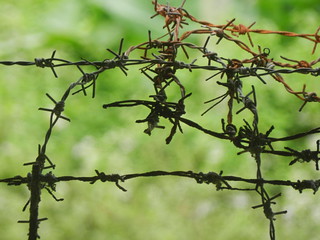
The efficacy of barbed wire lies in its ingenious yet simple design. It consists of two or more strands of steel wire twisted together to form a strong cable. At regular intervals, shorter pieces of wire are wrapped around the main strands, creating sharp, protruding points or barbs.
These barbs serve as the primary deterrent, inflicting discomfort or injury upon contact, thus preventing animals or unauthorized individuals from crossing. The tensile strength of the steel wire ensures the fence can withstand significant tension, while the barbs provide an active defense. Installation is relatively straightforward, requiring posts set at intervals and the wire stretched taut and secured, making it a practical solution for diverse terrains and for individuals with varying levels of construction expertise.
This ease of deployment contributed significantly to its rapid proliferation.
Beyond the Ranch
While its agricultural applications are most prominent, barbed wire's utility extends significantly into military and security contexts. Its effectiveness as an obstacle was starkly demonstrated in the trench warfare of World War I, where it was deployed in vast quantities to impede enemy advances, channel attackers into kill zones, and inflict casualties. The visual and physical barrier it presented was a formidable psychological and tactical challenge.
In contemporary times, barbed wire continues to be a common feature in security perimeters. It is frequently installed atop walls and fences surrounding correctional facilities, military bases, and high-security areas to enhance deterrence against breaches. Its low cost, ease of installation, and proven effectiveness as a physical impediment ensure its continued relevance in both historical military strategy and modern security architecture, underscoring its enduring impact across diverse human endeavors.
See also
Frequently Asked Questions
What is barbed wire?+
How does barbed wire keep animals out?+
Who invented barbed wire?+
Why did barbed wire change the American West?+
Where is barbed wire used today?+
Based on content from Wikipedia · Licensed under CC BY-SA 4.0