

Austro-Bavarian Language
Images
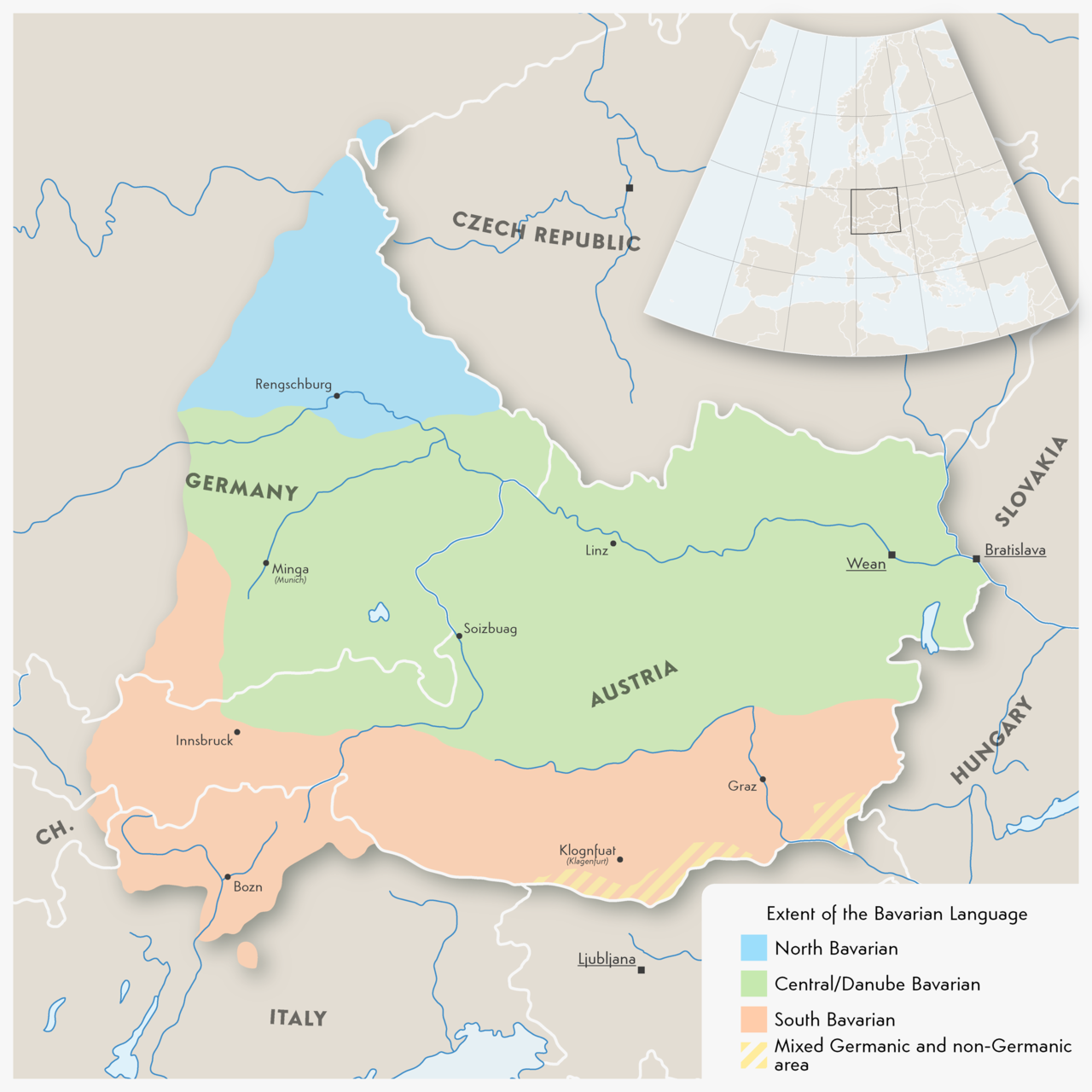
Austro Bavarian Languages-01
Defining the Austro-Bavarian Linguistic Landscape
Austro-Bavarian refers to a continuum of closely related dialects spoken primarily in Austria and the southern German state of Bavaria. It is classified as part of the West Germanic language branch, sharing common ancestry with Standard German but diverging significantly in phonology, morphology, syntax, and lexicon. These dialects are not monolithic; they exhibit considerable internal variation, often categorized into Northern, Central, and Southern Austro-Bavarian groups, each with its own unique features.
The perception of Austro-Bavarian as a distinct linguistic entity is strong among its speakers, who often identify with it as a marker of regional identity, separate from the standardized German language.
From Ancient Roots to Modern Dialects
The historical development of Austro-Bavarian can be traced back to the migration of the Bavarii tribe into the region around the 6th century AD, bringing with them an early form of Old High German. Over subsequent centuries, this ancestral language underwent significant evolution, influenced by geographical isolation, contact with neighboring languages, and internal linguistic changes. The High German consonant shift, which distinguished High German from other West Germanic languages, also impacted Bavarian, but in distinct ways.
The fragmentation into various dialects occurred as communities developed independently, leading to the rich diversity observed today. This long, organic development means that Austro-Bavarian preserves linguistic features that may be older or different from those found in Standard German, offering a window into historical language change.
The Enduring Significance of Austro-Bavarian Identity
The importance of Austro-Bavarian extends far beyond mere communication; it is a cornerstone of regional identity and cultural heritage. For many speakers, their dialect is a powerful symbol of belonging, connecting them to their history, traditions, and community. In regions where Austro-Bavarian is prevalent, it fosters a sense of local pride and distinctiveness.
While Standard German serves as the official language for administration, education, and national media, Austro-Bavarian dialects continue to thrive in informal settings, literature, music, and local media, demonstrating their resilience and continued relevance. The preservation of these dialects is crucial for maintaining linguistic diversity and understanding the complex cultural landscape of Central Europe.
Phonetic and Lexical Distinctions
Austro-Bavarian is characterized by a range of distinctive phonetic and lexical features that set it apart from Standard German. Phonologically, it often exhibits monophthongization of diphthongs (e.g., 'ei' becoming 'oa'), different vowel qualities, and specific consonant developments. Lexically, it boasts a rich vocabulary of words unique to the region, often related to alpine life, agriculture, and local customs.
Grammatically, while largely sharing the structure of German, certain dialects may present unique plural formations, verb conjugations, or case usage. These linguistic markers are not merely curiosities; they are integral to the identity of Austro-Bavarian speakers and are actively maintained, contributing to the vibrant linguistic mosaic of the area.
Austro-Bavarian in the Modern World
In contemporary society, Austro-Bavarian faces the common challenges of dialectal languages, including the influence of standardized languages and globalization. However, these dialects also demonstrate remarkable adaptability and continuity. Many speakers are bilingual, fluently using both their regional dialect and Standard German.
Furthermore, there is a growing appreciation for regional languages, with efforts to document, promote, and even revitalize certain dialects through cultural initiatives, media, and educational programs. The existence of Austro-Bavarian literature, theatre, and music underscores its enduring cultural vitality and its capacity to evolve while retaining its unique character in the modern era.
See also
Frequently Asked Questions
What is Austro-Bavarian?+
Where can you hear Austro-Bavarian?+
Why do people like to speak Austro-Bavarian?+
How is Austro-Bavarian different from Standard German?+
What are some cool words or sounds in Austro-Bavarian?+
Based on content from Wikipedia · Licensed under CC BY-SA 4.0