

Atlético Madrid
Images

Enrique Allende




Geographic Roots and the Metropolitano's Roar
Atlético Madrid is intrinsically linked to its namesake city, Madrid, the vibrant capital of Spain. Situated in the central Iberian Peninsula, Madrid is a sprawling metropolis characterized by a blend of historic grandeur and modern dynamism. The club's spiritual and physical home is the Civitas Metropolitano, a state-of-the-art arena with a capacity of 70,692.
This impressive venue is not merely a stadium; it's a coliseum where the club's narrative unfolds, hosting thrilling La Liga encounters and high-stakes European clashes. The sheer scale of the Metropolitano allows for an immersive fan experience, amplifying the passion and intensity that define Atlético's home advantage. The stadium's modern design and expansive seating ensure that every match is a spectacle, drawing in supporters from across the city and beyond, solidifying its role as a central hub for the club's identity.
Chronicles of Resilience
The genesis of Atlético Madrid traces back to April 26, 1903, when it was established as Athletic Club Sucursal de Madrid, a subsidiary of the Bilbao-based Athletic Club. This initial connection highlights an early sporting lineage, but the club soon forged its own distinct path. A pivotal merger in 1939 with Club Aviación Nacional marked a significant evolutionary step, leading to the formal adoption of the name Atlético de Madrid in 1946.
The club's trajectory has been punctuated by periods of immense success and challenging transitions. The post-1987 era, under the influence of Jesús Gil, saw a significant shift towards a 'sociedad anónima deportiva' (S.A.D.) structure, transforming the club into a publicly traded entity, albeit one where family control remained a dominant factor. This complex evolution underscores Atlético's enduring spirit and its ability to adapt and persevere through various historical and structural changes, building a rich tapestry of experiences.
Identity and Allegiance
Atlético Madrid's identity is vividly expressed through its traditional kit of red and white vertical stripes, complemented by blue shorts. This distinctive color scheme has given rise to the affectionate nickname 'Rojiblancos' (red-whites). More famously, the club's followers are known as 'Colchoneros,' a term derived from the resemblance of their striped jerseys to traditional mattresses.
This nickname, while seemingly humble, speaks to the working-class roots and enduring spirit of the club's fanbase. Another colloquialism, 'Indios' (Indians), adds a layer of mystique and historical resonance. These appellations are not mere labels but symbols of a deep-seated cultural connection, fostering a powerful sense of community and shared pride among supporters, who often identify with the club's tenacious and resilient playing style.
A Pantheon of Triumphs
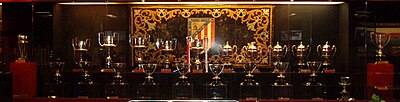
Atlético Madrid stands as one of Spain's most decorated football clubs, boasting an impressive collection of silverware. Domestically, they have secured the La Liga title 11 times, a testament to their consistent excellence. Their prowess in knockout competitions is further evidenced by 10 Copa del Rey victories and two Supercopas de España.
On the continental stage, Atlético has achieved significant success, including winning the European Cup Winners' Cup in 1962 and multiple UEFA Europa League titles in 2010, 2012, and 2018. Their triumphs extend to the UEFA Super Cup and the Intercontinental Cup in 1974. The club has also reached the pinnacle of European club football by competing in the UEFA Champions League final on three occasions (1974, 2014, 2016), underscoring their status as a perennial contender among Europe's elite.
Their enduring rivalry with city neighbors Real Madrid, known as the Madrid Derby, is one of the most anticipated fixtures in world football.
The Economic and Social Fabric of a Footballing Institution
Atlético Madrid functions as a significant economic entity within Spain and beyond. As a 'sociedad anónima deportiva' (S.A.D.), it operates with a corporate structure, generating revenue through ticket sales, broadcasting rights, merchandise, and sponsorships. The club's global appeal translates into substantial economic activity, impacting tourism and local businesses in Madrid.
Beyond its financial implications, Atlético plays a crucial role in the social fabric of the city and its supporters. It serves as a unifying force, bringing together people from diverse backgrounds under a shared passion. The club's commitment to youth development through its academy also contributes to the social landscape, nurturing future talent and instilling values of teamwork and discipline.
The honorary presidency held by Prince Felipe, now King Felipe VI, since 2003, further signifies the club's national importance and its integration into Spanish society.
See also
Frequently Asked Questions
What is Atlético Madrid?+
Where does Atlético Madrid play their home games?+
When was Atlético Madrid founded?+
What are Atlético Madrid's colors and nicknames?+
How many La Liga titles has Atlético Madrid won?+
Based on content from Wikipedia · Licensed under CC BY-SA 4.0