

Arrows: Flying Sticks of Fun!
Images

arrows 3388


The Paleolithic Revolution
The invention of the bow and arrow, likely emerging during the Upper Paleolithic period, represents a pivotal moment in human technological and social development. Prior to this innovation, projectile weapons were limited to spears and atlatls (spear-throwers), which required hunters to approach prey much closer, increasing risk and reducing success rates, especially with larger or faster animals. The bow and arrow offered a significant advantage: increased range, accuracy, and projectile velocity.
This allowed for more efficient hunting of a wider variety of game, contributing to dietary diversification and potentially supporting larger, more stable human populations. The development of specialized arrowheads, crafted from materials like flint, obsidian, and bone, further enhanced their lethality and adaptability to different prey and environments. This technological leap not only improved subsistence but also likely influenced early forms of territorial defense and conflict, marking the arrow as one of humanity's earliest and most impactful tools.
Materials and Aerodynamics
The construction of an effective arrow is a sophisticated blend of material science and aerodynamic principles. Historically, shafts were made from straight-grained woods like yew, ash, or cedar, carefully selected and seasoned to prevent warping. Modern arrows utilize advanced materials such as carbon fiber, aluminum, or composite materials, offering superior strength, consistency, and durability.
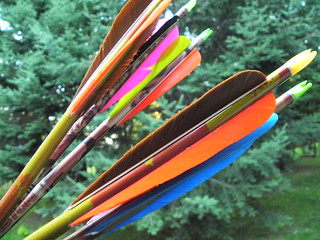
Arrowheads, or points, are designed for specific applications: broadheads for hunting are designed for maximum tissue damage and penetration, while field points for target practice are typically simpler and more durable. The fletching, traditionally made from bird feathers, plays a critical role in stabilizing the arrow's flight. These vanes create drag at the rear, inducing a slight spin or correcting deviations, ensuring the arrow travels point-first.
The nock, a precisely cut groove, ensures a secure fit on the bowstring and a clean release, crucial for consistent accuracy. The entire system, from the bow's draw weight to the arrow's spine (stiffness), must be matched for optimal performance.
Arrows in Warfare and Society
Beyond hunting, arrows played a transformative role in human conflict. Organized archery units became formidable forces in ancient and medieval warfare, capable of decimating enemy formations from a distance before close combat even began. Empires like the Mongols and the English longbowmen are testaments to the strategic importance of archery.
The development of specialized arrow types, such as bodkin points designed to penetrate armor, further illustrates the continuous innovation driven by warfare. In peacetime, archery evolved into a highly respected sport, demanding immense discipline, focus, and physical control. Today, archery is a prominent Olympic discipline, showcasing peak human performance.
Furthermore, arrows retain powerful symbolic meaning in art, literature, and culture, representing direction, intent, destiny, and the pursuit of goals, often appearing in mythological narratives and heraldry.
The Physics of Flight
The flight of an arrow is governed by fundamental principles of physics, often studied in the field of ballistics. When the bowstring is released, the stored elastic potential energy in the bow is rapidly converted into kinetic energy, propelling the arrow forward. The initial velocity of the arrow is determined by the bow's draw weight, draw length, and the arrow's mass.
As the arrow travels, it is subject to air resistance (drag), which opposes its motion and reduces its speed. The arrowhead's shape and the fletching's design are optimized to minimize drag and maintain stability. The trajectory of an arrow is a parabolic curve, influenced by gravity pulling it downwards and its initial velocity.
Achieving accuracy requires understanding and compensating for factors like wind, distance, and the arrow's aerodynamic properties. Modern archery equipment and techniques allow for remarkable precision, with arrows traveling at speeds often exceeding 200 feet per second.
The Arrow's Enduring Legacy
While no longer a primary tool for survival or warfare in most parts of the world, the arrow's legacy is far from over. Archery continues to thrive as a sport, offering a unique blend of physical and mental challenge. Competitive archery demands incredible precision, requiring athletes to master not only the mechanics of shooting but also mental fortitude to perform under pressure.
Beyond sport, archery is still practiced for hunting in many regions, regulated by conservation efforts. Furthermore, the arrow's symbolic power endures. It appears in modern design, branding, and art, continuing to represent concepts of focus, direction, and progress.
The historical significance of the arrow as a foundational human technology also makes it a subject of ongoing archaeological and anthropological study, offering insights into the ingenuity and adaptive capabilities of our ancestors.
Go deeper
Based on content from Wikipedia · Licensed under CC BY-SA 4.0