

Arrow
Images
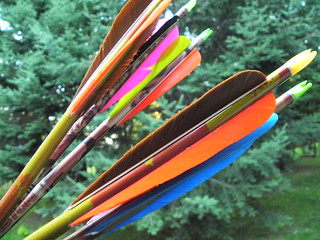
Arrow Tips


Engineering Elegance
The arrow, a seemingly simple projectile, is a testament to elegant engineering principles honed over millennia. Its construction typically involves a straight, rigid shaft, historically made from materials like wood (e.g., cedar, ash, pine) chosen for their straight grain and resilience, but now commonly manufactured from advanced composites such as carbon fiber or aluminum alloys for enhanced durability, consistency, and aerodynamic performance. Affixed to the anterior end is the arrowhead, a component whose form is dictated by its intended purpose.
These range from sharp, piercing points for hunting or combat, often crafted from stone, bone, or metal, to specialized heads for different applications. Crucially, the rear of the shaft features fletchings, typically three or four vanes or feather sections, which provide essential aerodynamic stability. These stabilizers prevent the arrow from yawing or pitching, ensuring a predictable and accurate trajectory by creating drag and guiding the arrow's flight.
The posterior end terminates in a nock, a precisely machined slot designed to securely engage the bowstring, facilitating an efficient transfer of energy from the bow to the arrow upon release. The entire system is a finely tuned instrument, where each component contributes to the projectile's effectiveness.
A Prehistoric Revolution
The advent of the bow and arrow represents a pivotal moment in human technological history, predating written records and becoming a near-universal tool across diverse cultures. While precise origins are debated, archaeological evidence points to widespread use by at least the Upper Paleolithic period, with some findings suggesting origins as far back as 20,000 years ago. This innovation dramatically expanded human capabilities, particularly in subsistence strategies.
It enabled more efficient and safer hunting of a wider range of game, from small game to large mammals, by allowing hunters to engage targets from a distance. This increased success in food acquisition likely contributed to population growth, the development of settled communities, and the ability to exploit varied ecological niches. Furthermore, the arrow transformed warfare, becoming a primary offensive weapon that dictated military tactics, fortifications, and the dynamics of conflict for thousands of years.
The specialized skills of fletchers (arrow makers) and arrowsmiths (arrowhead makers) were highly esteemed, reflecting the critical importance of this technology to societal survival and advancement.
Aerodynamics and Energy Transfer
The flight of an arrow is governed by fundamental principles of physics, primarily aerodynamics and energy transfer. When a bow is drawn, elastic potential energy is stored within its limbs. Upon release, this stored energy is rapidly converted into kinetic energy, which is then transferred to the arrow.
The efficiency of this transfer is influenced by the bow's design and the nock's ability to release cleanly. The arrowhead's mass and design affect the arrow's momentum and penetration capabilities. However, it is the fletchings that are paramount for stable flight.
Acting as airfoils, they generate corrective forces in response to any deviation from a straight path. If the arrow begins to pitch or yaw, the fletchings create drag that realigns the arrow with its direction of motion, much like the tail fins on a missile. This aerodynamic stabilization is crucial for achieving accuracy over distance.
The interplay between the arrow's mass, stiffness, fletching surface area, and the energy imparted by the bow determines its velocity, range, and trajectory.
Symbolism, Sport, and Modern Relevance
Beyond its utilitarian roles, the arrow carries profound symbolic weight across cultures, often representing directness, purpose, speed, and the pursuit of goals. It features prominently in mythology, art, and heraldry, frequently associated with deities of the hunt, war, or destiny. In contemporary society, the arrow's legacy endures most visibly through the sport of archery.
Modern competitive archery is a highly refined discipline that demands exceptional physical control, mental focus, and a deep understanding of equipment and environmental factors. Archers must master not only their own technique but also how variations in wind, temperature, and arrow spine affect flight. Furthermore, the principles embodied in arrow design continue to inform other fields, from the development of ballistics and aerodynamic projectiles to the conceptualization of directed energy and motion.
The arrow remains a powerful symbol of human ingenuity and a tangible link to our ancestral past.
Go deeper
Frequently Asked Questions
What is an arrow?+
Why do arrows have fletchings?+
How do arrows fly so accurately?+
What materials are arrow shafts made from?+
How did arrows help people in the past?+
Based on content from Wikipedia · Licensed under CC BY-SA 4.0