

Antarctic Krill: Tiny Ocean Superstars!
Images

Antarctic krill
![Bloom in the Ross Sea [detail]](https://live.staticflickr.com/5140/5398237910_d9b504ebe9_n.jpg)





The Unparalleled Abundance of Euphausia superba
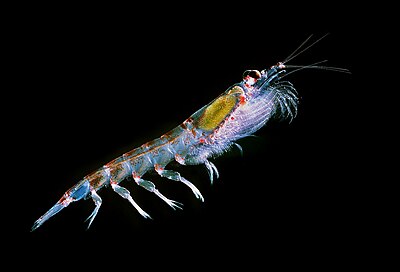
Antarctic krill (Euphausia superba) represents one of the most significant aggregations of animal life on Earth. Inhabiting the frigid waters of the Southern Ocean, these small crustaceans are characterized by their gregarious nature, forming immense swarms that can reach astonishing densities, sometimes exceeding 30,000 individuals per cubic meter. This schooling behavior is not merely a social phenomenon but a critical adaptation for survival, facilitating efficient foraging and predator avoidance in a vast and often food-scarce environment.
The sheer scale of these swarms is difficult to comprehend, often spanning kilometers and creating a dynamic, living biomass that is central to the functioning of the Antarctic marine ecosystem. Their pelagic life cycle is intrinsically linked to the seasonal dynamics of the Southern Ocean, dictating their distribution and abundance.
Phytoplankton to Apex Predators
The feeding strategy of Antarctic krill is a masterclass in ecological efficiency. As direct consumers of phytoplankton, they occupy a crucial position at the base of the Antarctic food web. Phytoplankton, harnessing solar energy through photosynthesis, are the primary producers in this environment.
Krill act as the primary converters of this solar-derived energy into a form accessible to higher trophic levels. Their diet consists exclusively of these microscopic algae, making them herbivores. This direct link to primary production means that the health and productivity of phytoplankton blooms directly influence krill populations.
Consequently, krill become the indispensable food source for a vast array of Antarctic fauna, including baleen whales, seals, penguins, seabirds, and numerous fish species, effectively linking primary productivity to the survival of apex predators.
Life Cycle and Biomass
Antarctic krill exhibit a life cycle that allows them to thrive in their challenging environment. They can live for up to six years, reaching lengths of approximately 6 centimeters and weights of up to 2 grams. This relatively long lifespan, coupled with their high reproductive rates, contributes to their extraordinary biomass.
The estimated total biomass of Euphausia superba is a staggering 500 million metric tons, making it one of the most abundant species on the planet by mass. This immense biomass is not just a biological curiosity; it is the literal foundation upon which the entire Antarctic marine ecosystem is built. The availability of this massive food resource dictates the population dynamics and distribution of many other species, underscoring krill's role as a keystone species.
Beyond Food
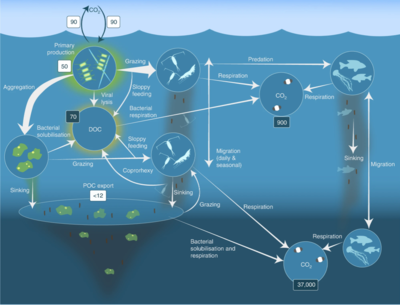
The ecological importance of Antarctic krill extends beyond their role as a food source. Their extensive vertical migrations, moving from the deep ocean to feed near the surface and then returning, play a significant role in the ocean's carbon cycle. Through their feeding and excretion, they help transport carbon from the surface waters to the deep sea, a process known as the biological pump.
Furthermore, krill populations are facing increasing pressures. Climate change, particularly the warming of the Southern Ocean and the reduction of sea ice (which is crucial for larval krill development), poses a significant threat. Overfishing for krill, primarily for aquaculture feed and Omega-3 supplements, also raises conservation concerns. Understanding and protecting Antarctic krill populations is therefore paramount to maintaining the health and biodiversity of the entire Antarctic region.
See also
Based on content from Wikipedia · Licensed under CC BY-SA 4.0