

Anguilla
Images

Flag Of Anguilla



Opens Google Maps in new tab
Geography
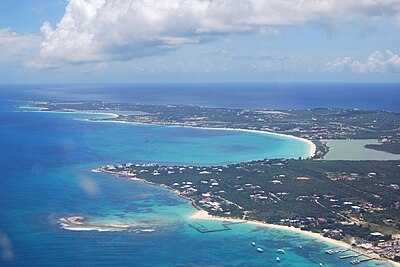
Anguilla is a British overseas territory situated in the eastern Caribbean Sea, forming part of the Leeward Islands within the Lesser Antilles archipelago. The main island measures approximately 16 mi (26 km) in length and 3 mi (5 km) at its widest point, making it one of the smallest islands in the region. The terrain is predominantly flat and low‑lying, composed mainly of coral and limestone, with the highest elevation being Crocus Hill at 240 ft (73 m).
The island’s soil is thin and nutrient‑poor, supporting mainly scrub and tropical forest vegetation. Anguilla’s surrounding waters are renowned for their extensive coral reefs, which provide habitat for a diverse array of marine life and attract snorkelers and divers worldwide. The climate is tropical, with an average annual temperature of about 80 °F (27 °C).
The rainy season runs from July to November, during which the island can experience tropical storms and hurricanes; the island has endured significant damage from hurricanes such as Luis (1995), Lenny (1999), and Irma (2017). Anguilla also includes several smaller, uninhabited islands and cays, such as Anguillita, Blowing Rock, and Sombrero, which contribute to its ecological diversity.
History
Anguilla’s human history stretches back to the Indigenous peoples who migrated from South America. Archaeological evidence, including tools dated to around 1300 BC and settlement remains from AD 600, indicates long‑term occupation. Two petroglyph sites, Big Spring and Fountain Cavern, contain over 100 carvings that date from AD 600–1200.
European contact began in the late 15th century; Christopher Columbus may have sighted the island on his second voyage in 1493, while the first recorded European settlement was by English colonists from Saint Kitts in 1650. The island’s name derives from the Italian word anguilla, meaning “eel,” reflecting its shape. Throughout the 17th and 18th centuries, Anguilla was contested by the French, Dutch, and Spanish, with the French briefly occupying it in 1666, 1688, 1745, and 1798. Slavery was introduced in the 17th century, with enslaved Africans working on tobacco and later sugar plantations until abolition in 1834.
In the 19th century, Anguilla was administered by Antigua and later by Saint Kitts, and it joined the West Indies Federation in 1958. The island’s desire for self‑governance culminated in the Anguillan Revolution of 1967, when Anguillans expelled the St Kitts police and declared independence from the associated state. After a brief period of British military intervention, Anguilla became a separate British Crown colony in 1980, and it has remained politically stable since.
Culture & People
Anguillans are predominantly of West African descent, with about 90 % of the population tracing ancestry to enslaved Africans brought in the 17th and 18th centuries. The island’s culture is a vibrant mix of African, European, and Caribbean traditions. English is the official language, but a local variety known as Anguillian, or Anguilla Talk, is widely spoken and reflects the island’s unique linguistic heritage.
A growing Muslim centre and small communities of Chinese, Indian, and Mexican workers also contribute to the island’s diversity. Traditional festivals such as Lobster Fest celebrate the island’s famous spiny lobster, while the annual Carnival features music, dancing, and boat races that showcase local talent. Anguillan cuisine is heavily seafood‑based, featuring prawns, shrimp, crab, conch, and spiny lobster, along with goat meat and rice with pigeon peas.
The sea shapes daily life; fishing, boating, and tourism are major economic activities, and many families live in close proximity on the island’s compact land area.
Economy
Anguilla’s economy is dominated by tourism and offshore financial services. The island’s pristine white beaches, clear waters, and coral reefs attract millions of visitors each year, supporting a network of hotels, restaurants, and boat tours that provide employment for locals. Because the island’s soil is thin and the land area is limited, agriculture is minimal; most food is imported, though local produce such as tomatoes, peppers, and citrus fruits is cultivated in small plots.
The financial sector is a major contributor, with banks, insurance companies, and trust firms offering services to international clients; Anguilla has no income, capital‑gain, or corporate taxes, making it an attractive jurisdiction for offshore companies. In 2011 the government introduced a 3 % interim levy to help balance the budget, and a 0.75 % property tax is also levied. The island’s internet domain .ai has become a lucrative asset, as technology firms register domain names ending in .ai, generating millions of dollars in registration fees.
Tourism, finance, and the .ai domain together sustain Anguilla’s economy, and the territory has seen growth in renewable energy projects, such as solar power, to reduce dependence on imported diesel.
Government
Anguilla is a British overseas territory, meaning that it is a territory under the sovereignty of the United Kingdom but enjoys a high degree of internal self‑government. The UK appoints a governor who represents the monarch and oversees the territory’s external affairs and defence. Anguilla has a parliamentary system with a Premier as the head of government and a unicameral House of Assembly that enacts legislation.
The constitution, first adopted in 1982 and amended in 1990, outlines the rights of citizens and the structure of the government. The judiciary is independent, with courts that interpret and apply the law. Anguilla is listed by the United Nations Committee on Decolonization as a non‑self‑governing territory.
Defence responsibilities lie with the UK, which maintains a Royal Navy patrol vessel in the Caribbean; locally, the Royal Anguilla Police Force handles law enforcement. The island’s political stability has allowed it to focus on economic development and tourism.
Education
Anguilla’s education system is a blend of public and private institutions that follows the British curriculum. The island operates six government primary schools and one secondary school, Albena Lake Hodge Comprehensive School, which offers education up to the secondary level. Two private schools also operate on the island, providing alternative educational options.
The public library, the Edison L. Hughes Education & Library Complex, serves as a learning centre for students and residents, offering books, computers, and community programmes. In 2011 a branch of the Saint James School of Medicine opened, providing medical training for students who wish to pursue careers in health care.
The University of the West Indies has an open campus on Anguilla, giving students access to higher‑education programmes in fields such as business, science, and the arts. The education system places emphasis on literacy, mathematics, and science, and many students go on to study abroad after completing their secondary education. The government also supports vocational training and adult education to meet the needs of the island’s workforce.
See also
Frequently Asked Questions
What is Anguilla?+
Where is Anguilla located?+
Why is Anguilla called "eel"?+
How big is Anguilla?+
What is the weather like in Anguilla?+
Based on content from Wikipedia · Licensed under CC BY-SA 4.0