

The Year 476: A Super Big Change!
Images

Alis Dhimmi Magd Petjezulma in Friesennerz (476)


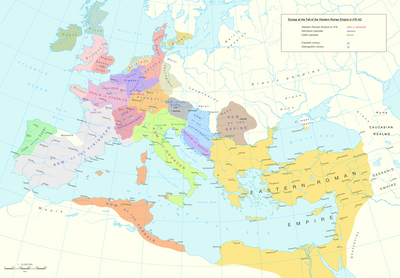


The Symbolic End of an Era
The year 476 AD is a cornerstone in Western historiography, primarily recognized for the deposition of Romulus Augustulus, the last Western Roman Emperor, by the Germanic chieftain Odoacer. While the Western Roman Empire had been in decline for decades, facing internal strife, economic instability, and external pressures, this event serves as a potent symbolic marker for its final dissolution. The year itself was a leap year under the Julian calendar, commencing on a Thursday.
Historically, years were often designated by their consuls or by counting from the founding of Rome (Ab urbe condita, 1229 in this case). However, the designation '476' gained prominence in the early medieval period with the widespread adoption of the Anno Domini (AD) system, solidifying its status as a pivotal date. This year is widely considered by scholars to represent the definitive end of antiquity and the commencement of the Middle Ages in Europe, fundamentally altering the continent's political, social, and cultural trajectory.
Deconstructing the 'Fall'
It is crucial to understand that the 'fall' of the Western Roman Empire in 476 was not an abrupt collapse but the culmination of a protracted decline. Centuries of complex factors, including overexpansion, administrative inefficiencies, economic exploitation, military overreach, and the increasing migration and settlement of Germanic peoples within imperial borders, had weakened the empire. By 476, imperial authority in the West was largely nominal, with various Germanic kingdoms exercising de facto control over former Roman territories.
Odoacer's act of deposing Romulus Augustulus and refusing to appoint a successor, instead sending the imperial regalia to the Eastern Roman Emperor in Constantinople, signified the end of a separate Western imperial line. This act effectively dissolved the Western imperial structure, leading to the establishment of independent Germanic kingdoms that would form the basis of future European states.
The Historiographical Significance of 476
The importance of 476 lies in its utility as a historiographical tool for periodization. Historians use such dates to delineate distinct historical epochs, facilitating analysis and understanding of long-term trends. The transition from the ancient world, characterized by large, centralized empires, sophisticated urban centers, and a relatively unified Mediterranean world, to the Middle Ages, marked by political fragmentation, the rise of feudalism, the increasing influence of the Church, and the development of distinct regional cultures, is a profound transformation.
While the legacy of Rome persisted in law, language, and religion, the political and social order of the West was irrevocably changed. The year 476, therefore, serves as a convenient, albeit debated, demarcation point for this monumental shift, allowing for a structured study of the subsequent millennium.
Continuity and Change
Despite the political fragmentation following 476, the influence of the Roman Empire did not vanish. Roman infrastructure, such as roads and aqueducts, continued to be used. Roman law provided a foundation for many emerging legal systems. Latin, the language of the Romans, evolved into the Romance languages (Italian, French, Spanish, Portuguese, Romanian) and heavily influenced Germanic languages.
Furthermore, the Christian Church, which had become the dominant religion of the Roman Empire, played a crucial role in preserving Roman culture and providing a sense of continuity and unity across the fragmented landscape of post-Roman Europe. The Eastern Roman Empire, or Byzantine Empire, also continued for another thousand years, preserving Roman traditions and classical knowledge. Thus, 476 represents not just an end, but also a complex beginning, where old structures gave way to new forms, heavily influenced by their Roman predecessors.
The Evolution of Calendrical Systems
The very concept of '476' as a year designation is a product of later historical developments. In 476 itself, the prevailing methods of dating would have been the Julian calendar, referencing the consuls in power (Basiliscus and Armatus), or the Roman system of counting years from the founding of Rome (Ab urbe condita). The Anno Domini (AD) system, which places the birth of Christ as year 1, began to gain traction in the early medieval period, largely through the work of scholars like Bede.
Its eventual widespread adoption provided a more standardized chronological framework across Christian Europe. This standardization was instrumental in solidifying 476's status as a key historical marker, allowing subsequent generations to universally reference this pivotal moment in the transition from antiquity to the Middle Ages.
See also
Frequently Asked Questions
What happened in the year 476 AD?+
Why is 476 called the end of the Western Roman Empire?+
Who was Odoacer and what did he do?+
How did the fall of the Western Roman Empire change Europe?+
Did anything from Rome still exist after 476?+
Based on content from Wikipedia · Licensed under CC BY-SA 4.0