

The Great Florida Vote Count Mystery!
Images
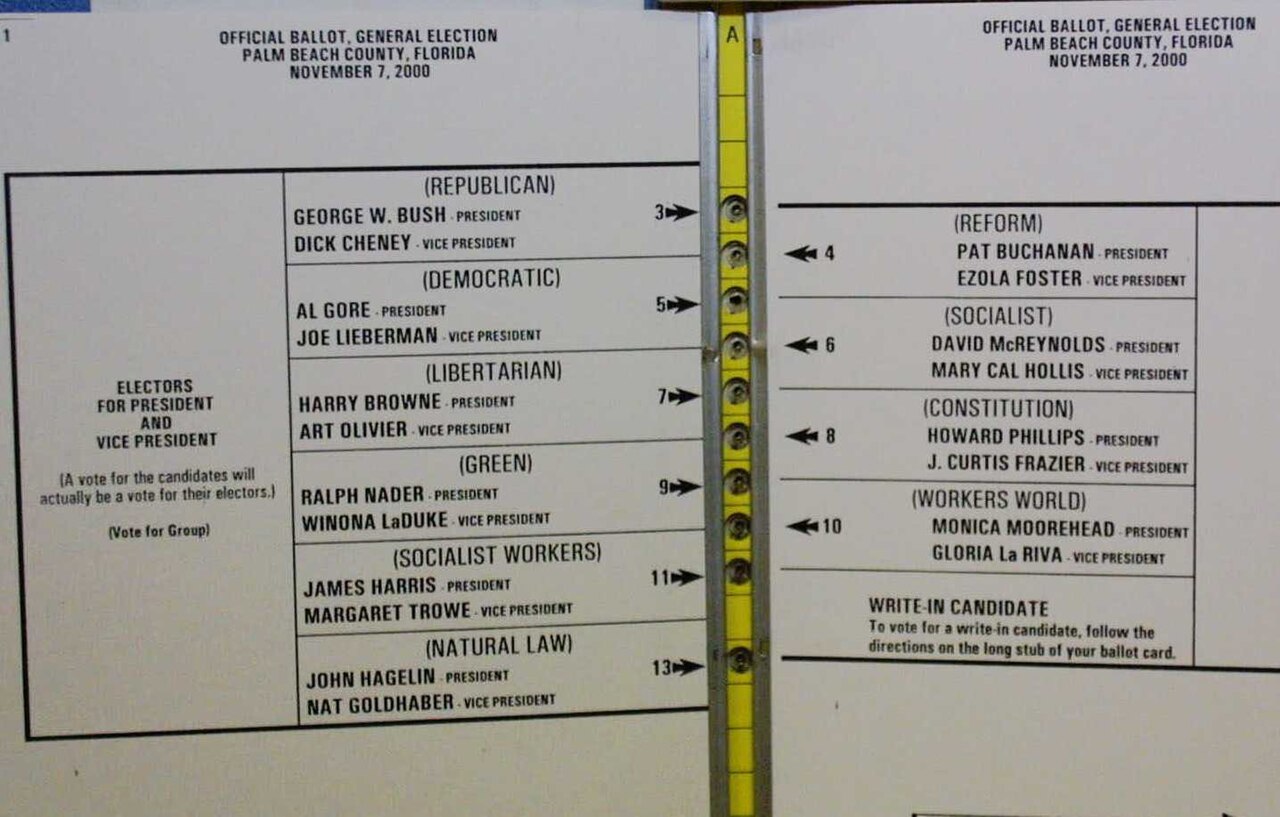
Butterfly Ballot, Florida 2000 (Large)


Florida's Electoral Crucible
The 2000 United States presidential election between Republican George W. Bush and Democrat Al Gore was one of the most contentious and closely watched in American history. The outcome hinged precariously on the state of Florida, a diverse and populous state with a complex electoral landscape.
On Election Night, the initial vote tallies showed an incredibly narrow margin, triggering automatic recounts in several counties. The state's unique demographic makeup, with a significant elderly population and a large Hispanic community, meant that voter turnout and ballot interpretation were critical factors. The sheer volume of votes cast in Florida, nearly six million, underscored the immense pressure and scrutiny placed upon its election officials.
The state's role as the ultimate arbiter of the presidential election transformed it into a national focal point, where every ballot, every machine, and every legal interpretation was intensely debated.
The Ballot Battleground
The weeks following Election Day were consumed by a meticulous and often chaotic recount process in Florida. The controversy intensified around 'undetermined' ballots, particularly those with 'hanging chads' or 'dimpled chads' – partial punches on punch-card ballots that made it unclear if the voter's intent was to select a candidate. This led to a series of legal challenges and counter-challenges, with both campaigns seeking to maximize their vote count.
Counties employed different methods for recounting, leading to accusations of bias and inconsistency. The Florida Supreme Court played a significant role, initially ordering a statewide manual recount. However, the Bush campaign appealed this decision, arguing that it violated the Equal Protection Clause of the Fourteenth Amendment by creating unequal standards for ballot counting.
This legal tug-of-war demonstrated the fragility of election processes and the profound impact of seemingly minor procedural details on national outcomes.
Bush v. Gore
The legal battles over the Florida recount ultimately reached the United States Supreme Court in the landmark case of Bush v. Gore. The central question before the Court was whether the ongoing manual recount, as ordered by the Florida Supreme Court, violated the Equal Protection Clause by failing to establish uniform standards for ballot counting.
In a highly controversial 5-4 decision, the U.S. Supreme Court ruled that the recount process, as it was being conducted, did not meet constitutional requirements for equal protection. The Court effectively halted the statewide manual recount, leaving the previously certified results in place.
This decision declared George W. Bush the winner of Florida by a margin of just 537 votes, thereby securing him the presidency. The ruling remains a subject of intense debate among legal scholars and historians, with critics arguing that the Court overstepped its bounds and intervened in a political process.
Echoes of Florida
The 2000 Florida recount left an indelible mark on American electoral politics and jurisprudence. It exposed vulnerabilities in election administration, particularly concerning voting technology and ballot design. The event spurred significant reforms, including the Help America Vote Act of 2002, which aimed to modernize voting systems and establish minimum standards for election administration.
Furthermore, the recount highlighted the profound implications of the Electoral College system, as Al Gore won the national popular vote but lost the presidency due to his defeat in Florida. The intense scrutiny and partisan divisions surrounding the recount underscored the critical importance of maintaining public trust in the electoral process. The legacy of Bush v.
Gore continues to inform discussions about election law, judicial review, and the very definition of democratic fairness in the United States.
See also
Frequently Asked Questions
What happened in the 2000 Florida election that made it so close?+
Why were the "hanging chads" a big problem during the recount?+
How did the Supreme Court decide to stop the recount?+
Why did the Florida Supreme Court order a manual recount?+
What changes were made after the recount to help future elections?+
Based on content from Wikipedia · Licensed under CC BY-SA 4.0